Digital Transformation

Artificial Intelligence, Business Intelligence, Data Analytics

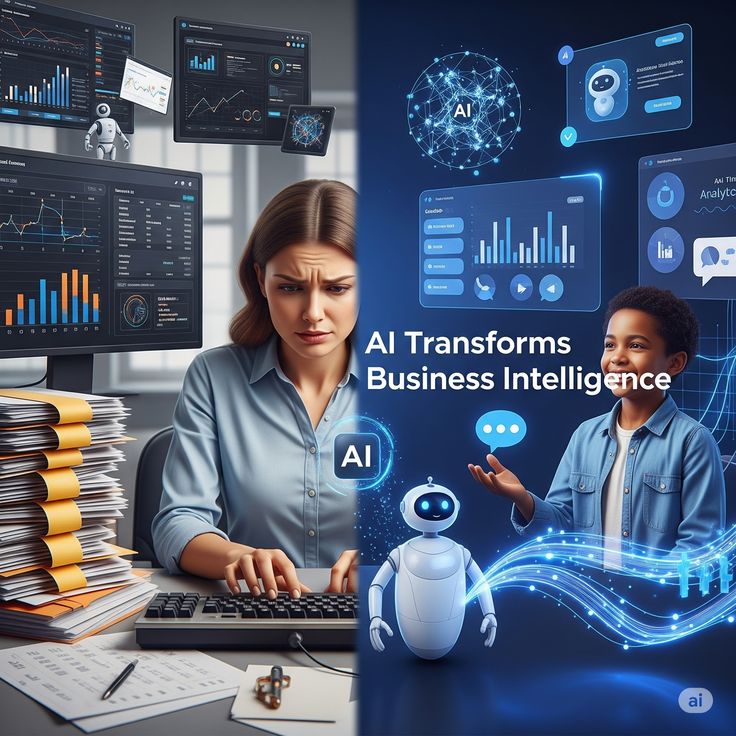
How AI Is Revolutionizing Business Intelligence and Analytics

Introduction In today’s digital economy, businesses generate massive amounts of data every second. From customer interactions and sales transactions to website activity and operational metrics, organizations have access to more information than ever before. However, collecting data alone is not enough. The real challenge lies in transforming that data into actionable insights that drive better business decisions. This is where Artificial Intelligence (AI) is changing the landscape of Business Intelligence (BI) and analytics. Traditional BI systems helped organizations analyze historical data and create reports. AI-powered BI takes this a step further by uncovering hidden patterns, predicting future outcomes, automating analysis, and providing real-time recommendations. As companies strive to remain competitive in rapidly changing markets, AI-driven business intelligence is becoming a critical tool for growth, efficiency, and innovation. What Is Business Intelligence? Business Intelligence refers to the technologies, processes, and strategies used to collect, analyze, and visualize business data. The primary goal of BI is to help organizations make informed decisions based on accurate information. Traditional BI solutions typically focus on: Data collection and storage Reporting and dashboards Performance monitoring Historical data analysis Trend identification While these capabilities remain valuable, modern businesses require deeper insights and faster decision-making. AI addresses these needs by enhancing the capabilities of conventional BI platforms. The Growing Role of AI in Business Intelligence Artificial Intelligence enables machines to analyze data, learn from patterns, and make predictions with minimal human intervention. When integrated with business intelligence systems, AI helps organizations move from descriptive analytics to predictive and prescriptive analytics. Instead of simply answering questions like: “What happened?” AI-powered systems can answer: “Why did it happen?” “What is likely to happen next?” “What actions should we take?” This shift allows businesses to become more proactive rather than reactive. Automated Data Analysis One of the biggest advantages of AI in business intelligence is automation. Traditional data analysis often requires teams of analysts to collect data, clean datasets, create reports, and identify trends manually. This process can take hours or even days. AI-powered analytics platforms can automate many of these tasks by: Cleaning and organizing data Detecting anomalies Identifying trends Generating reports Highlighting important insights Automation reduces human error and enables organizations to analyze larger volumes of data much faster. For example, a retail company can automatically monitor thousands of products and instantly identify unusual changes in sales patterns without requiring manual investigation. Predictive Analytics: Looking Into the Future Predictive analytics is one of the most impactful applications of AI in business intelligence. Using historical data and machine learning algorithms, AI can forecast future outcomes with impressive accuracy. Businesses use predictive analytics to: Forecast sales demand Predict customer behavior Estimate inventory requirements Identify market trends Reduce operational risks For instance, an e-commerce company can predict which products will experience increased demand during upcoming seasons and adjust inventory levels accordingly. This proactive approach helps organizations improve efficiency and reduce costs. Real-Time Decision Making Modern businesses operate in fast-moving environments where decisions often need to be made instantly. Traditional BI systems typically rely on periodic reports, which may already be outdated by the time they are reviewed. AI-driven analytics platforms continuously process incoming data and provide real-time insights. Benefits include: Faster response to market changes Improved customer service Immediate detection of operational issues Better financial monitoring Enhanced risk management For example, financial institutions can detect suspicious transactions in real time and prevent fraudulent activities before significant damage occurs. Enhanced Data Visualization Data visualization is a core component of business intelligence. AI is making dashboards smarter and easier to understand by automatically identifying key insights and presenting them in visually meaningful ways. Advanced BI tools can: Highlight critical trends automatically Generate dynamic charts and graphs Explain data patterns in plain language Customize dashboards for different users Instead of manually searching through hundreds of charts, decision-makers receive instant summaries of the most important business developments. This significantly improves productivity and decision quality. Natural Language Queries One of the most user-friendly innovations in AI-powered business intelligence is Natural Language Processing (NLP). NLP allows users to interact with BI systems using everyday language. Rather than writing complex database queries, users can simply ask questions such as: “What were our top-selling products last month?” “Why did sales decline in the northern region?” “Which customer segment generated the highest revenue?” The system then analyzes data and provides answers instantly. This capability makes data analysis accessible to employees without technical expertise, promoting a stronger data-driven culture throughout the organization. Improving Customer Insights Understanding customer behavior is essential for business success. AI-powered analytics helps organizations gain deeper insights into customer preferences, buying patterns, and engagement trends. Businesses can analyze: Purchase history Website interactions Social media activity Customer feedback Support requests By combining these data sources, AI creates a comprehensive customer profile that enables personalized experiences. Organizations can use these insights to: Improve marketing campaigns Increase customer retention Enhance product recommendations Deliver personalized services As a result, businesses can strengthen customer relationships and drive higher revenue. Fraud Detection and Risk Management Many industries face increasing challenges related to fraud and risk. AI significantly improves risk management by continuously monitoring transactions and identifying suspicious behavior. Machine learning algorithms can detect unusual patterns that may indicate: Financial fraud Cybersecurity threats Compliance violations Operational risks Unlike traditional rule-based systems, AI continuously learns and adapts to emerging threats. This capability helps organizations reduce financial losses and improve security. Supply Chain Optimization Supply chain management generates enormous amounts of operational data. AI-powered business intelligence solutions help companies optimize supply chains through advanced analytics and forecasting. Key benefits include: Demand prediction Inventory optimization Supplier performance monitoring Logistics planning Cost reduction For example, manufacturers can predict supply shortages before they occur and take preventive action to avoid production delays. This leads to greater efficiency and improved customer satisfaction. Personalized Business Strategies Every business operates under unique conditions and objectives. AI enables organizations to develop personalized strategies based on their specific data and performance metrics. Instead of relying solely on industry averages, companies can make decisions based on:

Artificial Intelligence, Digital Transformation, Educational Technology

Multimodal AI Explained: The Future of Human-Computer Interaction

Introduction Artificial Intelligence has evolved rapidly over the past decade, moving from simple rule-based systems to highly sophisticated models capable of understanding and generating human-like content. One of the most significant breakthroughs in recent years is the emergence of Multimodal AI, a technology that allows machines to process and understand multiple forms of data simultaneously, including text, images, audio, video, and even sensor inputs. Traditional AI systems typically specialize in a single type of input. For example, a chatbot processes text, while an image recognition system analyzes pictures. Multimodal AI changes this paradigm by combining different data types into a unified understanding. This advancement is paving the way for a new era of human-computer interaction where technology can communicate more naturally, understand context better, and provide richer experiences. As businesses, developers, and consumers increasingly adopt AI-powered tools, Multimodal AI is expected to become one of the defining technologies of the next decade. From virtual assistants and healthcare applications to autonomous vehicles and smart workplaces, its influence is already being felt across industries. What Is Multimodal AI? Multimodal AI refers to artificial intelligence systems that can process and interpret information from multiple sources or modalities simultaneously. These modalities include: Text Images Audio Video Sensor Data Gestures and Physical Inputs Humans naturally use multiple senses to understand the world. For example, during a conversation, we listen to words, observe facial expressions, and interpret body language at the same time. Multimodal AI aims to replicate this ability by integrating different forms of information into a single intelligent system. Instead of analyzing data in isolation, Multimodal AI combines various inputs to gain a deeper understanding of context and intent. This enables more accurate decision-making and more natural interactions between humans and machines. The Evolution of Human-Computer Interaction Human-computer interaction has undergone several major transformations over the years. Command-Line Interfaces Early computers relied on text-based commands. Users needed technical knowledge to communicate with machines effectively. Graphical User Interfaces The introduction of graphical interfaces made computers more accessible. Users could interact through windows, icons, and menus instead of memorizing commands. Touch-Based Interaction The rise of smartphones and tablets introduced touchscreens, making interaction more intuitive and mobile. Voice Assistants Virtual assistants brought voice recognition into mainstream technology, allowing users to perform tasks through spoken commands. Multimodal Interaction Today, AI systems are moving beyond single-input methods. Users can speak, type, upload images, share videos, and interact naturally with intelligent systems that understand all these inputs together. This shift represents one of the most significant changes in the history of computing. How Multimodal AI Works At its core, Multimodal AI combines information from different data sources and processes them through advanced machine learning models. The process generally involves several steps: Data Collection The AI gathers data from multiple sources such as text documents, images, microphones, cameras, and sensors. Data Processing Each data type undergoes specialized processing: Natural Language Processing for text Computer Vision for images and videos Speech Recognition for audio Sensor Analysis for environmental inputs Data Fusion The processed information is combined into a unified representation that allows the AI to understand relationships between different inputs. Contextual Understanding The AI analyzes the combined information to determine meaning, intent, and context. Response Generation Based on its understanding, the system generates an appropriate output, which could be text, speech, images, recommendations, or actions. This integrated approach enables more intelligent and context-aware interactions. Why Multimodal AI Is Important The significance of Multimodal AI lies in its ability to bridge the gap between human communication and machine understanding. Improved Accuracy Using multiple data sources reduces ambiguity and improves decision-making. For example, a voice command combined with visual context allows an AI assistant to better understand what a user is requesting. Better User Experiences Interactions become more natural because users can communicate in the way that feels most comfortable. Enhanced Context Awareness Multimodal systems understand situations more effectively by considering multiple signals simultaneously. Increased Accessibility People with different abilities can interact with technology using speech, images, gestures, or text. More Human-Like Communication By understanding various forms of input, AI systems can engage in conversations and interactions that closely resemble human communication. Key Technologies Powering Multimodal AI Several advanced technologies contribute to the development of multimodal systems. Natural Language Processing NLP enables machines to understand, interpret, and generate human language. Computer Vision Computer vision allows AI systems to analyze images, videos, objects, faces, and environments. Speech Recognition Speech technologies convert spoken language into machine-readable formats. Deep Learning Neural networks help identify complex patterns across multiple data types. Generative AI Models Modern generative models can create text, images, audio, and video content from various inputs. Large Language Models Advanced language models provide the reasoning and contextual understanding necessary for multimodal applications. Together, these technologies create AI systems capable of understanding and generating rich, multi-format content. Real-World Applications of Multimodal AI Healthcare Healthcare organizations are using Multimodal AI to analyze medical records, diagnostic images, laboratory reports, and physician notes simultaneously. Benefits include: Faster diagnosis Improved treatment planning Better patient monitoring Enhanced medical research Doctors can receive more comprehensive insights by combining information from multiple sources. Customer Service Businesses are implementing AI-powered support systems that understand: Customer messages Voice conversations Uploaded screenshots Product photos This allows customer service teams to resolve issues faster and improve customer satisfaction. Education Educational platforms use Multimodal AI to create personalized learning experiences. Students can: Ask questions verbally Submit handwritten assignments Upload images Receive customized explanations This makes learning more interactive and accessible. Autonomous Vehicles Self-driving vehicles rely heavily on multimodal intelligence. They combine information from: Cameras Radar systems LiDAR sensors GPS data Traffic information This comprehensive understanding helps vehicles navigate safely. Smart Assistants Next-generation AI assistants can process text, voice, images, and video simultaneously. Users may simply take a picture, ask a question, and receive an accurate response without needing to provide detailed descriptions. Retail and E-Commerce Retailers use Multimodal AI for: Visual product searches Personalized recommendations Inventory management Customer behavior analysis Shoppers can upload images of products they like

cybersecurity, Digital Transformation, Educational Technology, enterprise

Zero Trust Security: Why Organizations Are Adopting It Faster Than Ever

Zero Trust Security: Why Organizations Are Adopting It Faster Than Ever Cybersecurity has never been more important than it is today. Organizations across the globe are facing an unprecedented number of cyber threats, ranging from ransomware attacks and phishing campaigns to insider threats and sophisticated nation-state cyber operations. As businesses continue to embrace cloud computing, remote work, digital transformation, and interconnected technologies, traditional security models are proving increasingly inadequate. For decades, organizations relied on perimeter-based security strategies. The assumption was simple: anything inside the corporate network could be trusted, while anything outside should be treated as a potential threat. Firewalls, VPNs, and network segmentation formed the backbone of enterprise security. However, the modern digital environment has fundamentally changed this approach. Employees access company resources from multiple devices and locations. Applications reside in public and private clouds. Third-party vendors require network access. Sensitive data moves continuously between platforms and users. In this new reality, the concept of trust based solely on network location no longer works. This is where Zero Trust Security comes into the picture. Zero Trust has rapidly evolved from a cybersecurity concept into one of the most widely adopted security frameworks worldwide. Organizations of all sizes are investing heavily in Zero Trust architectures to protect their digital assets, strengthen compliance, and reduce cyber risks. But what exactly is Zero Trust Security, and why are organizations adopting it faster than ever before? Let’s explore. Understanding Zero Trust Security Zero Trust Security is a cybersecurity framework built on a simple but powerful principle: “Never Trust, Always Verify.” Unlike traditional security models that automatically trust users and devices inside a corporate network, Zero Trust assumes that every user, device, application, and connection could potentially be compromised. Under a Zero Trust model, no entity receives automatic trust, regardless of whether it is inside or outside the network perimeter. Every access request must be continuously verified before access is granted. This verification process typically includes: Identity verification Device authentication Access control policies User behavior analysis Multi-factor authentication Continuous monitoring The objective is to minimize risk by ensuring that only authorized users can access specific resources under predefined conditions. The Evolution of Cybersecurity Threats One of the biggest reasons organizations are embracing Zero Trust is the dramatic evolution of cyber threats. Modern cybercriminals have become more sophisticated than ever. Today’s attackers use advanced techniques such as: Ransomware-as-a-Service (RaaS) AI-powered phishing attacks Credential theft Supply chain attacks Insider threats Cloud account compromises Social engineering campaigns Many of these attacks bypass traditional security defenses because they exploit trusted accounts and legitimate access credentials. When attackers successfully steal login credentials, they can often move freely across traditional networks without triggering security alerts. Zero Trust eliminates this weakness by requiring verification at every stage of access. Even if an attacker compromises one account, they cannot automatically gain unrestricted access to sensitive systems. This significantly reduces the attack surface and limits potential damage. Why Traditional Security Models Are Failing The traditional “castle-and-moat” approach to cybersecurity was designed for a different era. In the past: Employees worked primarily from offices. Applications were hosted on-premises. Data remained within corporate networks. Devices were company-managed. Today, none of these assumptions consistently apply. Modern enterprises operate in highly distributed environments where: Employees work remotely. Applications run in multiple clouds. Data resides across various platforms. Contractors and vendors require access. Employees use personal devices. As a result, the network perimeter has effectively disappeared. Organizations can no longer rely solely on perimeter defenses because users and data exist far beyond traditional boundaries. Zero Trust addresses this challenge by focusing on identities, devices, and access rather than network location. The Core Principles of Zero Trust Security While Zero Trust implementations vary between organizations, most frameworks follow several key principles. Verify Every User Every user must authenticate before accessing resources. Authentication methods may include: Passwords Biometrics Security tokens Multi-factor authentication Identity verification is performed continuously rather than only during login. Least Privilege Access Users receive only the minimum access necessary to perform their tasks. This approach reduces risk because compromised accounts cannot access systems beyond their authorized permissions. Least privilege significantly limits lateral movement during cyberattacks. Continuous Monitoring Security teams continuously monitor user activities, devices, and network traffic. Behavior analytics help identify unusual patterns that may indicate malicious activity. Suspicious behavior triggers additional verification or access restrictions. Assume Breach Zero Trust operates under the assumption that breaches can occur at any time. Instead of focusing solely on prevention, organizations prioritize detection, containment, and response. This mindset improves resilience against sophisticated attacks. Device Security Verification Access decisions consider device health and security status. Devices may be evaluated based on: Operating system updates Antivirus status Encryption settings Security compliance Compromised or non-compliant devices may be denied access. The Remote Work Revolution Accelerated Adoption The global shift toward remote and hybrid work has dramatically accelerated Zero Trust adoption. Employees now access corporate resources from: Home offices Coffee shops Airports Co-working spaces Mobile devices Traditional VPN-based security approaches struggle to secure this distributed workforce effectively. Organizations need a security framework that protects users regardless of location. Zero Trust enables secure access by verifying users and devices rather than relying on network boundaries. As remote work becomes a permanent part of business operations, Zero Trust continues to gain momentum. Cloud Computing and Zero Trust Cloud adoption is another major driver behind the rise of Zero Trust Security. Modern organizations increasingly rely on: Software-as-a-Service (SaaS) Infrastructure-as-a-Service (IaaS) Platform-as-a-Service (PaaS) Cloud environments introduce new security challenges because resources are distributed across multiple providers and locations. Traditional security architectures often lack visibility and control in these environments. Zero Trust helps organizations secure cloud assets through: Strong identity management Granular access controls Continuous authentication Micro-segmentation Cloud workload protection This approach improves security without sacrificing flexibility. The Role of Multi-Factor Authentication Multi-factor authentication (MFA) has become a cornerstone of Zero Trust Security. Passwords alone are no longer sufficient. Attackers frequently obtain credentials through: Phishing attacks Data breaches Malware Credential stuffing MFA requires users to provide additional verification

Blockchain & Technology, Digital Transformation, Educational Technology, enterprise

Blockchain Beyond Cryptocurrency: Real-World Enterprise Applications

Introduction When most people hear the word blockchain, their minds immediately jump to cryptocurrencies like Bitcoin. While digital currencies played a significant role in introducing blockchain to the world, the technology has evolved far beyond its original purpose. Today, organizations across industries are leveraging blockchain to improve transparency, security, efficiency, and trust in business operations. From managing global supply chains to securing healthcare records and streamlining financial transactions, blockchain is emerging as a powerful tool for enterprise transformation. As businesses continue their digital transformation journeys, blockchain is increasingly becoming a strategic technology rather than merely a foundation for cryptocurrencies. This article explores how blockchain is being applied in real-world enterprise environments, the benefits it offers, the challenges organizations face, and what the future holds for this revolutionary technology. Understanding Blockchain Technology At its core, blockchain is a distributed digital ledger that records transactions across multiple computers. Unlike traditional databases controlled by a central authority, blockchain stores information in a decentralized manner. Each transaction is grouped into a block, and once verified, it becomes linked to the previous block, forming a chain of records. This structure creates an immutable and transparent history of transactions that cannot be altered without consensus from the network. Several characteristics make blockchain particularly valuable for enterprises: Transparency and auditability Enhanced security through cryptography Decentralized data management Reduced risk of fraud Improved trust among stakeholders Automation through smart contracts These capabilities have encouraged organizations to explore blockchain applications beyond digital currencies. Why Enterprises Are Investing in Blockchain Modern businesses operate in increasingly complex ecosystems involving suppliers, customers, partners, regulators, and service providers. Managing information across these networks often creates inefficiencies, duplication, and security risks. Blockchain addresses many of these challenges by providing a shared source of truth that all authorized participants can trust. Organizations are investing in blockchain because it can: Reduce operational costs Improve transaction speed Enhance transparency Strengthen cybersecurity Increase regulatory compliance Eliminate unnecessary intermediaries Improve customer trust As a result, blockchain adoption is growing across various sectors, including finance, healthcare, manufacturing, logistics, retail, and government services. Supply Chain Management and Traceability One of the most successful enterprise applications of blockchain is supply chain management. Traditional supply chains involve multiple parties, including manufacturers, distributors, suppliers, transportation providers, and retailers. Tracking products throughout this journey can be difficult, especially when data is stored in separate systems. Blockchain creates a shared ledger where every participant can record and verify information in real time. Product Traceability Companies can track products from raw material sourcing to final delivery. This visibility helps organizations verify authenticity, prevent counterfeiting, and ensure compliance with industry standards. For example, food producers can trace agricultural products back to their source within seconds. If contamination occurs, affected products can be identified and removed quickly, reducing risks and costs. Improved Transparency Customers increasingly demand information about where products originate and how they are manufactured. Blockchain enables businesses to provide transparent records regarding: Product origins Manufacturing processes Transportation history Sustainability practices Ethical sourcing standards This transparency strengthens consumer confidence and brand reputation. Reduced Fraud Counterfeit goods cost businesses billions of dollars annually. Blockchain records make it significantly more difficult for fraudulent products to enter legitimate supply chains. Smart Contracts and Business Automation Smart contracts are self-executing digital agreements stored on a blockchain. These contracts automatically perform actions when predefined conditions are met, reducing the need for manual intervention. Automating Payments Businesses can automate supplier payments when goods are delivered and verified. This eliminates delays and minimizes administrative overhead. Streamlining Procurement Procurement processes often involve extensive paperwork and approvals. Smart contracts can automatically: Verify purchase orders Confirm deliveries Trigger payments Update inventory systems This automation reduces processing time and human error. Insurance Claims Processing Insurance companies can use smart contracts to automatically process claims when specific conditions are verified. For example, travel insurance policies can issue compensation immediately when a flight delay is confirmed through trusted data sources. Blockchain in Financial Services Although blockchain originated within the financial sector, enterprise applications extend far beyond cryptocurrency trading. Cross-Border Payments Traditional international payments often involve multiple intermediaries and lengthy processing times. Blockchain networks can facilitate faster and more cost-effective cross-border transactions by reducing dependency on intermediary institutions. Trade Finance Trade finance processes frequently rely on paper-based documentation and manual verification. Blockchain helps digitize: Letters of credit Shipping documents Trade agreements Payment records This improves efficiency while reducing fraud and administrative costs. Fraud Prevention Financial institutions are adopting blockchain to strengthen transaction security and reduce fraudulent activities. The technology’s immutable records create reliable audit trails that make unauthorized alterations extremely difficult. Digital Identity Verification Banks and financial organizations can use blockchain-based identity systems to streamline customer verification procedures while enhancing privacy and security. Healthcare and Medical Records Management Healthcare organizations generate massive amounts of sensitive data. Managing patient records securely while ensuring accessibility remains a major challenge. Secure Patient Records Blockchain allows healthcare providers to store and share patient information securely. Authorized medical professionals can access accurate records while maintaining strict privacy controls. Improved Interoperability Medical records are often fragmented across multiple systems and providers. Blockchain can create unified patient histories accessible across healthcare networks, improving care coordination. Drug Supply Chain Verification Counterfeit medications represent a serious global concern. Blockchain enables pharmaceutical companies to track medications throughout the supply chain, ensuring authenticity and patient safety. Clinical Research Researchers can use blockchain to maintain transparent and tamper-proof records of clinical trial data, enhancing trust and regulatory compliance. Digital Identity and Access Management Identity verification is becoming increasingly important in the digital economy. Traditional identity systems often expose users to data breaches and identity theft. Blockchain-based identity solutions allow individuals to maintain greater control over their personal information. Self-Sovereign Identity Users can manage and share verified credentials without relying entirely on centralized databases. Benefits include: Enhanced privacy Reduced identity fraud Simplified verification processes Better user control Enterprise Access Control Organizations can use blockchain to manage employee credentials, system access permissions, and authentication processes more securely. Blockchain in Real Estate Real estate transactions typically

Cloud Computing and Technology, Educational Technology, Technology

The Evolution of Smart Factories: Industry 5.0 and Human-Machine Collaboration

Introduction The manufacturing industry has experienced several technological revolutions over the past century. From the introduction of mechanized production systems during the First Industrial Revolution to the emergence of automation and digital technologies in Industry 4.0, each phase has fundamentally changed how products are designed, manufactured, and delivered. Today, the world is entering a new era known as Industry 5.0. Unlike Industry 4.0, which primarily focused on automation, connectivity, and efficiency, Industry 5.0 places humans back at the center of industrial operations. It emphasizes collaboration between people and advanced technologies such as artificial intelligence, robotics, machine learning, digital twins, and the Industrial Internet of Things (IIoT). Smart factories are no longer designed to replace human workers. Instead, they are evolving into intelligent environments where humans and machines work together to achieve greater productivity, creativity, sustainability, and innovation. This shift is reshaping the future of manufacturing and creating opportunities for organizations to build more resilient, adaptive, and human-centric production systems. Understanding the Journey from Industry 4.0 to Industry 5.0 Industry 4.0 introduced technologies that transformed traditional factories into highly connected digital ecosystems. Sensors, cloud computing, big data analytics, and autonomous machines enabled manufacturers to automate repetitive tasks and optimize production processes. While Industry 4.0 delivered significant efficiency improvements, many organizations discovered that complete automation was not always the ideal solution. Human expertise, creativity, problem-solving abilities, and emotional intelligence remained essential in many industrial environments. Industry 5.0 emerged as a response to this realization. Rather than focusing solely on automation, Industry 5.0 aims to create a balanced relationship between human workers and intelligent machines. The goal is not to replace people but to empower them with advanced technologies that enhance their capabilities and improve decision-making. This approach recognizes that the most successful factories of the future will combine the strengths of both humans and machines. What Is a Smart Factory? A smart factory is a manufacturing facility that uses digital technologies to monitor, analyze, and optimize production processes in real time. Unlike traditional factories, smart factories can continuously collect data from machines, equipment, and production lines. This data is then processed using AI and analytics tools to improve efficiency, reduce downtime, and support better decision-making. Key characteristics of a smart factory include: Real-time data collection and monitoring Connected machines and devices Predictive maintenance systems Automated production workflows AI-powered analytics Digital twins and simulations Advanced robotics Cloud-based manufacturing platforms With the introduction of Industry 5.0, smart factories are becoming more human-centric, enabling workers to collaborate effectively with intelligent systems. The Core Principles of Industry 5.0 Industry 5.0 is built around three major principles: Human-Centric Manufacturing The human-centric approach focuses on improving the role of workers within industrial environments. Technology is designed to support people rather than replace them. Employees are empowered with AI-driven tools, augmented reality systems, and collaborative robots that assist them in performing complex tasks more efficiently. This creates a workplace where technology enhances human capabilities while improving job satisfaction and workplace safety. Sustainability Sustainability has become a critical priority for modern manufacturers. Industry 5.0 encourages organizations to reduce waste, optimize resource consumption, and minimize environmental impact. Smart factories can use AI and analytics to monitor energy usage, reduce emissions, and improve production efficiency. Sustainable manufacturing practices help businesses meet regulatory requirements while supporting global environmental goals. Resilience Recent global disruptions have highlighted the importance of resilient supply chains and manufacturing systems. Industry 5.0 emphasizes adaptability and flexibility, enabling factories to respond quickly to changing market conditions, supply chain disruptions, and customer demands. Advanced analytics and digital technologies allow manufacturers to identify potential risks and take proactive measures before problems escalate. Human-Machine Collaboration: The Foundation of Industry 5.0 One of the most significant aspects of Industry 5.0 is the concept of human-machine collaboration. Instead of operating independently, humans and machines work together as partners. Machines excel at tasks involving speed, precision, data processing, and repetitive operations. Humans contribute creativity, innovation, critical thinking, and emotional intelligence. When combined, these strengths create a highly efficient and adaptable manufacturing environment. Examples of human-machine collaboration include: Robots assisting workers with heavy lifting AI systems supporting quality control inspections Augmented reality guiding technicians during maintenance Machine learning tools providing production recommendations Digital assistants helping operators make informed decisions This collaborative approach enables organizations to achieve higher productivity while maintaining human oversight and expertise. The Rise of Collaborative Robots (Cobots) Collaborative robots, commonly known as cobots, are among the most important technologies driving Industry 5.0. Unlike traditional industrial robots that operate within isolated safety cages, cobots are designed to work directly alongside human employees. Cobots can perform repetitive, physically demanding, or dangerous tasks while allowing workers to focus on higher-value activities. Benefits of cobots include: Improved worker safety Increased productivity Reduced physical strain Faster production cycles Greater operational flexibility Easier deployment and programming Manufacturers across industries are adopting cobots to create safer and more efficient work environments. As technology continues to advance, cobots are becoming more intelligent and capable of adapting to changing production requirements. Artificial Intelligence in Smart Factories Artificial intelligence serves as the brain of modern smart factories. AI systems can analyze massive amounts of operational data and identify patterns that would be difficult for humans to detect. Applications of AI in manufacturing include: Predictive Maintenance AI algorithms can predict equipment failures before they occur. By analyzing machine performance data, manufacturers can schedule maintenance proactively, reducing downtime and repair costs. Quality Control Computer vision systems powered by AI can inspect products with remarkable accuracy. Defects can be identified in real time, ensuring higher product quality and reducing waste. Production Optimization AI can continuously evaluate production processes and recommend improvements. This helps manufacturers maximize efficiency while minimizing resource consumption. Demand Forecasting Machine learning models can predict market demand and optimize production schedules accordingly. This reduces inventory costs and improves supply chain management. AI is becoming an essential component of Industry 5.0, helping organizations make smarter and faster decisions. Digital Twins and Virtual Manufacturing Digital twin technology is transforming how manufacturers design and manage industrial operations.

Data Privacy & Security, Digital Transformation, Technology

Digital Sovereignty: Why Countries Want Greater Control Over Their Data

Digital Sovereignty: Why Countries Want Greater Control Over Their Data The digital economy has become one of the most valuable assets of the modern world. Every day, governments, businesses, and individuals generate enormous amounts of data through online transactions, cloud applications, social media platforms, connected devices, and artificial intelligence systems. Data now drives decision-making, economic growth, innovation, and national security. As technology becomes increasingly integrated into every aspect of society, many countries are asking a critical question: Who controls the data? This question has led to the rise of a concept known as digital sovereignty, a growing movement that seeks to give nations greater authority over their digital assets, infrastructure, and data. Governments worldwide are introducing policies and regulations designed to ensure that sensitive information remains protected and accessible according to national laws and interests. In 2026, digital sovereignty is no longer a niche policy discussion. It has become a central issue shaping technology strategies, international relations, cloud computing investments, and cybersecurity initiatives around the globe. What Is Digital Sovereignty? Digital sovereignty refers to a country’s ability to control its digital infrastructure, data, technologies, and online activities according to its own laws and regulations. The concept extends beyond simple data storage. It encompasses: Data ownership and governance Cloud infrastructure control Cybersecurity management Artificial intelligence regulation Digital identity systems Critical technology supply chains National internet policies In practical terms, digital sovereignty means ensuring that a country’s most important digital resources are not entirely dependent on foreign companies or governments. As digital technologies become essential to national economies, countries increasingly view data as a strategic resource similar to energy, natural resources, or critical infrastructure. Why Data Has Become a Strategic National Asset For decades, oil was often described as the world’s most valuable resource. Today, many experts argue that data has taken its place. Data powers: Artificial intelligence models Financial systems Healthcare innovation Smart city initiatives National defense systems E-commerce platforms Public services The more data organizations collect, the more effectively they can optimize operations, understand customer behavior, and develop new technologies. Because of its value, governments are becoming increasingly concerned about where data is stored, who has access to it, and how it is used. Countries recognize that losing control over critical data could create economic, political, and security vulnerabilities. The Growing Importance of Data Localization One of the most visible aspects of digital sovereignty is data localization. Data localization policies require certain types of information to be stored and processed within national borders. Governments implement these policies for several reasons: National Security Protection Sensitive government information, military data, and critical infrastructure records must remain protected from external threats. Storing such information domestically allows governments to apply local security standards and oversight. Regulatory Compliance Countries often require businesses to comply with local privacy laws and regulations. Domestic data storage simplifies enforcement and legal accountability. Economic Development Local data centers create jobs, attract technology investments, and strengthen national digital ecosystems. As a result, many nations are investing heavily in domestic cloud infrastructure. Cybersecurity Concerns Are Driving Sovereignty Efforts Cyberattacks continue to grow in both frequency and sophistication. Governments face threats from: State-sponsored hackers Cybercriminal organizations Ransomware groups Espionage operations Supply chain attacks When critical systems rely heavily on foreign technology providers, governments may have limited visibility into potential risks. Digital sovereignty initiatives help countries strengthen cybersecurity by: Building secure national infrastructure Developing local cybersecurity expertise Establishing stronger data protection controls Reducing dependency on external providers As cyber warfare becomes an increasingly important national security issue, governments view digital control as a strategic necessity. The Role of Cloud Computing in Digital Sovereignty Cloud computing has transformed the way organizations store and process data. Major cloud providers offer scalability, reliability, and cost efficiency that many organizations cannot achieve independently. However, cloud adoption has also raised concerns about sovereignty. Many governments worry about: Foreign jurisdiction over stored data Cross-border data transfers Access requests from foreign authorities Dependence on a small number of global providers To address these concerns, cloud vendors are introducing sovereign cloud solutions that provide greater transparency, local control, and compliance capabilities. These offerings are becoming increasingly attractive to governments, healthcare organizations, financial institutions, and regulated industries. Artificial Intelligence and Sovereign Data Artificial intelligence has added a new dimension to digital sovereignty discussions. AI systems rely heavily on data for training and operation. Governments are concerned about several issues: Control of Training Data Countries want assurance that sensitive national data is not being used without permission to train foreign AI models. AI Governance Governments seek to establish rules regarding how AI systems are developed, deployed, and monitored. National Competitiveness Access to high-quality data can influence a country’s ability to compete in AI innovation. As AI becomes a key driver of economic growth, digital sovereignty strategies increasingly include AI infrastructure and data governance frameworks. How Different Regions Are Approaching Digital Sovereignty Countries are pursuing digital sovereignty in different ways based on their priorities and regulatory environments. Europe European nations have emphasized privacy protection, data governance, and regulatory compliance. The region has introduced comprehensive regulations designed to strengthen control over personal data while promoting transparency and accountability. European policymakers often focus on reducing strategic dependence on non-European technology providers. Asia-Pacific Many countries in the Asia-Pacific region are investing heavily in domestic cloud infrastructure, cybersecurity programs, and AI development. Several governments have introduced data localization requirements to enhance national security and economic resilience. North America While cloud adoption remains widespread, discussions around critical infrastructure protection, cybersecurity, and AI governance continue to influence digital sovereignty initiatives. Governments increasingly recognize the importance of maintaining control over strategic digital assets. Middle East The Middle East has become a major hub for digital transformation projects. Many countries are building advanced data centers and cloud ecosystems to support economic diversification and strengthen national digital capabilities. The Economic Impact of Digital Sovereignty Digital sovereignty is creating significant economic opportunities. Growth of Local Data Centers Demand for domestic data storage is driving investments in: Data center construction Renewable energy integration Cloud infrastructure

Data Privacy & Security, Technology

Quantum Computing: Are We Closer to a Commercial Breakthrough?

Quantum Computing: Are We Closer to a Commercial Breakthrough? For decades, quantum computing has been viewed as one of the most promising yet elusive technologies in the world. Scientists, researchers, and technology companies have invested billions of dollars into developing machines that can solve problems beyond the capabilities of traditional computers. While the concept sounds futuristic, the reality is that quantum computing is steadily moving closer to practical commercial use. In recent years, advancements in quantum hardware, error correction, and quantum algorithms have accelerated progress at an impressive pace. Major technology companies, startups, governments, and research institutions are racing to unlock the true potential of this revolutionary technology. As a result, businesses across industries are beginning to ask an important question: Are we finally approaching a commercial breakthrough in quantum computing? The answer is not entirely straightforward. While quantum computers are becoming more powerful and reliable, significant challenges still remain before they can deliver widespread commercial value. However, the progress achieved over the past few years suggests that the quantum era may arrive sooner than many experts originally expected. Understanding Quantum Computing Before discussing commercial breakthroughs, it is important to understand what makes quantum computing different from classical computing. Traditional computers process information using bits that exist in either a 0 or 1 state. Every application, website, software program, and digital service relies on billions of these bits performing calculations. Quantum computers, on the other hand, use quantum bits, commonly known as qubits. Unlike classical bits, qubits can exist in multiple states simultaneously through a phenomenon called superposition. They can also become interconnected through entanglement, allowing information to be processed in entirely new ways. These unique properties enable quantum computers to perform certain calculations exponentially faster than traditional systems. Problems that might take conventional supercomputers thousands of years to solve could potentially be completed within hours or minutes using a sufficiently advanced quantum computer. This extraordinary computational power is what makes quantum computing one of the most exciting technological frontiers of the 21st century. Why Quantum Computing Matters Quantum computing is not simply about making computers faster. Instead, it represents an entirely different approach to problem-solving. Many real-world challenges involve enormous numbers of variables and possible outcomes. Classical computers often struggle with these highly complex calculations because the number of possibilities grows exponentially. Quantum computers have the potential to tackle problems in areas such as: Drug discovery Materials science Financial modeling Supply chain optimization Artificial intelligence Climate simulation Cryptography Energy management Logistics planning Advanced manufacturing The ability to process vast combinations of data simultaneously could transform industries and create opportunities that are impossible with current computing systems. The Journey from Theory to Reality The concept of quantum computing originated in the 1980s when physicists began exploring how quantum mechanics could be applied to information processing. For many years, progress was largely theoretical. Researchers developed mathematical models and algorithms while struggling to build physical quantum systems capable of stable operation. Throughout the 1990s and early 2000s, scientific breakthroughs laid the foundation for modern quantum computing. However, practical implementations remained limited because qubits were extremely fragile and difficult to control. The past decade has seen remarkable advancements in hardware development. Companies and research institutions have significantly increased qubit counts while improving stability and computational performance. Today, quantum computers are no longer laboratory curiosities. Cloud-based quantum platforms allow developers, researchers, and businesses to experiment with quantum systems from virtually anywhere in the world. This accessibility has accelerated innovation and expanded interest in commercial applications. Major Players Driving Quantum Innovation The race toward commercial quantum computing involves a diverse ecosystem of technology giants, startups, governments, and academic institutions. Several organizations are leading the charge through significant investments in research and development. IBM IBM has emerged as one of the most influential companies in quantum computing. Through its quantum cloud services and roadmap for scalable quantum systems, the company continues to push the boundaries of quantum hardware and software development. IBM’s long-term vision focuses on creating fault-tolerant quantum computers capable of solving practical business problems. Google Google gained global attention when its researchers demonstrated a milestone known as quantum supremacy. The company showed that a quantum processor could perform a specific calculation faster than a traditional supercomputer. Although the demonstration had limited practical applications, it highlighted the growing capabilities of quantum systems. Microsoft Microsoft is pursuing a unique approach to quantum computing through its focus on topological qubits and quantum software development. The company’s strategy emphasizes building a complete quantum ecosystem that includes hardware, programming tools, and cloud-based services. Amazon Amazon provides quantum computing access through cloud platforms that allow businesses and researchers to experiment with multiple quantum technologies. This approach reduces barriers to entry and helps organizations explore quantum solutions without purchasing specialized hardware. Quantum Startups In addition to major technology companies, numerous startups are driving innovation. Organizations specializing in quantum hardware, software, networking, and security are attracting substantial investments from venture capital firms and governments. These startups are contributing fresh ideas and accelerating the development of commercial quantum applications. Recent Breakthroughs Accelerating Progress Several technological breakthroughs have significantly improved the prospects for commercial quantum computing. Improved Qubit Stability One of the biggest challenges in quantum computing is maintaining qubit stability. Quantum states are highly sensitive to environmental interference, leading to computational errors. Researchers have made substantial progress in extending coherence times, allowing qubits to remain operational for longer periods. Advancements in Error Correction Error correction is essential for building reliable quantum systems. Recent innovations have demonstrated more effective methods for detecting and correcting quantum errors. These advancements bring the industry closer to achieving fault-tolerant quantum computing. Scalable Architectures Developers are designing new architectures that enable larger quantum processors. Scalability is critical because practical commercial applications often require thousands or even millions of high-quality qubits. Progress in chip design, fabrication techniques, and quantum networking is helping researchers move toward this goal. Quantum Software Development The growth of quantum software frameworks has expanded access to quantum computing. Developers can now create and test quantum

Artificial Intelligence, cybersecurity, Educational Technology, Technology

The Rise of Personal AI Assistants: Beyond Chatbots

The Rise of Personal AI Assistants: Beyond Chatbots Artificial Intelligence has rapidly evolved over the last few years, moving far beyond simple chatbots that could only answer basic questions or follow scripted commands. In 2026, personal AI assistants are becoming smarter, more personalized, and significantly more capable than ever before. They are no longer limited to responding to text prompts; instead, they are transforming into intelligent digital companions that can understand user preferences, manage tasks, automate workflows, and even make recommendations based on individual needs. From helping professionals manage their schedules to assisting students with learning and supporting businesses with daily operations, personal AI assistants are becoming an integral part of modern life. As advancements in machine learning, natural language processing, and generative AI continue to accelerate, these assistants are reshaping the way people interact with technology. Understanding the Evolution of AI Assistants The first generation of AI assistants focused primarily on basic voice commands and simple information retrieval. Users could ask for weather updates, set reminders, or search the internet. While these features were useful, the assistants often struggled with context, personalization, and complex requests. Today’s AI assistants are vastly different. They can understand conversations, remember preferences, learn from user interactions, and provide more meaningful responses. Modern AI systems are capable of handling multiple tasks simultaneously, analyzing data, generating content, and assisting with decision-making. This evolution has transformed AI assistants from reactive tools into proactive digital partners that can anticipate user needs and provide relevant support before being asked. What Makes Modern AI Assistants Different? The biggest difference between traditional chatbots and modern AI assistants is personalization. Instead of treating every interaction as a separate conversation, advanced AI assistants build contextual understanding over time. They can remember preferred writing styles, frequently used applications, work schedules, and personal interests. This enables them to deliver responses and recommendations that feel more relevant and tailored to individual users. For example, an AI assistant helping a marketing professional might automatically suggest content ideas based on industry trends, schedule social media posts, and summarize important emails. Meanwhile, a student using the same assistant may receive personalized study plans, learning resources, and exam preparation support. The ability to adapt to individual needs is making AI assistants significantly more valuable across different use cases. The Shift from Chat to Action One of the most important developments in personal AI technology is the transition from conversation-based assistance to action-based assistance. Modern AI assistants are increasingly capable of performing tasks instead of merely providing instructions. Rather than explaining how to complete a process, they can often execute portions of the workflow directly. Examples include: Scheduling meetings automatically Managing emails Organizing files and documents Generating reports Creating presentations Drafting content Tracking project deadlines Managing customer interactions This shift allows users to focus on higher-value work while routine tasks are handled by AI systems. As integration with software platforms continues to improve, AI assistants are becoming capable of interacting with multiple applications simultaneously, creating seamless digital workflows. Personalized Productivity and Time Management Productivity is one of the areas where personal AI assistants are creating the greatest impact. Modern professionals often deal with information overload, endless notifications, and growing workloads. AI assistants help reduce this burden by organizing information and prioritizing tasks. Instead of manually reviewing hundreds of emails, users can receive AI-generated summaries highlighting only the most important messages. Meeting transcripts can be automatically generated and converted into actionable tasks. Calendar management can be optimized based on priorities and availability. These capabilities allow individuals to spend less time managing work and more time focusing on meaningful activities. As AI becomes more context-aware, productivity assistance will become increasingly proactive, helping users identify opportunities, risks, and deadlines before they become problems. AI Assistants in Education Education is another sector experiencing significant transformation through personal AI assistants. Students can now access personalized tutoring experiences that adapt to their learning pace and knowledge level. AI assistants can explain difficult concepts, generate practice questions, create study schedules, and provide instant feedback. Unlike traditional learning resources, AI-powered educational tools can adjust their teaching methods based on student performance. If a learner struggles with a specific topic, the assistant can provide additional explanations and targeted exercises. Teachers are also benefiting from AI technology. Administrative tasks such as grading, lesson planning, and content creation can be streamlined, allowing educators to spend more time supporting students. As educational AI systems continue to improve, personalized learning experiences are expected to become more accessible worldwide. The Role of AI Assistants in Business Businesses are increasingly deploying AI assistants to improve efficiency and reduce operational costs. Customer support teams use AI assistants to handle routine inquiries, allowing human agents to focus on more complex issues. Sales teams leverage AI to analyze customer behavior, generate leads, and personalize communication. Project managers benefit from AI-generated status reports, automated documentation, and workflow tracking. Human resources departments use AI assistants for recruitment support, employee onboarding, and internal communication. The growing ability of AI systems to interact with enterprise software platforms is enabling organizations to automate processes that previously required significant human effort. As a result, businesses can improve productivity while maintaining a high level of service quality. The Emergence of AI Agents A major trend driving the future of personal AI assistants is the rise of AI agents. Unlike traditional assistants that respond only when prompted, AI agents can independently perform tasks, monitor objectives, and take action within defined boundaries. For example, an AI agent might: Monitor market trends Track project progress Analyze customer feedback Generate reports automatically Schedule follow-up actions Coordinate multiple software tools These capabilities represent a significant step toward autonomous digital assistants capable of managing entire workflows. While human oversight remains essential, AI agents are increasingly functioning as virtual team members rather than simple software tools. Privacy and Data Security Challenges As AI assistants become more personalized, concerns regarding privacy and data security are becoming increasingly important. Personalized experiences require access to user information, including schedules, preferences, communication history, and behavioral patterns.

Artificial Intelligence, Business Analytics, Business Intelligence, Data Privacy & Security, Digital Transformation

AI Agents in 2026: How Autonomous Systems Are Transforming Business Operations

Introduction Artificial Intelligence has moved far beyond simple chatbots and recommendation engines. In 2026, AI agents are becoming one of the most influential technologies shaping modern businesses. These intelligent systems are capable of understanding goals, making decisions, performing tasks, and even coordinating with other software tools with minimal human intervention. What once required teams of employees and multiple software platforms can now be managed by autonomous AI systems that work continuously and efficiently. The rise of AI agents marks a significant shift in how organizations approach productivity, operations, and decision-making. Rather than serving only as assistants, AI systems are increasingly acting as digital workers that can execute complex workflows, analyze large volumes of information, and adapt to changing business conditions in real time. As companies continue to invest in automation and digital transformation, AI agents are emerging as a critical component of business strategy. Their ability to reduce operational costs, improve efficiency, and accelerate innovation is changing the way organizations operate across industries. What Are AI Agents? AI agents are autonomous software systems designed to perform tasks on behalf of users or organizations. Unlike traditional automation tools that follow predefined rules, AI agents can understand context, learn from interactions, make decisions, and take actions to achieve specific objectives. These systems combine advanced artificial intelligence technologies such as large language models, machine learning, natural language processing, and workflow automation. They can interact with applications, access databases, communicate with users, and execute tasks without requiring constant human supervision. For example, an AI agent can receive a request to prepare a market research report, gather information from multiple sources, analyze trends, generate insights, create a presentation, and deliver the final report automatically. Instead of performing one isolated function, it manages an entire process from start to finish. This capability is what makes AI agents fundamentally different from conventional software automation solutions. Why AI Agents Are Gaining Momentum in 2026 Several factors are contributing to the rapid adoption of AI agents across industries. Businesses are generating more data than ever before, creating a growing need for systems that can process and interpret information quickly. At the same time, organizations face increasing pressure to improve efficiency while reducing operational costs. Advancements in generative AI and large language models have significantly improved the reasoning and decision-making abilities of AI systems. Modern AI agents can understand complex instructions, maintain context across multiple tasks, and interact naturally with both humans and software applications. Cloud computing infrastructure has also made it easier for businesses to deploy and scale AI-powered solutions. Organizations no longer need extensive hardware investments to access advanced AI capabilities. The combination of these technological developments has created an environment where AI agents can deliver measurable business value across a wide range of functions. How AI Agents Work At their core, AI agents operate through a cycle of perception, reasoning, action, and learning. First, the agent gathers information from its environment. This may include user requests, business data, emails, documents, databases, or external sources. Next, the system analyzes the information and determines the best course of action based on predefined objectives. Advanced reasoning models help the agent evaluate different possibilities and choose appropriate responses. Once a decision is made, the AI agent executes the required actions. This may involve sending emails, updating records, generating reports, scheduling meetings, processing transactions, or interacting with other software systems. Finally, the agent learns from outcomes and feedback to improve future performance. Over time, this continuous learning process helps the system become more effective and accurate. This ability to independently manage workflows makes AI agents particularly valuable in complex business environments. Transforming Customer Service Operations Customer service is one of the areas experiencing the most significant impact from AI agents. Traditional customer support often involves long wait times, repetitive inquiries, and high operational costs. AI agents are helping organizations overcome these challenges by providing instant, personalized, and scalable support. Modern AI customer service agents can understand customer questions, access relevant information, resolve issues, process requests, and escalate complex cases when necessary. They operate around the clock, ensuring customers receive assistance whenever needed. Beyond answering questions, AI agents can proactively identify potential issues, recommend solutions, and follow up with customers to ensure satisfaction. Businesses using AI-powered customer support systems are reporting faster response times, improved customer experiences, and reduced service costs. Revolutionizing Human Resources Management Human Resources departments are increasingly adopting AI agents to streamline administrative tasks and improve employee experiences. Recruitment is one area where these systems are delivering significant benefits. AI agents can screen resumes, schedule interviews, communicate with candidates, and identify suitable applicants based on specific job requirements. Employee onboarding processes are also becoming more efficient. AI agents can guide new hires through documentation, answer common questions, provide training materials, and ensure compliance requirements are completed. In addition, AI systems can assist with performance evaluations, workforce planning, employee engagement initiatives, and professional development recommendations. By automating routine administrative work, HR teams can focus more on strategic initiatives and employee relationships. Enhancing Sales and Marketing Performance Sales and marketing teams are using AI agents to improve customer engagement, generate leads, and optimize campaigns. AI-powered sales agents can identify potential customers, analyze purchasing behavior, personalize outreach efforts, and recommend next steps for sales representatives. These capabilities help organizations improve conversion rates and accelerate revenue growth. Marketing teams benefit from AI agents that can create content, monitor campaign performance, analyze audience behavior, and adjust strategies based on real-time insights. For example, an AI agent may automatically identify underperforming advertisements, suggest improvements, allocate budgets more effectively, and generate detailed performance reports. This level of automation allows businesses to respond more quickly to market changes and customer preferences. Improving Financial Operations Financial management is another area where AI agents are creating substantial value. Organizations handle large volumes of financial data every day, making accuracy and efficiency critical. AI agents can automate invoice processing, expense management, budgeting, forecasting, and financial reporting. These systems can identify unusual transactions, detect potential fraud, and alert financial teams to

Cloud Computing and Technology, Digital Transformation

How Cloud-Native Technologies Are Accelerating Digital Transformation

How Cloud-Native Technologies Are Accelerating Digital Transformation Digital transformation is no longer just a strategic initiative—it has become a necessity for businesses that want to remain competitive in a rapidly evolving digital landscape. Organizations across industries are continuously seeking ways to improve efficiency, deliver better customer experiences, and adapt quickly to changing market demands. At the center of this transformation lies a powerful approach known as cloud-native technology. Cloud-native technologies are fundamentally changing how businesses develop, deploy, and manage applications. Unlike traditional IT infrastructures that often struggle with scalability and flexibility, cloud-native solutions are designed specifically for modern cloud environments. They allow organizations to innovate faster, respond to customer needs more effectively, and create digital experiences that drive business growth. As companies continue their digital transformation journeys, cloud-native technologies are becoming one of the most important enablers of innovation, agility, and long-term success. Understanding Cloud-Native Technologies Cloud-native technologies refer to a collection of practices, architectures, and tools that enable organizations to build and run applications optimized for cloud environments. Instead of relying on large, monolithic systems, cloud-native applications are built using smaller, independent components that can be developed, deployed, and updated separately. Key cloud-native principles include: Microservices architecture Containerization DevOps practices Continuous Integration and Continuous Deployment (CI/CD) Automation and orchestration Dynamic scalability Resilience and fault tolerance By leveraging these principles, organizations can create highly flexible systems capable of adapting to changing business requirements without disrupting operations. Why Digital Transformation Requires Cloud-Native Approaches Traditional technology infrastructures often create challenges for organizations attempting to modernize their operations. Legacy systems can be expensive to maintain, difficult to scale, and slow to adapt to new opportunities. Digital transformation demands speed, flexibility, and innovation. Businesses need technology environments that support rapid development cycles, seamless integration, and real-time responsiveness. Cloud-native technologies provide these capabilities by enabling organizations to move beyond the limitations of traditional infrastructure. Whether launching a new digital service, expanding into new markets, or improving customer experiences, cloud-native platforms allow businesses to respond faster and more efficiently. Faster Application Development and Deployment One of the most significant advantages of cloud-native technologies is the ability to accelerate software development and deployment. In traditional development environments, releasing new features or updates often requires extensive testing, infrastructure preparation, and lengthy deployment processes. This can delay innovation and reduce an organization’s ability to compete effectively. Cloud-native environments support automated development pipelines through CI/CD practices. Developers can write code, test applications, and deploy updates quickly and reliably. Automated workflows reduce manual effort while minimizing errors. As a result, businesses can: Deliver new features faster Respond quickly to market demands Improve product quality Reduce development bottlenecks Accelerate innovation cycles This speed enables organizations to maintain a competitive advantage in fast-moving industries. Enhanced Scalability for Growing Businesses Modern businesses often experience fluctuating workloads. Traffic spikes during promotional campaigns, seasonal events, or product launches can place enormous pressure on IT infrastructure. Cloud-native technologies address this challenge through dynamic scalability. Resources can automatically scale up or down based on demand, ensuring optimal performance without overprovisioning infrastructure. For example, an e-commerce platform experiencing a surge in online shoppers during a major sale can automatically allocate additional computing resources. Once demand decreases, resources can be scaled back to reduce costs. This flexibility provides several benefits: Improved application performance Better customer experiences Reduced infrastructure costs Efficient resource utilization Support for business growth Scalability becomes a strategic advantage rather than a technical challenge. Improved Business Agility In today’s business environment, agility is critical. Organizations must quickly adapt to changing customer expectations, market conditions, and technological advancements. Cloud-native architectures support agility by enabling independent development and deployment of services. Teams can update specific components without affecting the entire application. This modular approach allows businesses to: Experiment with new ideas faster Launch products more quickly Implement changes with minimal risk Respond rapidly to customer feedback Adapt to market opportunities Greater agility empowers organizations to innovate continuously rather than relying on lengthy development cycles. The Role of Microservices in Digital Transformation Microservices have become a cornerstone of cloud-native development. Instead of building a single large application, organizations divide applications into smaller, specialized services. Each service performs a specific function and operates independently. This architecture offers numerous advantages: Easier maintenance Faster development Better scalability Improved fault isolation Greater flexibility For example, an online banking application may have separate microservices for account management, payments, authentication, and customer support. Updates to one service can occur independently without impacting the others. This approach significantly enhances an organization’s ability to innovate and evolve digital services. Containerization Simplifies Modern Application Management Containers are another key component of cloud-native technology. Containerization packages applications along with their dependencies into lightweight, portable units that can run consistently across different environments. Benefits of containerization include: Faster deployment Consistent performance Improved portability Efficient resource usage Simplified infrastructure management Containers eliminate many of the compatibility issues that traditionally occur when moving applications between development, testing, and production environments. Popular orchestration platforms help organizations manage large numbers of containers efficiently, enabling reliable operation at scale. Strengthening DevOps Culture Digital transformation is not only about technology—it also involves organizational culture and processes. Cloud-native technologies strongly support DevOps practices by encouraging collaboration between development and operations teams. This collaborative approach improves communication, automation, and overall efficiency. Organizations adopting DevOps often experience: Faster release cycles Improved software quality Reduced operational costs Better incident response Higher customer satisfaction By integrating development and operational workflows, businesses can accelerate innovation while maintaining reliability and security. Enhancing Customer Experiences Customer expectations continue to rise in the digital era. Users demand fast, reliable, and personalized experiences across websites, mobile applications, and digital services. Cloud-native technologies help organizations meet these expectations by providing: Faster application performance Higher availability Improved reliability Real-time updates Personalized digital experiences Because cloud-native applications can be updated frequently without significant downtime, businesses can continuously improve user experiences based on customer feedback and analytics. Enhanced customer experiences often lead to greater engagement, loyalty, and revenue growth. Supporting Innovation Through Automation Automation is one of the most powerful drivers

Scroll to Top