generative AI

Context engineering for enterprise AI using business data and relevant information
Artificial Intelligence

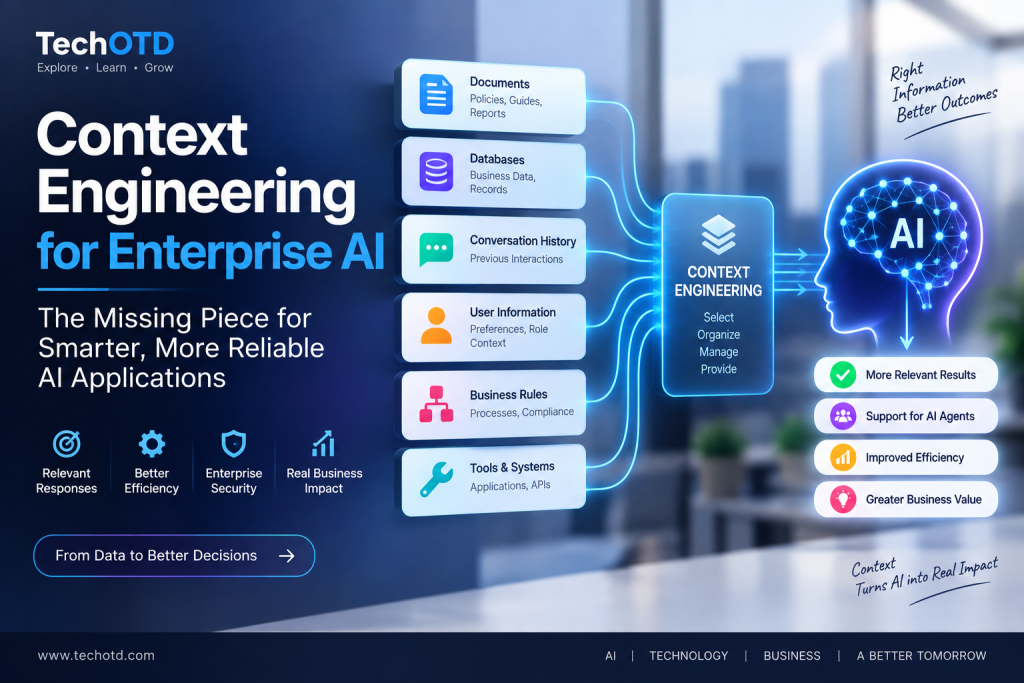
Context Engineering: Why It Is Becoming Essential for Enterprise AI

Introduction As artificial intelligence becomes more deeply integrated into business applications, the quality of AI responses depends on more than the prompt alone. AI systems often need access to relevant information, instructions, user history, business data, and task-specific context to produce useful and reliable results. Prompt engineering focuses on designing effective instructions for AI models, but enterprise AI applications often require a broader approach. Businesses need to determine what information should be provided to an AI system, how that information should be structured, and when it should be included in the AI workflow. Context engineering is the process of designing and managing the information available to an AI system so it can better understand a task and generate more relevant responses. As organizations build AI agents and complex AI applications, effective context management is becoming increasingly important for performance, reliability, and scalability. What Is Context Engineering? Context engineering is the process of selecting, organizing, and providing the right information to an AI system so it can better understand a task and generate relevant, accurate, and useful responses. This information can include instructions, user preferences, conversation history, business data, documents, retrieved knowledge, and details about the current task. More Than Writing Better Prompts Prompt engineering focuses primarily on how instructions are written, while context engineering takes a broader approach. It considers everything the AI system needs to know before generating a response, including relevant background information, data, rules, and the current situation. Providing the Right Information at the Right Time An AI system does not always need access to every available piece of information. Context engineering helps determine which information is relevant to a specific task and when that information should be provided to the model. Managing Different Types of Context Enterprise AI applications may use multiple types of context, including system instructions, conversation history, customer information, company documents, database records, retrieved knowledge, and outputs from other AI tools or workflows. Why Context Quality Matters The quality and relevance of the information provided to an AI model can directly influence the usefulness of its output. Too little context may lead to incomplete responses, while irrelevant or excessive information can make it harder for the AI system to focus on the task. By carefully managing what information an AI system receives, businesses can build applications that produce more relevant and consistent results while using AI resources more efficiently. Context Engineering vs Prompt Engineering Context engineering and prompt engineering are closely related, but they focus on different parts of an AI interaction. Prompt engineering focuses on designing effective instructions, while context engineering focuses on managing the broader set of information that an AI system receives before generating a response. The Role of Prompt Engineering Prompt engineering focuses on how instructions are written and structured to guide an AI model toward a desired response. A well-designed prompt can clarify the task, define the expected output, and provide instructions about tone, format, or constraints. The Role of Context Engineering Context engineering considers the wider information environment around the prompt. This can include conversation history, user preferences, business rules, retrieved documents, database information, previous actions, and other task-specific data. Why Enterprise AI Needs Both Enterprise AI applications often require both effective prompts and well-managed context. Clear instructions help the AI understand what it should do, while relevant context helps the model understand the information and situation required to complete the task effectively. A Simple Example A customer support AI may receive an instruction to answer a customer’s question, but it may also need access to the customer’s recent interactions, product information, account details, company policies, and relevant support documents. Context engineering helps determine which of this information should be available for that specific request. Prompt engineering helps define the task, while context engineering helps provide the information needed to complete that task. Together, they can support more useful and reliable AI applications. Why Context Engineering Is Important for Enterprise AI Enterprise AI applications often operate in complex environments where a simple prompt is not enough to produce reliable results. AI systems may need access to business knowledge, user information, current data, previous interactions, and specific organizational rules to understand and complete a task effectively. Enterprise Information Is Often Distributed Business information may be stored across documents, databases, internal applications, knowledge bases, and communication systems. Context engineering helps determine how relevant information can be selected and provided to AI applications when it is needed. Better Context Can Improve AI Output Quality AI models can generate more useful responses when they receive relevant and accurate information about the task. Providing appropriate context can help reduce incomplete responses and improve the relevance of AI-generated outputs. Supporting AI Agents and Complex Workflows AI agents often perform tasks across multiple steps and may interact with different tools, systems, and sources of information. Context engineering can help ensure that an AI agent has access to the relevant information required at each stage of a workflow. Reducing Unnecessary Information Providing every available document or data source to an AI model can create unnecessary complexity and increase resource usage. Context engineering helps focus the AI system on information that is relevant to the current task. Supporting More Consistent AI Applications Enterprise AI applications may be used by many employees, customers, or automated systems. Well-managed context can help create more consistent behavior by ensuring that AI systems receive relevant instructions and information across different interactions. As enterprise AI systems become more connected to business data and workflows, context engineering can play an important role in improving AI performance, reliability, efficiency, and scalability. Key Components of Context Engineering Effective context engineering involves managing different types of information that can influence how an AI system understands and completes a task. Businesses need to decide what information should be included, how it should be organized, and when it should be provided to the AI model. System Instructions System instructions define the overall role, rules, priorities, and behavior expected from an AI system. They can provide consistent guidance
Artificial Intelligence, Software development, Technology & Innovation

AI Agents vs. Traditional Automation: What’s Changing in 2026?

Introduction: The Evolution from Rules to Reasoning For decades, digital transformation was defined by a single, unwavering engineering paradigm: determinism. If you wanted a machine to execute a task, you had to explicitly map out every single variable, branch, and conditional statement beforehand. If an input deviated by even a single character from the expected schema, the automation would crash. This rigid framework birthed the massive market for Robotic Process Automation (RPA) and standard backend API integrations. By 2026, this deterministic wall has completely crumbled. We are currently witnessing a massive architectural migration from standard rule-based workflows to autonomous AI Agents. Unlike traditional software that simply accelerates data transmission across static structures, AI agents possess a cognitive layer. They don’t just execute instructions; they reason, interpret intent, adapt to unpredictable runtime changes, and dynamically formulate their own execution paths. This guide explores the deep technical divides between these two methodologies, maps out the core mechanics of agentic systems, and provides an enterprise blueprint for managing this massive shift. Section 1: Defining the Technical Boundary To understand this architectural evolution, we must establish clear technical boundaries between traditional automation and an actual AI agent. Traditional Automation: Rule-Based Systems Traditional automation operates entirely on if-this-then-that (IFTTT) execution graphs. A software engineer constructs a explicit pipeline using tools like Selenium, UiPath, or custom cron jobs. The software intercepts an input, references a hardcoded template or static database schema, maps fields explicitly, and routes the data to a destination API. The software has zero contextual understanding of the data it manipulates. If a vendor changes a button’s CSS selector on a billing portal, or if an invoice shifts a line item by five pixels, the script breaks. It cannot problem-solve because its world consists exclusively of binary conditions and explicitly coded paths. AI Agents: Goal-Oriented Systems An AI Agent is a software entity that leverages a Large Language Model (LLM) or Large Multimodal Model (LMM) as its central processing unit, running inside a continuous, stateful loop. Instead of receiving a step-by-step instruction set, an agent is given an objective, a set of constraints, and access to an array of external tools. The agent evaluates the current state of its environment, breaks down the main objective into an ordered series of sub-tasks, selects the appropriate tool for the immediate sub-task, analyzes the output of that tool, and continuously modifies its strategy based on real-time feedback. It handles unstructured data natively because it interprets semantic meaning rather than just looking for exact string matches. Section 2: Architectural Comparison: Static Pipelines vs. Cognitive Loops The foundational code paths of these two systems look fundamentally different under the hood. The Linear Pipeline Structure Traditional automation relies on linear or predictable branching logic. The execution flow looks like this: [Inbound Webhook] —> [Parse Exact JSON Schema] —> [Conditional Branching] —> [Write to Destination API] If any link in this chain encounters an anomaly, the execution thread fails, records an error log, and requires human intervention to patch the underlying code. The Agentic Cognitive Loop An autonomous AI agent runs within a non-linear, dynamic cognitive loop, often structured around the OODA Loop (Observe, Orient, Decide, Act) framework: +—————————————+ | Goal Formulation | +—————————————+ | v +———————————————+ —–> | Perception & Observation (Ingest Context) | | +———————————————+ | | | v | +———————————————+ | | Reasoning & Planning (LLM Evaluation) | | +———————————————+ | | | v | +———————————————+ | | Tool Selection & Execution (Take Action) | | +———————————————+ | | +—————————–+ The Core Pillars of Agent Architecture 1. The Planning Core The planning engine decomposes the primary target into manageable milestones. Modern agents utilize advanced prompt-engineering frameworks like Chain-of-Thought (CoT) or Tree-of-Thoughts (ToT) to explore multiple reasoning paths simultaneously, evaluating the probability of success for each direction before executing code. 2. Contextual Memory Systems Agents rely on two distinct memory tiers to maintain consistency over long-running operations: Short-Term Memory: Managed directly via the model’s active context window, keeping track of immediate conversational turns, tool outputs, and local state variables. Long-Term Memory: Powered by an external vector database or graph database. The agent saves past executions, successful problem-solving strategies, and corporate guidelines, retrieving them via semantic search whenever a similar task boundary arises. 3. Tool Utilization (Function Calling) Tools are the hands of the agent. A tool can be a database connection, an internal API, a web scraper, or a command-line terminal. The agent reads the documentation of these tools (written in clear, natural language schemas), determines which tool matches the current sub-task, formats the payload dynamically, executes the call, and parses the returned data to determine the next course of action. Section 3: In-Depth Comparison Matrix Technical Capability Traditional Automation (RPA/APIs) Autonomous AI Agents (2026 Paradigm) Input Type Access Strictly Structured (JSON, XML, CSV) Fully Unstructured (Audio, Video, PDFs, Free Text) Execution Paths Static, Pre-compiled, Deterministic Dynamic, Emergent, Goal-Oriented Error Handling Hardcoded try/catch blocks; immediate crash Autonomous Self-Healing and Error Correction Maintenance Profile High overhead; breaks on UI/API changes Self-adapting; updates strategies based on UI shifts Data Processing Exact string matching and regex parsers Semantic interpretation and conceptual mapping Compute Overhead Negligible; ultra-lightweight execution Substantial; high dependency on token throughput and inference speeds Section 4: Deep Dive into Multi-Agent Orchestration Systems As enterprise environments scale up, relying on a single, massive monolithic agent becomes inefficient. The complexity of managing massive context windows and disparate tool sets introduces latency and hallucinations. The industry has shifted heavily toward Multi-Agent Systems (MAS). In a multi-agent framework, complex corporate operations are divided among specialized, narrow AI agents that communicate with each other over structured protocol buses. +———————————–+ | Enterprise Controller | | (Manager/Router Agent) | +———————————–+ | +———————–+———————–+ | | v v +———————–+ +———————–+ | Security Audit Agent | | Data Extraction Agent | | – Validates Code | <== (Internal Bus) => | – Parses Documents | | – Monitors Regs | | – Cleans Inbound APIs| +———————–+ +———————–+ The Hierarchical Topology In this architecture, a Manager Agent intercepts user intents

Artificial Intelligence

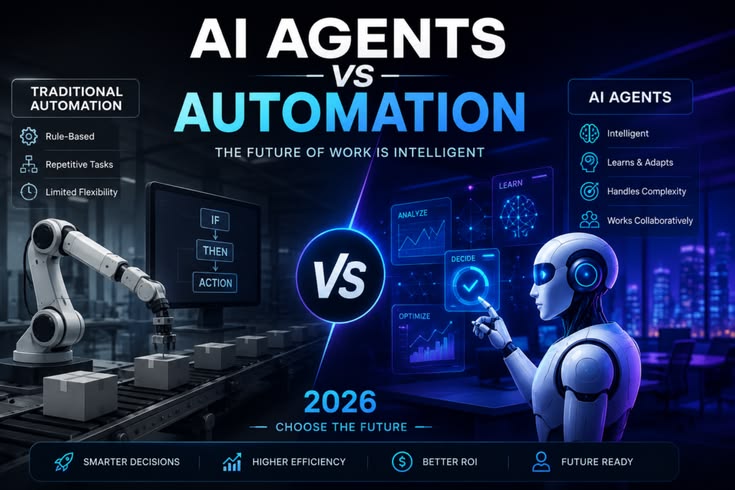
AI Agents vs Traditional Automation: What’s Changing in 2026?

Introduction:- Automation has been a cornerstone of digital transformation for decades. Businesses have long relied on software to eliminate repetitive tasks, reduce operational costs, and improve efficiency. From manufacturing lines to customer relationship management systems, traditional automation has helped organizations streamline workflows and maintain consistency. However, the technological landscape in 2026 is undergoing a significant shift. Organizations are no longer satisfied with systems that simply follow predefined rules. They increasingly require software that can understand context, adapt to changing situations, make informed decisions, and collaborate with humans. This demand has accelerated the adoption of AI agents, one of the most influential developments in modern artificial intelligence. Unlike traditional automation, AI agents are designed to reason, plan, and act toward specific goals. They can analyze large amounts of information, interact with multiple applications, learn from feedback, and even coordinate with other AI systems. Rather than replacing simple automation, AI agents expand what automation can achieve by handling more dynamic and complex tasks. This article explores how AI agents differ from traditional automation, why organizations are investing in intelligent systems, and how businesses can prepare for the next generation of digital operations. Understanding Traditional Automation Traditional automation refers to software that performs predefined actions based on fixed rules. These systems execute workflows exactly as they were programmed, making them highly reliable for repetitive processes. Examples include: Automated invoice generation Payroll processing Scheduled email campaigns Data backups Manufacturing assembly lines Basic customer support chatbots Rule-based approval workflows The primary advantage of traditional automation is consistency. Once configured correctly, it performs the same task repeatedly with minimal errors. It is ideal for environments where processes rarely change. However, these systems have clear limitations. They cannot interpret ambiguous information, adapt to unexpected scenarios, or make decisions beyond their programmed rules. If the business process changes, developers often need to redesign or update the automation. What Are AI Agents? AI agents are intelligent software systems capable of perceiving information, reasoning about it, making decisions, and taking actions to achieve defined objectives. Unlike conventional automation tools, AI agents do not rely solely on fixed rules. They use technologies such as large language models, machine learning, natural language processing, retrieval systems, and external tools to solve problems dynamically. For example, an AI customer support agent can: Read a customer’s email. Identify the issue and urgency. Search internal documentation. Check order status. Draft a personalized response. Escalate complex cases when necessary. Learn from user feedback over time. Instead of executing a single scripted workflow, the agent evaluates the situation and chooses the most appropriate action. Traditional Automation vs AI Agents Feature Traditional Automation AI Agents Decision-making Rule-based Context-aware Learning No Yes, through AI models and feedback Flexibility Low High Handles unstructured data Limited Excellent Human-like communication Minimal Advanced Adaptability Requires reprogramming Can adjust to changing inputs Best suited for Repetitive tasks Complex, evolving workflows Why 2026 Marks a Turning Point Several technological trends have converged to make AI agents practical at scale. Large language models have become significantly more capable, enabling agents to understand natural language and generate useful responses. Cloud infrastructure now provides the computing power needed to run advanced AI workloads efficiently. Businesses have also accumulated vast amounts of digital data, creating opportunities for AI systems to deliver meaningful insights and automation. At the same time, organizations are under pressure to improve productivity, reduce costs, and respond faster to customer expectations. AI agents address these needs by automating tasks that previously required human judgment. Real-World Business Applications Customer Service Modern AI agents can resolve support tickets, summarize conversations, translate languages, and personalize responses while maintaining a consistent customer experience. Software Development Development teams use AI agents to generate code, review pull requests, identify bugs, write documentation, and automate testing. These capabilities accelerate delivery while allowing engineers to focus on architecture and innovation. Cybersecurity Security operations centers increasingly deploy AI agents to monitor logs, detect anomalies, investigate suspicious behavior, and recommend remediation steps. This helps analysts respond more quickly to emerging threats. Cloud Operations Cloud management platforms benefit from AI agents that optimize infrastructure, monitor resource utilization, predict outages, and recommend cost-saving opportunities. They can assist administrators in maintaining reliable and scalable environments. Healthcare Hospitals and healthcare providers use intelligent agents to organize patient records, assist with appointment scheduling, summarize clinical notes, and support administrative workflows, enabling staff to spend more time on patient care. Benefits of AI Agents Organizations adopting AI agents are seeing improvements in several areas: Increased productivity through intelligent task automation. Faster decision-making based on real-time data. Improved customer experiences with personalized interactions. Reduced operational costs by minimizing manual work. Better scalability across departments. Continuous learning and optimization through AI-driven feedback loops. These advantages make AI agents an important part of digital transformation strategies across industries. AI Governance in 2026: Balancing Innovation and Regulation  

Artificial Intelligence, Digital Transformation, Educational Technology

Multimodal AI Explained: The Future of Human-Computer Interaction

Introduction Artificial Intelligence has evolved rapidly over the past decade, moving from simple rule-based systems to highly sophisticated models capable of understanding and generating human-like content. One of the most significant breakthroughs in recent years is the emergence of Multimodal AI, a technology that allows machines to process and understand multiple forms of data simultaneously, including text, images, audio, video, and even sensor inputs. Traditional AI systems typically specialize in a single type of input. For example, a chatbot processes text, while an image recognition system analyzes pictures. Multimodal AI changes this paradigm by combining different data types into a unified understanding. This advancement is paving the way for a new era of human-computer interaction where technology can communicate more naturally, understand context better, and provide richer experiences. As businesses, developers, and consumers increasingly adopt AI-powered tools, Multimodal AI is expected to become one of the defining technologies of the next decade. From virtual assistants and healthcare applications to autonomous vehicles and smart workplaces, its influence is already being felt across industries. What Is Multimodal AI? Multimodal AI refers to artificial intelligence systems that can process and interpret information from multiple sources or modalities simultaneously. These modalities include: Text Images Audio Video Sensor Data Gestures and Physical Inputs Humans naturally use multiple senses to understand the world. For example, during a conversation, we listen to words, observe facial expressions, and interpret body language at the same time. Multimodal AI aims to replicate this ability by integrating different forms of information into a single intelligent system. Instead of analyzing data in isolation, Multimodal AI combines various inputs to gain a deeper understanding of context and intent. This enables more accurate decision-making and more natural interactions between humans and machines. The Evolution of Human-Computer Interaction Human-computer interaction has undergone several major transformations over the years. Command-Line Interfaces Early computers relied on text-based commands. Users needed technical knowledge to communicate with machines effectively. Graphical User Interfaces The introduction of graphical interfaces made computers more accessible. Users could interact through windows, icons, and menus instead of memorizing commands. Touch-Based Interaction The rise of smartphones and tablets introduced touchscreens, making interaction more intuitive and mobile. Voice Assistants Virtual assistants brought voice recognition into mainstream technology, allowing users to perform tasks through spoken commands. Multimodal Interaction Today, AI systems are moving beyond single-input methods. Users can speak, type, upload images, share videos, and interact naturally with intelligent systems that understand all these inputs together. This shift represents one of the most significant changes in the history of computing. How Multimodal AI Works At its core, Multimodal AI combines information from different data sources and processes them through advanced machine learning models. The process generally involves several steps: Data Collection The AI gathers data from multiple sources such as text documents, images, microphones, cameras, and sensors. Data Processing Each data type undergoes specialized processing: Natural Language Processing for text Computer Vision for images and videos Speech Recognition for audio Sensor Analysis for environmental inputs Data Fusion The processed information is combined into a unified representation that allows the AI to understand relationships between different inputs. Contextual Understanding The AI analyzes the combined information to determine meaning, intent, and context. Response Generation Based on its understanding, the system generates an appropriate output, which could be text, speech, images, recommendations, or actions. This integrated approach enables more intelligent and context-aware interactions. Why Multimodal AI Is Important The significance of Multimodal AI lies in its ability to bridge the gap between human communication and machine understanding. Improved Accuracy Using multiple data sources reduces ambiguity and improves decision-making. For example, a voice command combined with visual context allows an AI assistant to better understand what a user is requesting. Better User Experiences Interactions become more natural because users can communicate in the way that feels most comfortable. Enhanced Context Awareness Multimodal systems understand situations more effectively by considering multiple signals simultaneously. Increased Accessibility People with different abilities can interact with technology using speech, images, gestures, or text. More Human-Like Communication By understanding various forms of input, AI systems can engage in conversations and interactions that closely resemble human communication. Key Technologies Powering Multimodal AI Several advanced technologies contribute to the development of multimodal systems. Natural Language Processing NLP enables machines to understand, interpret, and generate human language. Computer Vision Computer vision allows AI systems to analyze images, videos, objects, faces, and environments. Speech Recognition Speech technologies convert spoken language into machine-readable formats. Deep Learning Neural networks help identify complex patterns across multiple data types. Generative AI Models Modern generative models can create text, images, audio, and video content from various inputs. Large Language Models Advanced language models provide the reasoning and contextual understanding necessary for multimodal applications. Together, these technologies create AI systems capable of understanding and generating rich, multi-format content. Real-World Applications of Multimodal AI Healthcare Healthcare organizations are using Multimodal AI to analyze medical records, diagnostic images, laboratory reports, and physician notes simultaneously. Benefits include: Faster diagnosis Improved treatment planning Better patient monitoring Enhanced medical research Doctors can receive more comprehensive insights by combining information from multiple sources. Customer Service Businesses are implementing AI-powered support systems that understand: Customer messages Voice conversations Uploaded screenshots Product photos This allows customer service teams to resolve issues faster and improve customer satisfaction. Education Educational platforms use Multimodal AI to create personalized learning experiences. Students can: Ask questions verbally Submit handwritten assignments Upload images Receive customized explanations This makes learning more interactive and accessible. Autonomous Vehicles Self-driving vehicles rely heavily on multimodal intelligence. They combine information from: Cameras Radar systems LiDAR sensors GPS data Traffic information This comprehensive understanding helps vehicles navigate safely. Smart Assistants Next-generation AI assistants can process text, voice, images, and video simultaneously. Users may simply take a picture, ask a question, and receive an accurate response without needing to provide detailed descriptions. Retail and E-Commerce Retailers use Multimodal AI for: Visual product searches Personalized recommendations Inventory management Customer behavior analysis Shoppers can upload images of products they like

Artificial Intelligence, cybersecurity, Technology

The Future of Cybersecurity in the Age of Generative AI

The Future of Cybersecurity in the Age of Generative AI The cybersecurity landscape is undergoing a dramatic transformation. As organizations continue to embrace digital technologies, cloud computing, remote work, and interconnected systems, cyber threats are becoming increasingly sophisticated. At the same time, a new technological revolution is reshaping how businesses defend themselves against these threats: Generative Artificial Intelligence (Generative AI). Generative AI has rapidly evolved from a fascinating innovation into a powerful business tool capable of creating content, analyzing data, automating processes, and assisting with complex decision-making. While much of the public attention has focused on AI-generated text, images, and videos, one of its most significant impacts is emerging in the field of cybersecurity. Generative AI is creating both opportunities and challenges. On one hand, it enables organizations to detect threats faster, automate security operations, and strengthen defenses against cybercriminals. On the other hand, malicious actors are leveraging the same technology to launch more convincing phishing attacks, develop advanced malware, and exploit vulnerabilities at unprecedented speeds. As businesses prepare for the future, understanding the relationship between generative AI and cybersecurity has become essential. The future of digital security will be defined by how effectively organizations can harness AI while managing the risks it introduces. Understanding Generative AI in Cybersecurity Generative AI refers to artificial intelligence systems capable of creating new content, generating responses, producing code, and learning patterns from massive datasets. Unlike traditional AI systems that primarily analyze information, generative AI can actively create solutions, recommendations, and predictions based on its training. In cybersecurity, this capability opens new possibilities for threat detection, incident response, vulnerability management, and security automation. AI systems can analyze vast amounts of security data, identify suspicious activities, and provide actionable insights in real time. Security teams are increasingly overwhelmed by the volume of alerts generated by modern networks. Generative AI helps reduce this burden by filtering irrelevant alerts, prioritizing threats, and assisting analysts in understanding complex attack patterns. This shift allows security professionals to focus on strategic decision-making rather than spending valuable time on repetitive tasks. The Growing Complexity of Cyber Threats Cybercriminals continue to evolve their methods as organizations strengthen their defenses. Traditional cybersecurity approaches often struggle to keep pace with the scale and speed of modern attacks. Attack surfaces have expanded significantly due to cloud adoption, Internet of Things (IoT) devices, remote work environments, and digital transformation initiatives. Every connected device and application introduces potential vulnerabilities that attackers can exploit. Modern threats include: Advanced phishing campaigns Ransomware attacks Supply chain compromises Zero-day vulnerabilities Insider threats Credential theft Social engineering attacks The increasing sophistication of these threats requires equally advanced defense mechanisms. Generative AI provides organizations with the ability to analyze complex environments continuously and identify emerging risks before they become major incidents. AI-Powered Threat Detection and Prevention One of the most promising applications of generative AI in cybersecurity is threat detection. Traditional security systems often rely on predefined rules and known attack signatures. While effective against familiar threats, these systems may struggle to identify new or evolving attack techniques. Generative AI can analyze patterns across networks, endpoints, user behavior, and application activity to detect anomalies that may indicate malicious activity. For example, if an employee suddenly accesses sensitive data from an unusual location or begins transferring large volumes of information, AI systems can recognize the abnormal behavior and trigger alerts. The benefits include: Faster threat identification Reduced false positives Improved accuracy Real-time monitoring Continuous learning capabilities By identifying threats earlier in the attack lifecycle, organizations can minimize damage and reduce recovery costs. Automating Security Operations Security operations centers (SOCs) face significant challenges due to staffing shortages and increasing workloads. Many organizations struggle to hire enough cybersecurity professionals to manage growing security demands. Generative AI can help bridge this gap by automating routine tasks and supporting security teams. AI-driven automation can assist with: Log analysis Incident classification Threat intelligence gathering Vulnerability assessment Security reporting Compliance monitoring Instead of manually reviewing thousands of alerts each day, analysts can rely on AI-powered systems to summarize incidents, recommend actions, and prioritize critical threats. This automation improves efficiency while enabling security teams to respond more quickly to potential attacks. The Role of Generative AI in Incident Response When a cyberattack occurs, rapid response is critical. Every minute of delay can increase financial losses, operational disruptions, and reputational damage. Generative AI can significantly accelerate incident response processes. AI systems can analyze attack data, identify affected systems, determine the likely attack path, and generate recommended remediation steps. Security teams can use AI-generated insights to: Investigate incidents faster Contain threats more effectively Reduce downtime Improve recovery processes Document incidents automatically As AI technologies continue to mature, organizations may increasingly rely on autonomous response systems capable of taking immediate defensive actions without human intervention. Predictive Cybersecurity and Risk Assessment One of the most exciting developments in AI-driven security is predictive threat analysis. Rather than simply reacting to attacks after they occur, organizations can use generative AI to anticipate future threats. By analyzing historical attack data, vulnerability trends, industry intelligence, and global threat activity, AI systems can identify potential risks before they are exploited. Predictive cybersecurity enables businesses to: Prioritize security investments Patch vulnerabilities proactively Strengthen high-risk systems Improve risk management strategies Reduce attack exposure This proactive approach represents a significant shift from traditional reactive security models. How Cybercriminals Are Using Generative AI While generative AI offers powerful defensive capabilities, it also provides new tools for cybercriminals. Attackers are increasingly using AI technologies to enhance their operations and improve attack success rates. Some malicious applications include: AI-Generated Phishing Attacks Traditional phishing emails often contain grammatical errors and suspicious language. Generative AI can produce highly convincing messages that closely resemble legitimate communications. These personalized attacks can be tailored to specific individuals, making them significantly harder to detect. Advanced Social Engineering AI can generate realistic conversations, fake identities, and persuasive messages designed to manipulate victims into revealing sensitive information. Automated Malware Development Cybercriminals may use AI-assisted coding tools to create malware variants more quickly and

Artificial Intelligence, cybersecurity, Educational Technology, Technology

The Rise of Personal AI Assistants: Beyond Chatbots

The Rise of Personal AI Assistants: Beyond Chatbots Artificial Intelligence has rapidly evolved over the last few years, moving far beyond simple chatbots that could only answer basic questions or follow scripted commands. In 2026, personal AI assistants are becoming smarter, more personalized, and significantly more capable than ever before. They are no longer limited to responding to text prompts; instead, they are transforming into intelligent digital companions that can understand user preferences, manage tasks, automate workflows, and even make recommendations based on individual needs. From helping professionals manage their schedules to assisting students with learning and supporting businesses with daily operations, personal AI assistants are becoming an integral part of modern life. As advancements in machine learning, natural language processing, and generative AI continue to accelerate, these assistants are reshaping the way people interact with technology. Understanding the Evolution of AI Assistants The first generation of AI assistants focused primarily on basic voice commands and simple information retrieval. Users could ask for weather updates, set reminders, or search the internet. While these features were useful, the assistants often struggled with context, personalization, and complex requests. Today’s AI assistants are vastly different. They can understand conversations, remember preferences, learn from user interactions, and provide more meaningful responses. Modern AI systems are capable of handling multiple tasks simultaneously, analyzing data, generating content, and assisting with decision-making. This evolution has transformed AI assistants from reactive tools into proactive digital partners that can anticipate user needs and provide relevant support before being asked. What Makes Modern AI Assistants Different? The biggest difference between traditional chatbots and modern AI assistants is personalization. Instead of treating every interaction as a separate conversation, advanced AI assistants build contextual understanding over time. They can remember preferred writing styles, frequently used applications, work schedules, and personal interests. This enables them to deliver responses and recommendations that feel more relevant and tailored to individual users. For example, an AI assistant helping a marketing professional might automatically suggest content ideas based on industry trends, schedule social media posts, and summarize important emails. Meanwhile, a student using the same assistant may receive personalized study plans, learning resources, and exam preparation support. The ability to adapt to individual needs is making AI assistants significantly more valuable across different use cases. The Shift from Chat to Action One of the most important developments in personal AI technology is the transition from conversation-based assistance to action-based assistance. Modern AI assistants are increasingly capable of performing tasks instead of merely providing instructions. Rather than explaining how to complete a process, they can often execute portions of the workflow directly. Examples include: Scheduling meetings automatically Managing emails Organizing files and documents Generating reports Creating presentations Drafting content Tracking project deadlines Managing customer interactions This shift allows users to focus on higher-value work while routine tasks are handled by AI systems. As integration with software platforms continues to improve, AI assistants are becoming capable of interacting with multiple applications simultaneously, creating seamless digital workflows. Personalized Productivity and Time Management Productivity is one of the areas where personal AI assistants are creating the greatest impact. Modern professionals often deal with information overload, endless notifications, and growing workloads. AI assistants help reduce this burden by organizing information and prioritizing tasks. Instead of manually reviewing hundreds of emails, users can receive AI-generated summaries highlighting only the most important messages. Meeting transcripts can be automatically generated and converted into actionable tasks. Calendar management can be optimized based on priorities and availability. These capabilities allow individuals to spend less time managing work and more time focusing on meaningful activities. As AI becomes more context-aware, productivity assistance will become increasingly proactive, helping users identify opportunities, risks, and deadlines before they become problems. AI Assistants in Education Education is another sector experiencing significant transformation through personal AI assistants. Students can now access personalized tutoring experiences that adapt to their learning pace and knowledge level. AI assistants can explain difficult concepts, generate practice questions, create study schedules, and provide instant feedback. Unlike traditional learning resources, AI-powered educational tools can adjust their teaching methods based on student performance. If a learner struggles with a specific topic, the assistant can provide additional explanations and targeted exercises. Teachers are also benefiting from AI technology. Administrative tasks such as grading, lesson planning, and content creation can be streamlined, allowing educators to spend more time supporting students. As educational AI systems continue to improve, personalized learning experiences are expected to become more accessible worldwide. The Role of AI Assistants in Business Businesses are increasingly deploying AI assistants to improve efficiency and reduce operational costs. Customer support teams use AI assistants to handle routine inquiries, allowing human agents to focus on more complex issues. Sales teams leverage AI to analyze customer behavior, generate leads, and personalize communication. Project managers benefit from AI-generated status reports, automated documentation, and workflow tracking. Human resources departments use AI assistants for recruitment support, employee onboarding, and internal communication. The growing ability of AI systems to interact with enterprise software platforms is enabling organizations to automate processes that previously required significant human effort. As a result, businesses can improve productivity while maintaining a high level of service quality. The Emergence of AI Agents A major trend driving the future of personal AI assistants is the rise of AI agents. Unlike traditional assistants that respond only when prompted, AI agents can independently perform tasks, monitor objectives, and take action within defined boundaries. For example, an AI agent might: Monitor market trends Track project progress Analyze customer feedback Generate reports automatically Schedule follow-up actions Coordinate multiple software tools These capabilities represent a significant step toward autonomous digital assistants capable of managing entire workflows. While human oversight remains essential, AI agents are increasingly functioning as virtual team members rather than simple software tools. Privacy and Data Security Challenges As AI assistants become more personalized, concerns regarding privacy and data security are becoming increasingly important. Personalized experiences require access to user information, including schedules, preferences, communication history, and behavioral patterns.

Artificial Intelligence, Business Analytics, Business Intelligence, Data Privacy & Security, Digital Transformation

AI Agents in 2026: How Autonomous Systems Are Transforming Business Operations

Introduction Artificial Intelligence has moved far beyond simple chatbots and recommendation engines. In 2026, AI agents are becoming one of the most influential technologies shaping modern businesses. These intelligent systems are capable of understanding goals, making decisions, performing tasks, and even coordinating with other software tools with minimal human intervention. What once required teams of employees and multiple software platforms can now be managed by autonomous AI systems that work continuously and efficiently. The rise of AI agents marks a significant shift in how organizations approach productivity, operations, and decision-making. Rather than serving only as assistants, AI systems are increasingly acting as digital workers that can execute complex workflows, analyze large volumes of information, and adapt to changing business conditions in real time. As companies continue to invest in automation and digital transformation, AI agents are emerging as a critical component of business strategy. Their ability to reduce operational costs, improve efficiency, and accelerate innovation is changing the way organizations operate across industries. What Are AI Agents? AI agents are autonomous software systems designed to perform tasks on behalf of users or organizations. Unlike traditional automation tools that follow predefined rules, AI agents can understand context, learn from interactions, make decisions, and take actions to achieve specific objectives. These systems combine advanced artificial intelligence technologies such as large language models, machine learning, natural language processing, and workflow automation. They can interact with applications, access databases, communicate with users, and execute tasks without requiring constant human supervision. For example, an AI agent can receive a request to prepare a market research report, gather information from multiple sources, analyze trends, generate insights, create a presentation, and deliver the final report automatically. Instead of performing one isolated function, it manages an entire process from start to finish. This capability is what makes AI agents fundamentally different from conventional software automation solutions. Why AI Agents Are Gaining Momentum in 2026 Several factors are contributing to the rapid adoption of AI agents across industries. Businesses are generating more data than ever before, creating a growing need for systems that can process and interpret information quickly. At the same time, organizations face increasing pressure to improve efficiency while reducing operational costs. Advancements in generative AI and large language models have significantly improved the reasoning and decision-making abilities of AI systems. Modern AI agents can understand complex instructions, maintain context across multiple tasks, and interact naturally with both humans and software applications. Cloud computing infrastructure has also made it easier for businesses to deploy and scale AI-powered solutions. Organizations no longer need extensive hardware investments to access advanced AI capabilities. The combination of these technological developments has created an environment where AI agents can deliver measurable business value across a wide range of functions. How AI Agents Work At their core, AI agents operate through a cycle of perception, reasoning, action, and learning. First, the agent gathers information from its environment. This may include user requests, business data, emails, documents, databases, or external sources. Next, the system analyzes the information and determines the best course of action based on predefined objectives. Advanced reasoning models help the agent evaluate different possibilities and choose appropriate responses. Once a decision is made, the AI agent executes the required actions. This may involve sending emails, updating records, generating reports, scheduling meetings, processing transactions, or interacting with other software systems. Finally, the agent learns from outcomes and feedback to improve future performance. Over time, this continuous learning process helps the system become more effective and accurate. This ability to independently manage workflows makes AI agents particularly valuable in complex business environments. Transforming Customer Service Operations Customer service is one of the areas experiencing the most significant impact from AI agents. Traditional customer support often involves long wait times, repetitive inquiries, and high operational costs. AI agents are helping organizations overcome these challenges by providing instant, personalized, and scalable support. Modern AI customer service agents can understand customer questions, access relevant information, resolve issues, process requests, and escalate complex cases when necessary. They operate around the clock, ensuring customers receive assistance whenever needed. Beyond answering questions, AI agents can proactively identify potential issues, recommend solutions, and follow up with customers to ensure satisfaction. Businesses using AI-powered customer support systems are reporting faster response times, improved customer experiences, and reduced service costs. Revolutionizing Human Resources Management Human Resources departments are increasingly adopting AI agents to streamline administrative tasks and improve employee experiences. Recruitment is one area where these systems are delivering significant benefits. AI agents can screen resumes, schedule interviews, communicate with candidates, and identify suitable applicants based on specific job requirements. Employee onboarding processes are also becoming more efficient. AI agents can guide new hires through documentation, answer common questions, provide training materials, and ensure compliance requirements are completed. In addition, AI systems can assist with performance evaluations, workforce planning, employee engagement initiatives, and professional development recommendations. By automating routine administrative work, HR teams can focus more on strategic initiatives and employee relationships. Enhancing Sales and Marketing Performance Sales and marketing teams are using AI agents to improve customer engagement, generate leads, and optimize campaigns. AI-powered sales agents can identify potential customers, analyze purchasing behavior, personalize outreach efforts, and recommend next steps for sales representatives. These capabilities help organizations improve conversion rates and accelerate revenue growth. Marketing teams benefit from AI agents that can create content, monitor campaign performance, analyze audience behavior, and adjust strategies based on real-time insights. For example, an AI agent may automatically identify underperforming advertisements, suggest improvements, allocate budgets more effectively, and generate detailed performance reports. This level of automation allows businesses to respond more quickly to market changes and customer preferences. Improving Financial Operations Financial management is another area where AI agents are creating substantial value. Organizations handle large volumes of financial data every day, making accuracy and efficiency critical. AI agents can automate invoice processing, expense management, budgeting, forecasting, and financial reporting. These systems can identify unusual transactions, detect potential fraud, and alert financial teams to

Artificial Intelligence, Data Privacy & Security

The Rise of Private AI: Why Businesses Want More Control Over Their Data

The Rise of Private AI: Why Businesses Want More Control Over Their Data Artificial Intelligence has become one of the most transformative technologies of the modern business era. From automating routine processes and generating content to analyzing massive datasets and enhancing customer experiences, AI is helping organizations operate more efficiently than ever before. However, as AI adoption accelerates, a new concern has emerged alongside the excitement: data privacy. Businesses today generate and store enormous volumes of sensitive information. Customer records, financial data, intellectual property, strategic plans, employee information, and proprietary research are among the most valuable assets an organization possesses. While public AI platforms offer impressive capabilities, many companies are becoming increasingly cautious about how their data is processed, stored, and used. This growing concern has led to the rise of Private AI, an approach that allows organizations to harness the power of artificial intelligence while maintaining greater control over their data. Rather than sending sensitive information to public AI services, businesses are exploring private AI environments that prioritize security, compliance, and ownership. As digital transformation continues to reshape industries, Private AI is quickly becoming a critical component of enterprise technology strategies. Understanding Private AI Private AI refers to artificial intelligence systems that operate within a controlled environment owned or managed by an organization. These systems can be deployed on-premises, within private cloud infrastructure, or through dedicated environments that ensure data remains isolated from public systems. Unlike public AI platforms that often rely on shared infrastructure and external data processing, Private AI enables businesses to retain control over where their information resides, who can access it, and how it is used. The objective is simple: gain the benefits of advanced AI capabilities without exposing sensitive business data to unnecessary risks. Private AI solutions can include: Self-hosted large language models Private generative AI assistants Secure machine learning environments Enterprise AI platforms with dedicated infrastructure Industry-specific AI systems designed for regulated sectors This model is becoming increasingly attractive as organizations seek to balance innovation with security and regulatory compliance. Why Businesses Are Prioritizing Data Control Data has become one of the most valuable assets in the modern economy. As AI systems require access to large datasets for analysis and decision-making, organizations want assurance that their information remains protected. Several factors are driving the shift toward Private AI. Protecting Sensitive Information Many businesses handle confidential data that cannot be shared outside approved environments. Financial institutions manage customer transactions, healthcare providers process medical records, and technology companies store proprietary intellectual property. Using public AI systems may raise concerns about data exposure, accidental leaks, or unauthorized access. Private AI allows organizations to keep critical information within secure boundaries. For industries where trust is essential, maintaining complete control over sensitive data is often non-negotiable. Meeting Regulatory Requirements Governments and regulatory bodies worldwide are introducing stricter data protection laws. Regulations such as GDPR, industry-specific compliance frameworks, and national privacy laws require organizations to demonstrate responsible data handling practices. Businesses operating across multiple regions face increasing pressure to comply with diverse regulatory requirements. Private AI environments provide greater transparency and control, helping organizations meet compliance obligations more effectively. By knowing exactly where data is stored and processed, businesses can reduce regulatory risks and avoid costly penalties. Safeguarding Intellectual Property For many organizations, proprietary information represents a significant competitive advantage. Product designs, research findings, source code, business strategies, and internal documentation are assets that businesses cannot afford to expose. As generative AI tools become more integrated into daily workflows, concerns have emerged about how submitted data may be used by external systems. Private AI offers a solution by ensuring sensitive business knowledge remains within the organization’s own ecosystem. This level of protection is particularly important for industries driven by innovation and intellectual property. The Growing Trust Challenge in AI Despite the remarkable capabilities of AI, trust remains one of the biggest barriers to adoption. Business leaders often ask critical questions: Who owns the data used by the AI system? Where is the information stored? Can external parties access company data? How is the data protected? What happens if a security breach occurs? These concerns become even more significant when AI systems are used for mission-critical operations. Private AI helps address these trust issues by providing greater visibility and governance over AI operations. Organizations can establish clear policies regarding data access, model training, monitoring, and security controls. When employees and customers trust how AI is being implemented, adoption tends to increase significantly. How Private AI Improves Security Cybersecurity threats continue to evolve at an alarming pace. Data breaches can lead to financial losses, reputational damage, legal consequences, and operational disruptions. Private AI strengthens security through several mechanisms. Controlled Access Organizations can define who has access to AI systems and what information can be processed. Role-based permissions reduce the risk of unauthorized access and internal misuse. Enhanced Monitoring Private environments enable businesses to monitor AI activity more closely. Security teams can track interactions, detect anomalies, and respond quickly to potential threats. Reduced Data Exposure Keeping data within private infrastructure minimizes the need to transmit sensitive information across external networks, reducing potential attack surfaces. Custom Security Policies Businesses can implement security measures aligned with their specific needs, including encryption, authentication, network isolation, and auditing capabilities. These controls provide a level of protection that many organizations consider essential for enterprise-scale AI adoption. The Role of Private AI in Highly Regulated Industries Certain industries face particularly strict requirements regarding privacy and data protection. Healthcare Healthcare organizations manage highly sensitive patient information. AI can assist with diagnostics, patient engagement, medical research, and operational efficiency, but privacy concerns remain paramount. Private AI allows healthcare providers to leverage AI while maintaining compliance with healthcare regulations and safeguarding patient trust. Financial Services Banks and financial institutions process vast amounts of confidential customer data. Fraud detection, risk analysis, and customer support increasingly rely on AI technologies. Private AI helps financial organizations maintain strict security standards while improving operational performance. Government and Public Sector Government agencies often handle classified

Artificial Intelligence, Software development, Technology

How Generative AI Is Reshaping Software Development

How Generative AI Is Reshaping Software Development Software development has always evolved alongside technological innovation. From the early days of manual coding to the rise of integrated development environments (IDEs), cloud computing, and DevOps practices, every advancement has aimed to make building software faster, more efficient, and less error-prone. Today, another major transformation is underway, driven by Generative Artificial Intelligence (AI). Generative AI is no longer a futuristic concept limited to research labs or tech giants. It has become a practical tool that developers, businesses, and organizations are actively using to accelerate software creation, automate repetitive tasks, improve code quality, and streamline entire development lifecycles. What once required hours of manual effort can now be accomplished in minutes with the assistance of AI-powered tools. As businesses continue their digital transformation journeys, Generative AI is emerging as one of the most influential technologies reshaping how software is designed, developed, tested, and maintained. Understanding Generative AI in Software Development Generative AI refers to artificial intelligence systems capable of creating new content based on patterns learned from large datasets. While many people associate Generative AI with text, images, and videos, its impact on software development is equally significant. Modern AI coding assistants can understand natural language instructions and generate functional code snippets, entire functions, documentation, test cases, and even complete applications. Developers can describe what they want in plain English, and AI tools can suggest code that accomplishes the task. Rather than replacing developers, Generative AI acts as an intelligent collaborator that helps teams work faster and focus on higher-value problem-solving activities. Accelerating Code Generation One of the most visible impacts of Generative AI is its ability to generate code quickly. Developers often spend a significant portion of their time writing repetitive code structures, configuring frameworks, or implementing common functionalities. AI-powered coding assistants can automate these tasks by generating code suggestions in real time. For example, instead of manually creating API endpoints, authentication modules, or database queries, developers can provide a prompt and receive ready-to-use code within seconds. This dramatically reduces development time and allows teams to focus on innovation rather than repetitive implementation work. The result is increased productivity, shorter development cycles, and faster delivery of software products. Enhancing Developer Productivity Software engineers frequently switch between coding, researching solutions, reviewing documentation, and troubleshooting issues. These context switches can impact efficiency and slow progress. Generative AI helps reduce these interruptions by providing instant assistance directly within development environments. Developers can ask questions, request code explanations, generate examples, or seek alternative implementation approaches without leaving their workflow. This immediate access to information enables developers to spend more time building solutions and less time searching for answers. For junior developers, AI also serves as a valuable learning companion, helping them understand complex concepts and best practices while coding. Improving Code Quality and Consistency Maintaining code quality is essential for building reliable and scalable software applications. Poor coding practices can lead to technical debt, security vulnerabilities, and maintenance challenges. Generative AI contributes to better software quality by identifying potential issues, suggesting improvements, and promoting coding standards. AI tools can analyze existing codebases and recommend cleaner, more efficient implementations. Organizations can also use AI to enforce coding guidelines across development teams, ensuring consistency in naming conventions, architecture patterns, and documentation practices. By reducing human errors and encouraging best practices, AI helps create more maintainable and robust software systems. Revolutionizing Software Testing Testing remains one of the most time-consuming phases of software development. Writing test cases, identifying edge cases, and validating application behavior often require extensive effort. Generative AI is transforming this process by automatically generating test scenarios, unit tests, integration tests, and regression testing scripts. AI can analyze application logic and identify areas that require testing, reducing the likelihood of overlooked bugs. Furthermore, AI-powered testing tools can predict potential failure points and suggest additional test coverage based on historical data and code changes. This leads to faster testing cycles, improved software reliability, and reduced quality assurance costs. Simplifying Debugging and Error Resolution Debugging can consume countless hours, especially when dealing with large and complex applications. Generative AI helps developers identify the root causes of errors more efficiently. By analyzing logs, error messages, and source code, AI systems can suggest likely solutions and explain why issues are occurring. Instead of manually searching through documentation or forums, developers can receive contextual recommendations tailored to their specific problem. This capability significantly reduces troubleshooting time and accelerates software maintenance activities. Streamlining Documentation Creation Documentation is critical for software success, yet it is often neglected due to time constraints. Generative AI can automatically create technical documentation, API references, user guides, code comments, and onboarding materials. As developers write code, AI tools can generate accompanying explanations and documentation in real time. This ensures that projects remain well-documented throughout their lifecycle rather than requiring documentation efforts at the end of development. Better documentation improves collaboration, simplifies maintenance, and accelerates knowledge transfer within teams. Supporting Low-Code and No-Code Development Generative AI is also contributing to the growth of low-code and no-code development platforms. Business users who may not have extensive programming expertise can describe application requirements using natural language. AI-powered systems can then generate workflows, interfaces, databases, and business logic automatically. This democratization of software development enables organizations to build applications faster while reducing dependency on specialized development resources. Although professional developers remain essential for complex projects, Generative AI is making software creation more accessible than ever before. Strengthening DevOps and Deployment Processes Modern software development extends beyond writing code. Continuous integration, deployment, monitoring, and infrastructure management are equally important. Generative AI is helping DevOps teams automate configuration management, deployment scripts, infrastructure provisioning, and incident response workflows. AI can analyze deployment patterns, predict infrastructure requirements, and recommend optimizations for cloud environments. It can also identify anomalies before they become critical issues, improving system reliability and performance. By automating operational tasks, organizations can achieve faster releases and more resilient software systems. Enhancing Cybersecurity in Development Security has become a top priority as cyber threats continue

Artificial Intelligence, Digital Transformation, Technology

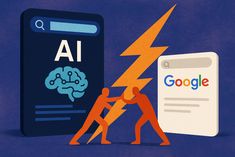
AI-Powered Search vs Traditional Search Engines: What’s Changing?

AI-Powered Search vs Traditional Search Engines: What’s Changing? The way we search for information online is undergoing one of the biggest transformations since the birth of the internet. For more than two decades, traditional search engines have been our gateway to the digital world. Whether we wanted to find a nearby restaurant, learn a new skill, research a topic, or compare products, search engines have always been the first stop. However, the rise of Artificial Intelligence has started a new chapter in the evolution of search technology. AI-powered search is changing how users interact with information, moving beyond simply displaying links and providing direct, conversational answers. From AI assistants and chatbots to intelligent search platforms integrated into browsers and applications, the search experience is becoming faster, smarter, and more personalized than ever before. But what exactly is changing? How does AI-powered search differ from traditional search engines? And what does this shift mean for businesses, content creators, and everyday users? Let’s explore. Understanding Traditional Search Engines Traditional search engines have dominated the internet for years. Their primary purpose is to help users discover relevant web pages based on keywords entered into a search box. When a user searches for something like “best laptops for students,” the search engine scans its index of billions of web pages and returns a list of links ranked according to relevance and authority. This process generally involves: Crawling websites Indexing content Ranking pages Displaying search results The user then clicks through multiple links to find the information they need. Traditional search has been highly effective because it provides access to a vast amount of information. However, it often requires users to visit several websites before finding a complete answer. For simple questions, this process may feel inefficient in today’s fast-paced digital environment. What Is AI-Powered Search? AI-powered search represents a significant evolution in information retrieval. Instead of simply presenting a list of links, AI search systems understand user intent, analyze context, and generate direct answers in natural language. These systems use advanced technologies such as: Natural Language Processing (NLP) Machine Learning Large Language Models (LLMs) Contextual Understanding Generative AI When users ask a question, AI-powered search can provide a summarized response, explain concepts, compare options, and even engage in follow-up conversations. For example, instead of searching: “Best smartphones under ₹30,000” Users can ask: “Which smartphone under ₹30,000 has the best camera and battery life for daily use?” An AI-powered system can analyze the query, understand the requirements, and provide a tailored recommendation instantly. This conversational approach makes information discovery significantly more intuitive. The Biggest Differences Between AI Search and Traditional Search Although both approaches aim to help users find information, they operate very differently. 1. Links vs Direct Answers Traditional search engines primarily provide lists of relevant links. Users must browse multiple websites to gather information and form conclusions. AI-powered search, on the other hand, often delivers a complete answer directly within the search interface. This reduces the need to open multiple tabs and saves valuable time. 2. Keyword Matching vs Intent Understanding Traditional search heavily relies on keywords. While modern search engines have become better at understanding language, keyword relevance remains a major factor. AI-powered search focuses more on understanding intent. It analyzes the meaning behind the query rather than just matching keywords. This allows users to ask questions naturally without worrying about specific search terms. 3. Static Results vs Conversational Interaction Traditional search results are generally static. If users need clarification, they must perform additional searches. AI-powered search creates an interactive experience. Users can ask follow-up questions, request explanations, or refine their search without starting over. This makes information gathering more efficient and user-friendly. 4. Information Gathering vs Information Synthesis Traditional search presents information from multiple sources. Users are responsible for reading and synthesizing the content. AI search performs much of this work automatically by combining information from various sources and presenting it in a summarized format. This significantly reduces research time. 5. One-Size-Fits-All vs Personalized Experiences AI systems can adapt responses based on context, previous interactions, and user preferences. This creates a more personalized experience compared to traditional search methods that often display similar results for everyone. Why AI-Powered Search Is Gaining Popularity The rapid adoption of AI search is not happening by accident. Several factors are driving this shift. Faster Access to Information Modern users expect instant answers. AI-powered search reduces the number of steps needed to find information, improving efficiency. Instead of reading multiple articles, users receive concise responses immediately. Better Understanding of Complex Queries People often struggle to find the right keywords when using traditional search. AI-powered systems understand natural language, making searches more intuitive. Users can communicate as if they were speaking to another person. Enhanced Productivity Professionals, students, researchers, and businesses are increasingly using AI search tools to accelerate workflows. Tasks that once required hours of research can now be completed in minutes. Improved User Experience The conversational nature of AI search creates a more engaging experience. Rather than searching repeatedly, users can refine questions naturally and receive increasingly relevant responses. How AI Search Is Impacting Businesses The shift toward AI-powered search is creating both opportunities and challenges for businesses. Changing SEO Strategies For years, businesses have optimized content to rank highly on search engine results pages. As AI search becomes more common, SEO strategies are evolving. Content creators now need to focus on: Answering user questions clearly Providing valuable insights Demonstrating expertise Creating trustworthy content Structuring information effectively High-quality content is becoming more important than ever. Increased Importance of Authority AI systems prioritize reliable and authoritative information. Businesses that consistently publish accurate, informative, and credible content are more likely to gain visibility. Building trust is becoming a competitive advantage. New Opportunities for Brand Visibility Although AI-generated answers may reduce clicks to websites in some cases, they also create opportunities for brands to be cited as trusted sources. Businesses that produce valuable content can strengthen their authority and reach broader audiences. Challenges Facing AI-Powered Search Despite

Scroll to Top