threat detection

Artificial Intelligence, cybersecurity, Technology & Innovation

The Double-Edged Sword: How Artificial Intelligence is Rewriting the Rules of Cybersecurity

The Double-Edged Sword: How Artificial Intelligence is Rewriting the Rules of Cybersecurity We live in a world where our lives are fundamentally digital. From the photos of our kids stored in the cloud to the banking apps that hold our hard-earned savings, our digital footprints are massive. But behind the convenience of this connected world lies a chaotic, hidden battleground. Every single day, millions of cyberattacks are launched across the globe. Sneaky phishing emails, devastating ransomware, and massive corporate data breaches have become a regular part of our daily news cycle. For years, human security analysts were the primary defense line against these threats. But the sheer scale of the digital universe has outgrown human capacity. It’s like trying to drink from a firehose while playing a high-stakes game of Whack-A-Mole. Enter Artificial Intelligence (AI). AI has burst onto the scene as the ultimate savior for digital defense. It promises to analyze billions of data points in milliseconds, predict attacks before they happen, and patch vulnerabilities instantly. But there is a dark side to this story. The very same technology that shields us is also being weaponized by cybercriminals. Let’s dive deep into the fascinating, slightly terrifying, and incredibly fast-moving world of Artificial Intelligence in cybersecurity. We will explore how it works, how the bad guys are abusing it, and what the future holds for human defense teams. Part 1: Why Traditional Cybersecurity is Failing To truly appreciate why AI is a game-changer, we first have to understand why our old ways of doing things are falling apart. Traditionally, cybersecurity relied on something called signature-based detection. Think of it like a digital “Most Wanted” poster. When a security company discovered a new virus, they isolated its unique digital signature (a specific piece of code) and added it to a database. Your antivirus software would scan your computer, look for that specific signature, and block it if found. For a long time, this worked decently well. But it has two massive, fatal flaws: The “Zero-Day” Problem: Signature-based systems can only catch threats that have been seen before. If a hacker writes a brand-new piece of malware that isn’t in the database yet—known as a “Zero-Day” attack—the traditional software is completely blind to it. Alert Fatigue: Modern companies generate millions of security logs every day. Traditional software flags anything even slightly unusual, drowning human IT managers in a sea of alerts. When everything is a warning, nothing is a warning. Exhausted analysts inevitably miss the real, dangerous threats buried in the noise. The reality is that hackers have evolved. They move at lightning speed, changing their code dynamically to bypass traditional filters. Human beings simply cannot type, think, or react fast enough to keep up. We needed a system that doesn’t just look backward at past threats, but one that can think, adapt, and predict in real-time. Part 2: How AI Transforms Cyber Defense AI doesn’t sleep, it doesn’t get tired, and it doesn’t suffer from alert fatigue. By leveraging machine learning models, modern cybersecurity systems have shifted from a reactive stance to a proactive one. Here is exactly how AI is changing the defensive landscape. 1. Behavioral Analysis (Anomalous Activity Detection) Instead of looking for specific bad code, AI looks at behavior. It starts by learning what “normal” looks like for a specific network or user. For instance, it learns that Sarah from Accounting typically logs in from Chicago at 9:00 AM, uses Microsoft Excel, and downloads about 50 megabytes of data a day. If Sarah suddenly logs in at 3:00 AM from an IP address in eastern Europe and attempts to download 40 gigabytes of sensitive source code, the AI immediately flags it. Even if the hacker has Sarah’s valid username and password, the AI recognizes the behavior as highly anomalous and locks down the account instantly. 2. Automated Incident Response When a cyberattack hits, seconds matter. If a ransomware strain begins encrypting files on a company server at 2:00 AM on a Sunday, waiting for a human technician to wake up, check their email, drive to the office, and pull the plug could mean total devastation. AI-driven security systems can execute SOAR (Security Orchestration, Automation, and Response) playbooks. The moment an attack is detected, the AI can automatically isolate the infected computer from the rest of the network, block the malicious IP address, and preserve the data logs for investigation. It mitigates the damage in milliseconds, long before a human can even open their eyes. 3. Predictive Threat Intelligence AI excels at finding patterns in chaos. By scraping data from global security feeds, forums, and even the dark web, AI can predict where hackers are likely to strike next. It scans an organization’s public-facing infrastructure, identifies weak spots (like unpatched software), and tells the IT team precisely what they need to fix before malicious actors find it. Part 3: The Dark Side — When Hackers Use AI Technology is inherently neutral; it is defined by the intent of the person using it. Unfortunately, the exact same AI capabilities that make defenses stronger are giving cybercriminals unprecedented superpowers. We have officially entered the era of AI vs. AI warfare. Here is how the bad guys are exploiting Artificial Intelligence. 1. Hyper-Realistic Phishing and Social Engineering We all know the classic phishing email: full of terrible grammar, weird fonts, and a glaringly obvious fake link from a “Nigerian Prince” or a “bank manager” asking you to update your details. They were relatively easy to spot. Not anymore. Generative AI tools like ChatGPT have made it incredibly easy for hackers—even those who don’t speak English well—to write flawless, highly persuasive, and professionally phrased emails. Worse yet, hackers can use AI to crawl an individual’s public social media profiles (LinkedIn, Twitter, Facebook) to gather personal details. The AI can then automatically generate a highly tailored, deeply convincing email customized just for them. This is called Spear Phishing, and when powered by AI, its success rate skyrockets. 2. Deepfakes: The Next Frontier of
Cybersecurity team analyzing AI-driven cyber attack patterns, phishing threats, deepfakes, and adaptive malware risks on a digital dashboard.
cybersecurity

How Cyber Attacks Are Changing in the Age of AI

Introduction Cyber attacks have always evolved alongside technology, but AI has changed the pace and scale of that evolution. What once required skilled attackers, long preparation, and manual effort can now be partially or fully automated, allowing criminals to launch more attacks in less time. This means organizations are no longer dealing with isolated threats; they are facing industrialized cybercrime that can adapt quickly and target more victims at once. One of the biggest shifts is in social engineering. AI makes phishing messages sound more natural, personalized, and believable, which increases the chances that people will click, reply, or share sensitive information. Attackers are also using deepfake audio and video to impersonate executives, coworkers, or trusted contacts, turning identity fraud into a much more serious threat. AI is also improving the speed and precision of technical attacks. Criminals can use it to scan for vulnerabilities, optimize exploit attempts, and adjust malware behavior in real time. This makes attacks harder to stop because they can change their method as defenders respond. Another major change is that cyberattacks are becoming multi-channel. Instead of relying only on email, attackers now combine messaging apps, phone calls, collaboration tools, social platforms, and even legitimate authentication flows to reach targets. This creates a more realistic and coordinated attack path that is harder for users and security teams to recognize quickly. AI is also affecting the defensive side of security, because the same technology used by attackers can help defenders detect unusual behavior, analyze threats, and respond faster. But the overall risk is rising because attackers often move faster than organizations can adapt. As a result, cybersecurity teams are being pushed to focus more on prevention, identity verification, and resilience than on detection alone. Key changes Phishing is becoming more personalized and convincing. Deepfakes are making impersonation attacks more dangerous. Malware is becoming more adaptive and difficult to detect. Attacks are happening across more channels than email alone. Attackers are using AI to move faster than traditional defense teams. Conclusion Cyber attacks in the age of AI are faster, smarter, and more scalable than before. That means companies and individuals must become more careful about identity verification, suspicious messages, and security habits. The future of cyber defense will depend on using AI wisely, improving awareness, and building systems that can stop attacks before they spread. In this new environment, speed matters on both sides, but defense must become more proactive and resilient.extension. FAQ How is AI changing cyber attacks? AI is making attacks more automated, personalized, and difficult to detect by helping attackers create better phishing, deepfakes, malware, and multi-channel campaigns. What is the most common AI-powered attack? Phishing is one of the most common because AI can make messages sound more believable and targeted. Are deepfakes really a cybersecurity threat? Yes, deepfakes can be used to impersonate leaders, employees, or trusted contacts and trick people into sharing money or information. Can AI help defenders too? Yes, AI can help security teams detect threats, analyze patterns, and respond faster, but attackers are also using it aggressively. Why are AI attacks harder to stop? They are harder to stop because they can adapt in real time, operate across many channels, and move at machine speed. What should businesses do now? Businesses should improve employee awareness, verify identities carefully, strengthen security controls, and prepare for more advanced AI-driven threats.

Artificial intelligence network scanning for cyber threats and data protection.
Artificial Intelligence, cybersecurity

The Role of Artificial Intelligence in Cybersecurity

Introduction In a world where cyberattacks are growing more sophisticated by the day, traditional defense systems are no longer enough. Businesses, governments, and individuals face threats ranging from phishing scams to ransomware and identity theft. To combat this, Artificial Intelligence (AI) has emerged as a game-changing weapon in the field of cybersecurity. By combining machine learning (ML), predictive analytics, and automation, AI helps security teams identify, prevent, and respond to attacks — often before they occur. As per IBM’s Cost of a Data Breach Report 2025, organizations using AI-driven cybersecurity tools save an average of $3 million per breach compared to those without it. Clearly, the future of cybersecurity is AI-powered. What Is AI in Cybersecurity? Artificial Intelligence in Cybersecurity involves using algorithms and machine learning models to analyze data, detect anomalies, and automatically respond to threats. Unlike traditional security systems that rely on pre-defined rules, AI systems learn and adapt to new threats dynamically — making them ideal for handling today’s complex digital environments.     Core Functions: Real-time threat detection Automated response and mitigation Behavioral analysis Network monitoring Predictive analytics Why AI Is Essential in Cybersecurity Traditional cybersecurity relies on human experts and static rule-based systems. However, with billions of daily data points and evolving attack patterns, humans alone can’t keep up. AI brings: Speed: Instantly processes large datasets to identify threats. Accuracy: Reduces false positives compared to manual analysis. Scalability: Monitors thousands of endpoints simultaneously. Adaptability: Learns from new data and evolving attacks. AI acts as a force multiplier — enhancing human intelligence rather than replacing it. Key Applications of AI in Cybersecurity 1. Threat Detection and Prediction AI systems analyze historical attack data to predict potential threats. By learning patterns, AI can detect zero-day vulnerabilities that traditional systems might miss. Example: Darktrace uses AI to continuously learn an organization’s network behavior and identify anomalies in real-time. 2. Behavioral Analytics AI monitors user and system behavior to detect suspicious activities such as unauthorized access or data transfers. Example: If an employee’s account suddenly downloads huge amounts of data at odd hours, AI can flag and isolate that activity. 3. Automated Incident Response AI can automate the initial response to threats — such as isolating infected devices or blocking suspicious IP addresses — reducing the time between detection and action. Example: SOAR (Security Orchestration, Automation, and Response) platforms use AI to streamline security workflows. 4. Phishing and Email Security Machine learning models analyze email content, sender patterns, and URLs to detect phishing attacks before they reach users’ inboxes. Example: Google’s Gmail AI blocks over 100 million phishing emails daily using ML filters. 5. Malware Detection AI-powered systems can detect new malware strains by studying code structure and execution patterns — even if the malware hasn’t been seen before. Example: Cylance uses AI models trained on millions of malicious files to predict threats in real-time. 6. Network Security and Monitoring AI helps track massive network traffic volumes, identifying abnormalities that might signal cyberattacks like DDoS (Distributed Denial of Service). Example: AI tools detect unusual spikes in network activity and alert administrators instantly. 7. Fraud Detection Banks and e-commerce companies use AI to analyze user transactions and detect fraudulent behavior. Example: Mastercard’s Decision Intelligence uses AI to evaluate transaction risks within milliseconds.  Advantages of Using AI in Cybersecurity Advantage Impact Speed & Efficiency Real-time threat detection and mitigation Improved Accuracy Fewer false alarms and better prioritization Cost Reduction Reduced operational costs and data breach impact Predictive Capabilities Prevents attacks before they occur 24/7 Monitoring Continuous protection without downtime Adaptive Learning Evolves with emerging cyber threats Challenges and Limitations While AI offers immense potential, it’s not without challenges. 1. Adversarial AI Attacks Hackers use AI to create smarter malware or bypass security systems by mimicking legitimate behavior. 2. High Implementation Costs Building and training AI models require significant investment in infrastructure and expertise. 3. False Positives Poorly trained AI systems may still misclassify safe activities as threats, leading to unnecessary alerts. 4. Data Privacy Concerns AI models need large datasets to train — which sometimes include sensitive user data. 5. Skill Gap The shortage of AI and cybersecurity professionals makes it difficult for many organizations to deploy AI effectively. The Future of AI in Cybersecurity The next era of cybersecurity will be autonomous, predictive, and intelligent. Key Trends to Watch: AI + Blockchain Integration: For tamper-proof data verification. Quantum AI Security: Defending against quantum computing-based attacks. Self-Healing Systems: Networks that can automatically detect, isolate, and repair vulnerabilities. Edge AI: Real-time protection for IoT and edge devices. AI-driven Cyber Threat Intelligence (CTI): Collaborative global databases for predictive defense. By 2030, AI will be the central pillar of all major cybersecurity infrastructures — empowering organizations to respond to threats faster than hackers can act. Real-World Case Studies IBM Watson for Cybersecurity Uses natural language processing and machine learning to analyze millions of security reports, helping security teams make faster decisions. Capital One Implements AI to monitor billions of transactions in real time, protecting customers from credit card fraud and identity theft. Healthcare Networks Hospitals use AI-based security tools to protect sensitive patient records and detect ransomware attacks. Conclusion The rise of Artificial Intelligence has redefined the battle against cybercrime. From predictive threat detection to automated defense mechanisms, AI enables businesses to stay one step ahead of hackers. As digital transformation accelerates, the fusion of AI and cybersecurity will become the cornerstone of trust and resilience in the online world. However, with great power comes responsibility — ensuring AI is used ethically, transparently, and securely will be crucial for a safer digital future. In short, AI is not just defending the digital world — it’s redefining it. FAQs 1. How is AI used in cybersecurity?AI analyzes patterns, detects anomalies, and automates responses to identify and mitigate cyber threats in real time. 2. Can AI prevent cyberattacks completely?AI reduces risks and improves detection, but human oversight remains essential for complex decision-making. 3. What are the main benefits of AI in cybersecurity?Faster detection, improved accuracy,

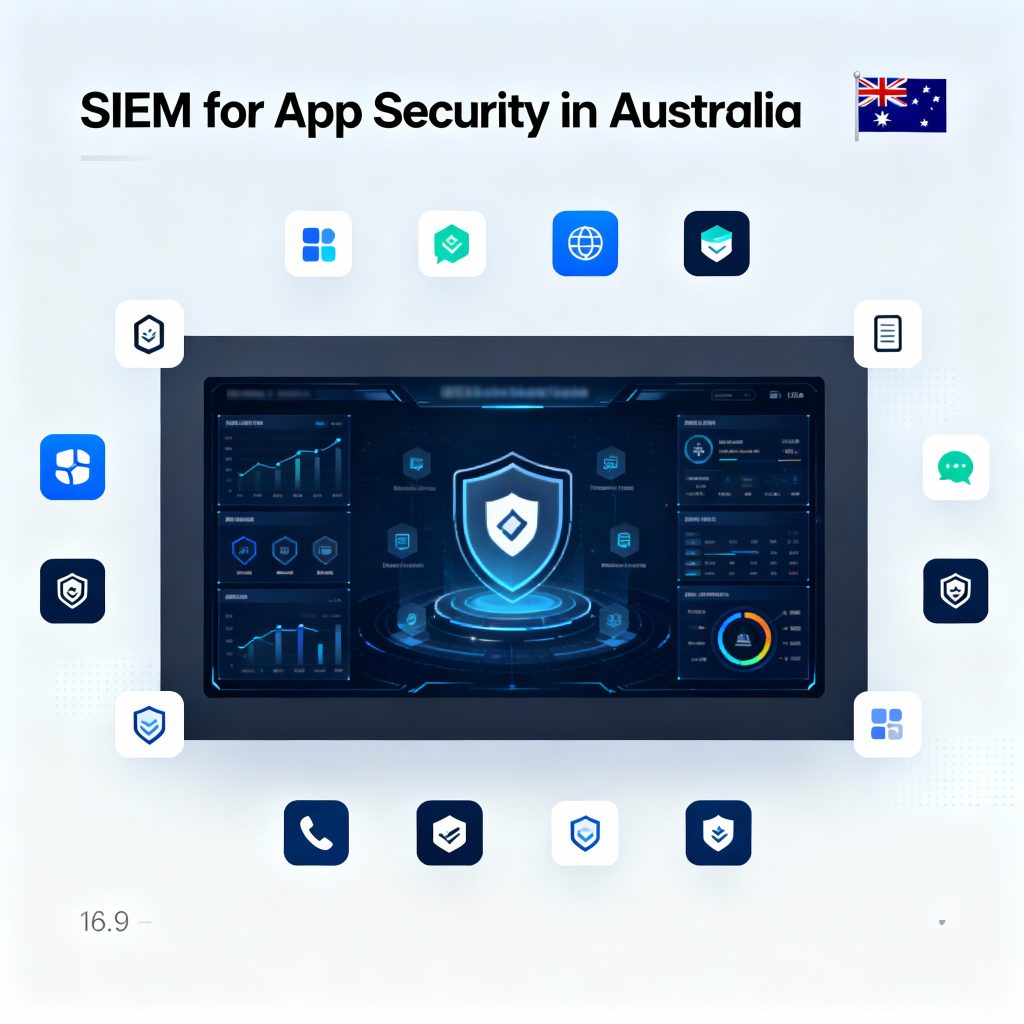
Futuristic SIEM dashboard interface overlayed with application security icons and the Australian flag, representing application security solutions for Australia
Artificial Intelligence

SIEM for App Security in Australia

Introduction Organisations in Australia are grappling with a rapidly evolving cyber threat landscape where application-layer attacks are more frequent and far-reaching than ever before. As digital infrastructures grow more complex and interconnected, security teams need efficient solutions to detect, investigate, and respond to threats targeting their applications. Security Information and Event Management (SIEM) platforms have emerged as a vital line of defense, providing both real-time visibility and advanced analytics to help businesses stay ahead of attackers. This blog explores why SIEM has become indispensable for Australian organisations seeking robust application security—and how it serves as a strategic weapon against the next generation of threats.​ SIEM for App Security in Australia How SIEM Protects Modern Applications Centralised Log Management: SIEM consolidates logs from across your entire stack—web apps, APIs, databases, and cloud services—transforming fragmented data into one coherent intelligence stream.​ Real-Time Threat Detection: Automated monitoring and correlation engines analyse events at scale, detecting suspicious behaviours and potential breaches before they escalate.​ Incident Response Enablement: SIEM alerts analysts to actionable threats, allowing them to prioritise and respond quickly, preventing damage and downtime.​ Compliance Support: With Australia’s data privacy regulations and the Security of Critical Infrastructure Act, SIEM helps organisations maintain auditable records and meet regulatory requirements efficiently.​ Key Benefits Early Breach Identification: By connecting seemingly minor events, SIEM unmasks coordinated attacks—like credential-stuffing or API abuse—that could remain undetected in siloed systems.​ Streamlined Security Operations: Automating event triage and investigation reduces the manual workload for security professionals and accelerates incident remediation.​ Integration with SOAR: Many SIEM platforms now work alongside Security Orchestration, Automation, and Response (SOAR) tools, further improving response times and consistency.​ SIEM in the Australian Security Landscape Australian businesses face increasingly complex and sophisticated attacks, prompting widespread adoption of SIEM solutions. According to recent market analysis:​ Growth Driven by Compliance and Threats: Demand for SIEM is surging as organisations strive to comply with the Australia Cyber Security Strategy and protect critical infrastructure, especially in sectors like BFSI, IT, and government.​ Rise of AI and Automation: Modern SIEM systems leverage artificial intelligence and machine learning to detect threats and automate responses, addressing the skills shortage and increasing detection accuracy.​ Operational Challenges: Integrating SIEM with legacy infrastructures, managing the volume of security data, and controlling costs remain significant hurdles for Australian businesses.​ Use Cases & Statistics Essential Eight Maturity: SIEM is a cornerstone for achieving the Australian Signals Directorate’s Essential Eight maturity model, translating to better preparedness and faster detection.​ Incident Response Uptake: 86% of Australian entities had an active incident response plan in 2024, showing a maturing industry that sees SIEM as critical to readiness.​ Market Outlook: The SIEM market in Australia is set for robust growth, fueled by both enterprise and SME adoption, as real-time detection and actionable security analytics become business imperatives.​ Conclusion SIEM has become a non-negotiable pillar for application security in Australia’s cyber threat environment. By centralising log data, delivering advanced analytics, and supporting compliance, SIEM empowers organisations to defend against evolving threats efficiently and confidently. Investing in SIEM today means not just meeting regulatory demands, but enabling your team to spot sophisticated attacks much earlier—and respond faster. As cyber risks grow, the question is not if, but how soon your organisation will face them. Make SIEM the cornerstone of your cyber strategy and stay a step ahead. Ready to take your application security to the next level? Explore advanced SIEM platforms or consult with a cybersecurity expert to start protecting your business today! FAQ 1. What is SIEM and why is it important for Australian businesses? SIEM stands for Security Information and Event Management—a platform to collect, analyse, and correlate security data in real-time, crucial for early threat detection and regulatory compliance.​ 2. How does SIEM help meet Australian compliance standards? SIEM provides auditable logs, automated reporting, and breach detection, helping organisations comply with regulations like the Privacy Act and Security of Critical Infrastructure Act.​ 3. What kinds of threats can SIEM detect in applications? SIEM detects credential stuffing, API abuse, insider threats, and targeted cyber-attacks by correlating anomalous events across application layers.​ 4. Are SIEM platforms suitable for both large enterprises and SMEs? Yes, both large enterprises and small-to-medium businesses are increasingly adopting SIEM to strengthen their security posture and compliance readiness.​ 5. What trends are shaping SIEM adoption in Australia? AI-powered analytics, automation, and integration with SOAR are top trends, addressing complexity and improving response speeds in the face of rising threats.

Scroll to Top