
scalable AI solutions

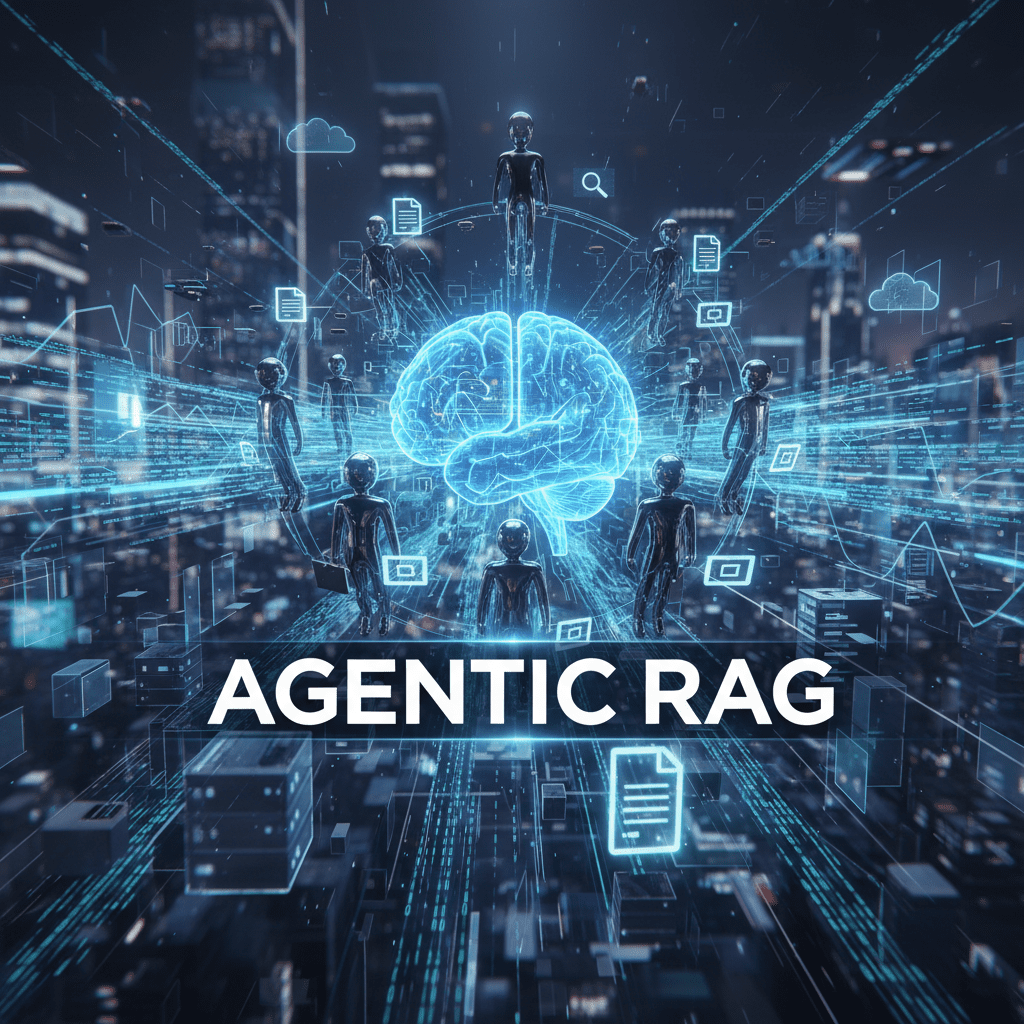
Futuristic business illustration showing a central AI brain connected to digital agent nodes and data streams, with document icons symbolizing smart retrieval. Bold title reads 'Agentic RAG
React native doveploment

Agentic RAG

Introduction Agentic RAG is transforming the way organizations approach information retrieval, research, and automation by combining the power of retrieval-augmented generation (RAG) with intelligent, autonomous agents. This advanced AI framework empowers systems to reason, plan, use external tools, and learn over time, resulting in highly accurate and context-aware outputs. As modern enterprises face exponential growth in data, agentic RAG offers new ways to access reliable information, automate workflows, and create advanced virtual assistants—ushering in a new era of scalable, adaptive business intelligence. What Is Agentic RAG? Agentic RAG merges retrieval-based AI models with generative language models, empowered by autonomous agents that go beyond static query matching. Agents can decide what information to retrieve, break down complex queries into sub-tasks, access external APIs, and synthesize data for comprehensive responses. Unlike classic RAG, agentic RAG adapts to new data and context dynamically, leveraging iterative planning and feedback to continually improve output quality. Key Features: Autonomous decision-making and reasoning Multi-step planning and query decomposition Dynamic retrieval from diverse sources (databases, APIs, knowledge bases) Enhanced accuracy, efficiency, and real-time adaptability Continual learning and context management Types of Agentic RAG Agentic RAG systems employ several types of agents based on function and complexity: Routing Agent: Directs queries to the most suitable RAG pipeline, using agentic reasoning to analyze tasks such as document summarization or question answering. One-Shot Query Planning Agent: Breaks queries into independent sub-queries, executes them in parallel, and synthesizes unified answers. Tool Use Agent: Integrates external tools and APIs for real-time or specialized data, enhancing generative responses. ReAct Agent (Reason + Act): Iteratively reasons and interacts with multiple sources or tools, adapting its approach mid-task for the most precise result. Dynamic Planning & Execution Agent: Manages multi-step and complex workflows, separating long-term plans from immediate execution. Utilizes computational graphs and orchestrates stepwise execution. Applications in Real-World Scenarios Agentic RAG offers transformative benefits across industries: Enterprise Knowledge Management: Streamlines access to organizational data, enabling employees to make fast, informed decisions. Automated Support & Virtual Assistants: Reduces workloads by providing instant, context-relevant answers in customer and employee support. Healthcare: Improves patient insights and research capabilities with agents that gather and contextualize medical knowledge. Legal Research & Finance: Accelerates analysis of documents, regulations, and market data with agents capable of domain-specific data synthesis. Innovation & Research: Assists in synthesizing ideas, comparing multiple sources, and driving strategic initiatives through intelligent information retrieval. How To Implement Agentic RAG Follow these steps for building an agentic RAG system: Define Objectives: Identify tasks suitable for agentic RAG, such as chatbots or automated research. Choose Core Components: Select a retrieval system (e.g., dense passage retrieval, hybrid search) and a generative AI model (e.g., GPT, BERT). Prepare Data: Collect, clean, and preprocess documents to ensure compatibility and maximize retrieval accuracy. Build the Retrieval Layer: Index documents for fast, context-aware search. Agent Integration: Introduce agents to orchestrate workflows—query planning, tool use, and multimodal integration. Fine-Tune & Feedback Loops: Continuously refine models with user feedback and retraining to maintain high performance. Deploy & Monitor: Set up APIs, real-time monitoring, and performance dashboards for ongoing optimization. Key Tools: LlamaIndex and LangChain for agent orchestration, reasoned workflows, and tool integration. Low-code platforms like ZBrain for business workflows and rapid issue response. Conclusion Agentic RAG is redefining the landscape of AI-driven knowledge management, automating complex information retrieval, and powering scalable enterprise solutions. Its combination of multi-agent intelligence, context-awareness, dynamic adaptation, and modular flexibility gives organizations the tools to succeed in an information-rich, rapidly evolving market. Unlock the power of agentic RAG to supercharge research, virtual assistants, and automated decision-making. Call-to-Action: Explore how agentic RAG can optimize workflows and revolutionize information access—connect with AI experts today to get started on a future-ready solution! FAQ What is Agentic RAG? Agentic RAG is a framework that empowers AI agents to retrieve and use external information, plan multi-step workflows, and generate intelligent, context-aware responses far beyond classic RAG capabilities. How does it differ from traditional RAG? Agentic RAG adds autonomous reasoning, multi-task orchestration, and external tool use—enabling more accurate and adaptable information synthesis. What are the main benefits for enterprises? Benefits include scalable automation, enhanced data accuracy, personalized user experiences, and efficiency with reduced costs and improved decision quality. What are common implementation challenges? Challenges involve complex system integration, managing data quality, ensuring scalability, and maintaining real-time performance. Which platforms support agentic RAG development? Popular frameworks are LlamaIndex, LangChain, and low-code platforms like ZBrain, offering flexible workflow design and seamless data integration. The Real Benefits of Hiring a React Native App Development Company
data science

Top 7 Myths About Predictive Analytics That Are Holding Businesses Back

Introduction Predictive analytics has emerged as a transformative technology for businesses across industries today. Leveraging data, algorithms, and machine learning, predictive analytics helps organizations forecast trends, optimize operations, reduce risk, and deliver personalized experiences. However, despite its proven benefits, many business leaders and decision-makers hesitate to fully embrace predictive analytics due to prevalent myths and misconceptions. These myths introduce fear, uncertainty, and resistance that hold businesses back from unlocking the full potential of their data and AI investments. Understanding and debunking these misconceptions is essential to harness predictive analytics genuinely. This extensive blog will cover the top 7 myths about predictive analytics that stall business growth, explain why they are false, and provide actionable insights to overcome them. By demystifying these barriers, businesses can accelerate innovation, improve ROI, and stay competitive in an AI-driven world. Myth 1: Predictive Analytics Requires Massive Data Sets to Be Effective A common myth is that predictive analytics only works if an organization has an enormous volume of data. Many companies, especially small and medium businesses, assume they cannot benefit from predictive models because they do not operate at “big data” scale. Why This Myth is False Predictive analytics models can work effectively even on small to medium-sized, high-quality data sets. Advanced techniques like transfer learning and synthetic data generation help create accurate models with less data. Data preprocessing, feature engineering, and domain expertise significantly influence model performance more than raw data volume. Tools and platforms today (including those with backend support from providers like TechOTD AI solutions) enable democratized access to predictive analytics for businesses of all sizes. Overcoming the Myth Focus on data quality, relevance, and proper feature selection rather than merely increasing quantity. Start small with pilot projects and scale as you validate results. Myth 2: Predictive Analytics Replaces Human Decision-Making Many fear that predictive models will diminish the role or importance of human judgment in business decisions. This myth creates resistance, especially among executives and operational teams. Why This Myth is False Predictive analytics is a decision-support tool designed to augment human intuition, not replace it. Models provide data-driven insights and risk assessments, but final decisions require human oversight considering context and ethics. Collaborative intelligence combining AI and human expertise leads to better accuracy, accountability, and trust. Case studies from industries like finance and healthcare, detailed in this article on LLM applications in finance, show human-in-the-loop systems outperform fully automated decisions. Embrace the Tool Use predictive analytics to enhance decision speed and quality but maintain transparent human review for critical judgments. Myth 3: Predictive Analytics Is Too Expensive and Complex for Most Businesses Another misconception is that predictive analytics implementation demands prohibitively high costs, complex infrastructure, and specialized AI talent—making it inaccessible to all but the largest enterprises. Why This Myth is False The rise of cloud-based AI platforms, APIs, and pre-built models has drastically reduced the cost and complexity barriers. Businesses can leverage low-code and no-code predictive analytics solutions that require minimal technical expertise. Cloud providers like AWS, Azure, and Google Cloud enable pay-as-you-go services to optimize investments. Consulting experts, such as those offered by TechOTD’s AI consulting and development, help companies plan feasible roadmaps tailored for budgets and scale. Open-source tools and online communities foster skills development and shared resources. Making it Cost-Effective Start with targeted use cases offering clear ROI, then expand capabilities over time. Adopt incremental build-test-learn cycles. Myth 4: Predictive Analytics Can Guarantee 100% Accurate Predictions Some organizations expect predictive analytics to replace uncertainty with certainty, promising flawless forecasts. This unrealistic expectation leads to disappointment and mistrust when models inevitably have errors. Why This Myth is False Predictions are probabilistic, not deterministic. Models provide likelihoods and risk assessments, not certainties. Accuracy depends on data quality, model choice, and constantly updated inputs. The business value often lies in improved risk management and informed decision-making, not perfect outcomes. Prediction intervals, confidence scores, and scenario simulations reflect inherent uncertainty effectively. Real-world cases reviewed in predictive analytics software development guide underline setting practical expectations. Manage Expectations Educate teams on probabilities and uncertainties, and use models as one input among many to support decisions. Myth 5: Predictive Analytics Is Only for Large Enterprises and Specific Industries A common belief is that only large companies or specific sectors like finance or retail gain benefits from predictive analytics. Why This Myth is False Predictive analytics benefits businesses of every size and sector, including healthcare, education, manufacturing, and beyond. Use cases include demand forecasting, customer churn prediction, equipment maintenance, fraud detection, and personalized marketing. SMEs readily adopt predictive tools to optimize supply chain, improve customer experience, and reduce operational costs. Resources such as TechOTD’s blog industry insights showcase diverse industry use cases. Explore Your Industry Use Cases Identify pain points where predictive analytics applies to your context and explore affordable tools. Myth 6: Predictive Analytics Tools Are Plug-and-Play – No Expertise Needed There is a misconception that predictive analytics tools are simple plug-and-play solutions that instantly generate valuable insights without domain knowledge or expertise. Why This Myth is False While tools increasingly automate workflows, building reliable models requires domain expertise, data science skills, and continuous refinement. Understanding business context, data nuances, and model limitations is critical. Collaborative teams of business analysts, data scientists, and IT specialists ensure relevant and ethical application. Partnership with experienced solution providers like TechOTD’s custom AI model development guarantees expertise-backed deployments. Invest in Skills and Process Develop in-house capabilities or engage trusted experts to translate analytics outputs into strategic business actions. Myth 7: Predictive Analytics Does Not Need Continuous Monitoring or Updating Some businesses deploy predictive models once and expect them to work indefinitely without ongoing maintenance or improvement efforts. Why This Myth is False Predictive models degrade over time as data patterns, customer behavior, and external factors evolve. Continuous monitoring, retraining, and validation ensure models stay accurate and relevant. Dynamic updating supports adaptation to new market conditions, regulations, or operational changes. Robust governance frameworks covering data privacy, compliance, and ethical AI maintain trust and legal adherence (see AI ethical considerations). Ongoing support services, such as those offered by TechOTD, cover continuous improvement and risk mitigation. Plan for Lifecycle Management Integrate monitoring and governance into predictive analytics strategy from the start for sustainable

Scroll to Top