

Multi-Agent Systems

Artificial Intelligence, Software development

Beyond the Chatbot: How Agentic AI and Multi-Agent Workflows Are Quietly Replacing Software Rules

Beyond the Chatbot: How Agentic AI and Multi-Agent Workflows Are Quietly Replacing Software Rules For the past few years, our relationship with Artificial Intelligence has felt like a very advanced game of text tennis. You type a prompt, the AI spits out an answer. You ask it to write an email, it gives you a draft. You ask it to find a bug in your Python script, it points it out. But at the end of the day, you are still the project manager. You have to copy the email, paste it into your Outlook, fill in the recipient’s name, and hit send. You have to take that fixed code, paste it back into your development environment, run the test suite, and deploy it to the server. The AI is just an advisor trapped inside a browser tab. That era is officially ending. We are living through a massive, silent paradigm shift in technology. The industry is moving away from conversational AI and sprinting toward Agentic AI. Instead of waiting around for your next prompt, Agentic AI systems are designed to think, plan, use digital tools, and execute complex, multi-step workflows completely on their own. They don’t just answer your questions; they accomplish your goals. Let’s pull back the curtain on this next evolutionary leap of software. We will explore what Agentic AI actually is, how “multi-agent networks” work under the hood, and how this technology is completely rewriting the rules of software development, business operations, and the future of human productivity. Part 1: What Exactly is Agentic AI? To understand Agentic AI, it helps to look at the short history of how we got here. Early AI systems were predictive—they looked at data and told you what might happen next (like your Netflix recommendations). Then came Generative AI, which took the world by storm by creating new content based on user prompts. Agentic AI takes that underlying generative power and gives it agency—the ability to act autonomously within an environment to achieve a specific objective. If traditional generative AI is an exceptionally smart textbook, an Agentic AI is an autonomous intern. The Core Pillars of an AI Agent A true AI agent isn’t just an LLM wrapped in a sleek user interface. To be truly “agentic,” a system must possess four distinct characteristics: Autonomy: Once you give it a high-level goal, it determines the necessary steps to achieve it without requiring constant human “next” commands. Goal-Orientation: It understands the desired final state and can measure its own progress toward that target. Tool Utilization: It knows how to interface with the digital world. It can read and write to databases, make API calls, browse the web, open software applications, and even modify files on a server. Reflection and Adaptation: If an agent encounters an error (like an API returning a 404 error), it doesn’t just crash. It looks at the failure, changes its strategy, and tries an alternative path to finish the job. A Simple Real-World Comparison: Generative AI: You ask, “Write an itinerary for a 5-day trip to Tokyo.” The AI lists popular tourist spots. Agentic AI: You say, “Book me a 5-day trip to Tokyo under $2,000 that aligns with my Google Calendar, favors boutique hotels, and uses my airline miles.” The agent checks your calendar, logs into flight portals via APIs, compares hotel locations against transit maps, filters for your budget, presents you with the optimal choice, and books it when approved. Part 2: The Magic of Multi-Agent Workflows While a single autonomous AI agent is powerful, the real magic happens when you bring multiple agents together into a coordinated ecosystem. This is known as a Multi-Agent System (MAS) or a multi-agent workflow. Think about how human organizations operate. You don’t have one single person who handles product design, backend engineering, sales, legal compliance, and customer support. If they tried, they would be incredibly mediocre at all of them. Instead, you break complex problems down and assign them to specialized roles. Multi-agent architecture does the exact same thing with software. ┌────────────────────────────────────────────────────────┐ │ Multi-Agent Dev Workflow │ ├────────────────────────────────────────────────────────┤ │ [Product Manager Agent] ──> Outlines requirements │ │ │ │ │ ▼ │ │ [Software Engineer Agent] ──> Writes the code │ │ │ │ │ ▼ │ │ [QA Tester Agent] ──> Finds bugs & sends back │ │ │ │ │ ▼ │ │ [DevOps Agent] ──> Deploys to live server │ └────────────────────────────────────────────────────────┘ In a multi-agent system, a single prompt kicks off a chain reaction of specialized agents talking to one another: The Coordinator Agent: Receives the user request, breaks it into smaller sub-tasks, and assigns them to specialized agents. The Research Agent: Scours internal databases, documentation, and the internet to collect factual context. The Execution Agent: Takes the research and actually builds the asset, whether that’s writing a chunk of Java backend code or creating a marketing campaign. The Critic/QA Agent: Acts as an internal quality filter. It reviews the work of the Execution Agent, checks for security vulnerabilities or syntax errors, and sends it back for revisions if it doesn’t meet the project benchmarks. By separating concerns, these systems reduce the “hallucination” rates that plague single LLMs. Because each agent has a narrow focus and a dedicated set of rules, the entire system becomes drastically more reliable, precise, and scalable. Part 3: How It Redefines Software Development For developers, students, and engineers, Agentic AI is radically shifting the day-to-day experience of writing code. For decades, software development has been explicitly imperative. You write strict, line-by-line logical instructions: If X happens, do Y. If Z happens, loop through this array. If you miss a semicolon, the whole house of cards falls down. With Agentic systems, we are moving toward declarative engineering. You describe the what, and the agentic system figures out the how. Automated Code Maintenance and Refactoring Imagine a large enterprise codebase with thousands of legacy components written years ago. Upgrading that system to use modern frameworks is usually a miserable, months-long chore for
Artificial Intelligence, Digital Transformation, Educational Technology

AI Workflow Automation for Enterprises

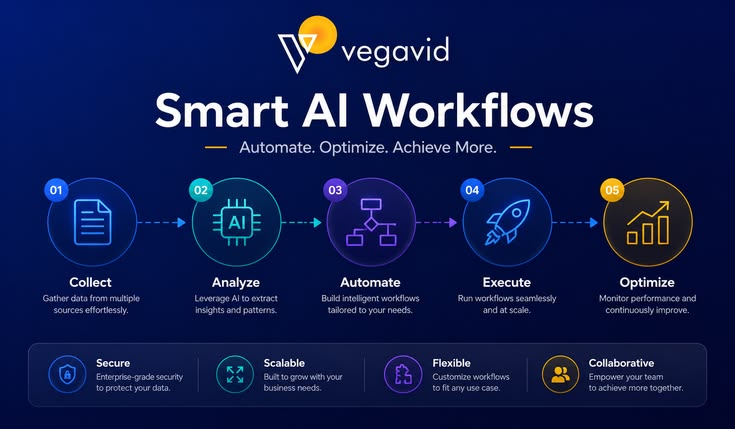
AI Workflow Automation for Enterprises: The Ultimate Blueprint for Scalable Digital Transformation (2026) The global corporate landscape has decisively moved past the experimental phase of artificial intelligence. Today, the core operational differentiator between market leaders and lagging firms isn’t just the adoption of AI—it’s orchestration. Enterprises are no longer looking for isolated AI chatbots to summarize emails. Instead, they are demanding end-to-end AI Workflow Automation: complex, self-healing, multi-agent systems that integrate with legacy infrastructure, automate decision-making pipelines, and fundamentally redefine human-machine collaboration. This comprehensive guide serves as an enterprise-grade blueprint for tech executives, operations leaders, and digital transformation architects looking to deploy scalable AI automation across their organizational fabric. 1. Defining Enterprise AI Workflow Automation To build an effective automation strategy, we must first distinguish modern AI workflow automation from legacy systems. For over a decade, Robotic Process Automation (RPA) served as the backbone of operational efficiency. RPA excels at deterministic, rule-based tasks: “If data arrives in Form A, copy it exactly into Field B.” However, the moment a user submits an unformatted invoice, an unexpected error code pops up, or an email contains nuanced human emotion, traditional RPA breaks down. +———————————————————————–+ | THE AUTOMATION EVOLUTION | +———————————————————————–+ | LEGACY RPA | MODERN AI | | “Deterministic & Rigid” | “Probabilistic & Adaptive” | | • Rule-bound execution | • Contextual understanding | | • Breaks on unstructured data| • Learns from edge cases | | • Requires static formats | • Handles text, voice, and video | +———————————————————————–+ Modern Enterprise AI Automation shifts the paradigm from deterministic to probabilistic. Backed by Large Language Models (LLMs), vision systems, and specialized embedding models, these workflows possess cognitive context. They don’t just move data; they comprehend data, make judgment calls based on corporate playbooks, learn from edge cases, and seamlessly pass control to human supervisors when structural thresholds are crossed. 2. The Architecture of an Automated AI Workflow An enterprise-grade AI workflow is rarely built on a single, isolated prompt. It is a layered, multi-component architecture engineered to maximize accuracy, data security, and execution speed. Layer 1: Data Ingestion and Semantic Parsing Every automated pipeline begins with data. The ingestion layer utilizes advanced optical character recognition (OCR), speech-to-text engines, and computer vision to ingest unstructured assets—such as raw PDFs, audio recordings of client calls, complex internal spreadsheets, or customer emails—and normalize them into structured JSON schemas. Layer 2: Vector Infrastructure and Corporate Memory To prevent the underlying models from hallucinating or losing track of corporate standards, workflows use Retrieval-Augmented Generation (RAG) systems tied to low-latency vector databases. When a new transaction or support ticket enters the pipeline, the system extracts semantic embeddings, queries the vector infrastructure for relevant corporate historical data, and constructs a highly contextual prompt. Layer 3: The Multi-Agent Orchestration Core Instead of relying on one massive, generalized AI model to handle an entire process, modern architectures break workflows down into discrete, specialized AI Agents. [Ingested Customer Ticket] | v +——————————+ | Orchestrator Agent | +——————————+ / | \ +————————+ | +————————-+ | v | +———————–+ +——————–+ +———————–+ | Data Extraction Agent | | Legal Compliance | | Quality Assurance | | | | Agent | | Agent | +———————–+ +——————–+ +———————–+ | | | +————————+ | +————————-+ \ | / v +——————————+ | Final Response / Action | +——————————+ The Orchestrator Agent: Receives the inbound payload, analyzes intent, and maps out an execution plan. The Specialist Agents: Micro-tuned models dedicated to singular tasks. For example, in an insurance claims pipeline, one agent extracts medical billing codes, a second agent cross-references the claim against policy terms, and a third agent checks for historical patterns of fraud. The Critic/Validator Agent: A separate model designed specifically to stress-test the output of the specialist agents against strict regulatory constraints before any action is committed. Layer 4: System Integration and Actuation (Tool Use) An AI that can only output text is a passive advisor. True automation requires action. Through unified API gateways, enterprise AI frameworks interact directly with core business software: writing data directly into SAP ERP systems, updating customer records in Salesforce, or pushing alerts to Microsoft Teams and Slack. 3. High-Impact Enterprise Use Cases While AI automation can be applied universally, organizations see the fastest, highest-margin returns on investment (ROI) by targeting data-heavy, communication-intensive friction points. A. Supply Chain Logistics and Vendor Management The Friction Point: Managing thousands of global vendor invoices, bills of lading, customs declarations, and shifting spot-market price quotes. The AI Automation Solution: An autonomous agent continually monitors shared procurement inboxes. When an invoice arrives, the agent automatically extracts line items, matches them against existing purchase orders (POs) within Oracle or NetSuite, verifies customs compliance documentation via RAG, flags discrepancies to a human logistics manager, and pre-approves flawless entries for payment execution. B. Legal and Financial Compliance Auditing The Friction Point: Reviewing multi-hundred-page commercial contracts, loan applications, or regulatory fillings for subtle non-compliance risks. The AI Automation Solution: Legal teams deploy specialized analysis pipelines where contracts are run through automated safety scripts. The workflow flags clauses that deviate from standard corporate positions, automatically generates alternative, compliant legal phrasing, and highlights potential financial liabilities—reducing initial contract review timelines by over 80%. C. Hyper-Personalized Global Customer Operations The Friction Point: Scaling localized customer care across multiple continents without ballooning headcounts or degrading response quality. The AI Automation Solution: Multimodal AI pipelines ingest inbound customer issues across voice, chat, and email. By recognizing user intent and tone natively, the system resolves routine technical support, processes exchanges inside the billing database, drafts highly localized, context-aware email resolutions, and seamlessly escalates frustrated or VIP accounts to human agents with a fully summarized case history. 4. Selecting the Core AI Infrastructure Stack Building an enterprise pipeline requires selecting an foundational model provider that aligns with your operational realities, technical constraints, and data security requirements. Capability / Metric OpenAI (GPT-4o / o1 Ecosystem) Anthropic (Claude 3.5 Suite) Google Cloud (Gemini Enterprise) Primary Structural Strength Elite tool usage, complex logic, massive developer market. Highly articulate prose,

Scroll to Top