Intelligent Automation

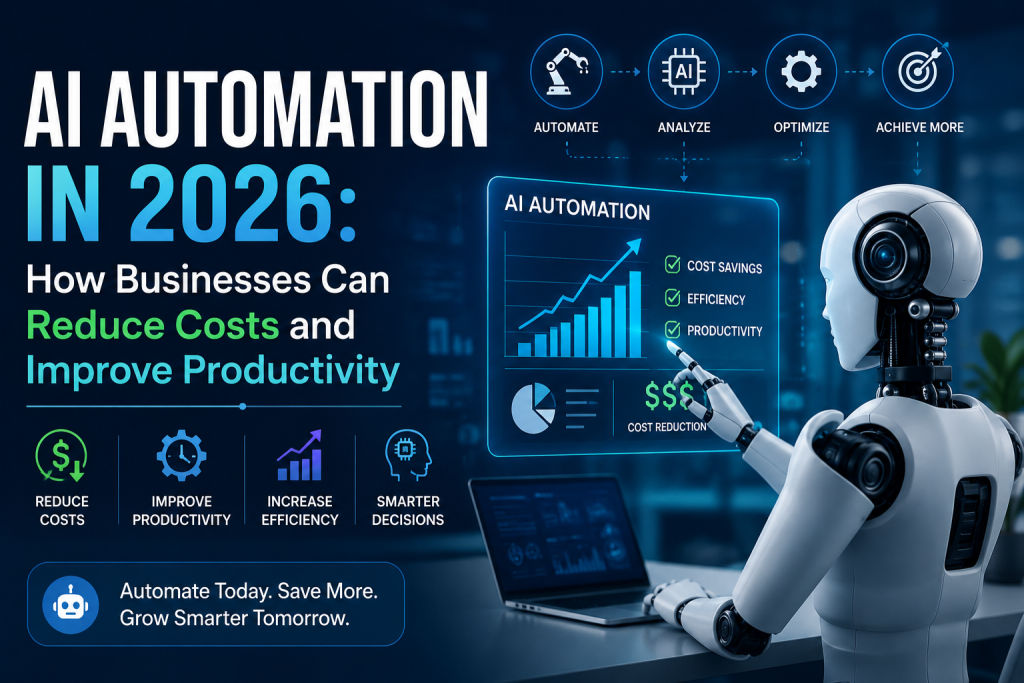
AI automation in 2026 helping businesses reduce costs and improve productivity
AI + Digital Transformation

AI Automation in 2026: How Businesses Can Reduce Costs and Improve Productivity

Artificial Intelligence is rapidly changing the way businesses operate. In 2026, AI automation is moving beyond simple chatbots and repetitive task automation. Businesses are increasingly using AI-powered systems to analyze information, automate workflows, assist employees, improve customer experiences, and make faster decisions. For organizations dealing with increasing operational costs, large amounts of data, and repetitive processes, AI automation can provide a practical way to improve efficiency without continuously increasing manual workloads. From customer support and sales to finance, human resources, software development, and business analytics, AI automation is becoming an important part of modern digital transformation. What Is AI Automation? AI automation combines artificial intelligence with automated workflows to perform tasks that traditionally require human intervention. Traditional automation usually follows predefined rules: Input → Rule → Action → Result AI automation can work with more flexible processes: Data → AI Analysis → Decision → Automated Action → Evaluation This allows automated systems to handle information, identify patterns, make recommendations, and trigger appropriate actions based on changing situations. For example, a traditional workflow might automatically send the same email to every new customer. An AI-powered workflow could analyze customer information, identify their interests, personalize the message, update the CRM, and schedule a follow-up automatically. This makes AI automation more adaptable to modern business processes. Why AI Automation Matters in 2026 Businesses are under constant pressure to improve productivity while controlling operational costs. Employees often spend significant amounts of time performing repetitive activities such as: Entering data Responding to routine emails Updating CRM systems Preparing reports Scheduling meetings Processing documents Answering common customer questions Monitoring business metrics Managing repetitive administrative workflows AI automation can reduce the amount of manual work involved in these processes. The goal is not simply to automate everything. Instead, businesses can use AI to automate suitable tasks while allowing employees to focus on activities that require creativity, strategic thinking, communication, and human judgment. Some major benefits include: Reduced repetitive work Improved employee productivity Faster business processes Lower operational overhead Faster customer responses Better data utilization Improved decision-making Scalable workflows 24/7 automated operations How AI Automation Helps Businesses Reduce Costs Reducing costs does not always mean reducing employees. In many cases, businesses can reduce operational costs by improving how existing resources are used. AI automation can help organizations achieve this in several ways. 1. Reduce Repetitive Manual Work Employees can spend hours performing repetitive tasks that follow predictable patterns. AI automation can handle many of these processes automatically. For example: Manual Process: Employee receives request → Reads information → Updates system → Sends response → Creates follow-up task Automated Process: Request received → AI analyzes request → System updated → Personalized response sent → Follow-up created This allows employees to spend more time on higher-value work. 2. Improve Operational Efficiency Manual processes often involve multiple systems and departments. For example, processing a new customer may require information to be entered into: CRM Email platform Accounting system Project management software Customer support platform Analytics system AI automation can coordinate these systems and reduce unnecessary manual data entry. 3. Reduce Errors Manual data entry and repetitive processing can result in mistakes. AI-powered workflows can validate information, identify inconsistencies, and trigger alerts when something requires human attention. This can help reduce the operational cost associated with avoidable errors and rework. 4. Improve Resource Utilization Businesses can use automation to handle routine processes while employees focus on more complex responsibilities. Instead of hiring additional resources for every increase in workload, organizations can automate suitable processes and scale operations more efficiently. 5. Provide 24/7 Support AI-powered systems can operate outside normal business hours. Customer questions, internal requests, monitoring activities, and other automated processes can continue even when employees are unavailable. This can improve service availability without requiring a larger support team to work around the clock. How AI Automation Improves Productivity Cost reduction is only one side of AI automation. The larger opportunity is improving productivity. Faster Task Completion AI systems can process large amounts of information quickly and automate workflows that previously required multiple manual steps. Less Administrative Work Employees can spend less time on repetitive activities such as documentation, scheduling, reporting, and data entry. Better Access to Information AI-powered systems can help employees search internal information and retrieve relevant data using natural language. Faster Decision Support AI automation can analyze business information and highlight trends, anomalies, and important changes. This gives teams faster access to information needed for decision-making. Improved Collaboration Automated workflows can notify the right team members, create tasks, update systems, and share information automatically. This reduces delays caused by manual communication between departments. AI Automation in Customer Support Customer support is one of the most practical areas for AI automation. Businesses can use AI-powered systems to handle routine customer interactions and automate support workflows. Common applications include: Answering frequently asked questions Tracking orders Checking account information Creating support tickets Categorizing customer requests Routing issues to the appropriate department Scheduling appointments Providing personalized responses Escalating complex issues to human agents For example, when a customer submits a support request, an AI system can understand the request, retrieve relevant information, categorize the issue, and either provide an answer or route the request to a human support professional. This can reduce response times while allowing support teams to focus on more complex customer problems. AI Automation in Sales and Marketing Sales and marketing teams manage large amounts of customer and prospect information. AI automation can help reduce administrative workloads across the sales process. A sales automation workflow can: Identify potential leads. Collect relevant customer information. Qualify prospects. Update CRM records. Generate personalized outreach. Schedule follow-ups. Notify sales representatives. Track engagement. Generate performance reports. Marketing teams can also use AI automation for: Content planning Audience segmentation Campaign analysis Lead scoring Customer research Trend identification Personalized communication Performance reporting The objective is not to remove human involvement from sales and marketing. Instead, automation can handle administrative tasks so professionals can focus on relationships, creativity, and strategy. AI Automation in Finance and Accounting Finance
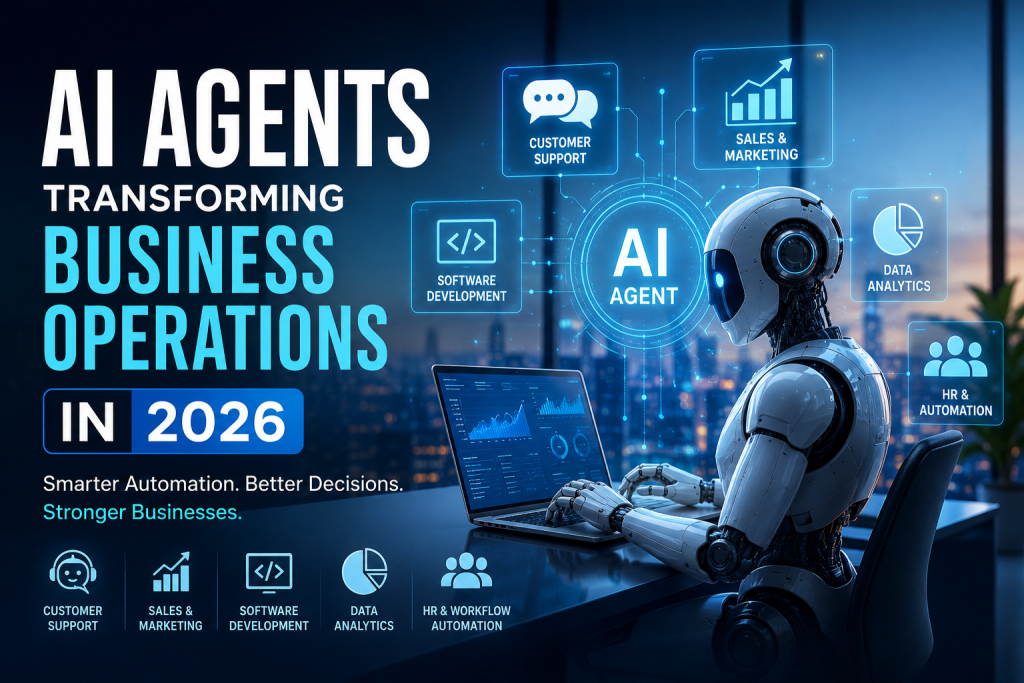
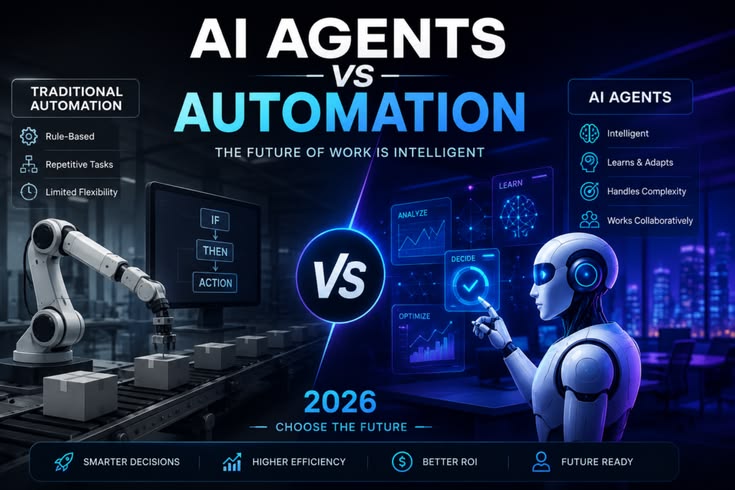
AI Agents Transforming Business Operations in 2026
Artificial Intelligence

How AI Agents Are Transforming Business Operations in 2026

Artificial Intelligence has moved far beyond chatbots and simple automation. In 2026, businesses are increasingly adopting AI agents that can understand goals, make decisions, use digital tools, and complete multi-step tasks with minimal human intervention. Unlike traditional software automation, which generally follows predefined rules, AI agents can analyze information, determine the next action, interact with different systems, and adapt their approach based on the situation. From customer service and sales to software development, finance, human resources, and data analysis, AI agents are changing how organizations operate and make decisions. For businesses looking to improve productivity, reduce operational costs, and deliver better customer experiences, AI agents are becoming an important part of the modern digital transformation strategy. What Are AI Agents? AI agents are intelligent software systems designed to achieve specific goals by combining artificial intelligence with reasoning, decision-making, and tool usage. Traditional automation generally follows a fixed sequence: Input → Rule → Action → Result AI agents can operate more dynamically: Goal → Analyze → Plan → Use Tools → Take Action → Evaluate → Adapt For example, instead of simply responding to a customer’s question, an AI-powered customer service agent could: Understand the customer’s request. Retrieve relevant customer information. Check an order or account status. Determine the appropriate solution. Update the required system. Respond to the customer. Escalate the issue to a human when necessary. This ability to perform multiple connected tasks makes AI agents particularly valuable for modern businesses. Why AI Agents Matter for Businesses in 2026 Businesses generate enormous amounts of data and perform thousands of repetitive processes every day. Employees often spend valuable time searching for information, updating systems, preparing reports, responding to routine queries, and managing repetitive workflows. AI agents can help automate many of these processes while allowing employees to focus on more strategic and creative work. Some of the biggest advantages include: Higher productivity Faster business processes Reduced repetitive work 24/7 operational support Improved customer experiences Faster decision-making Better utilization of business data Scalable automation The biggest shift is that businesses are moving from simply using AI as an assistant to using AI as an active participant in business workflows. AI Agents in Customer Support Customer support is one of the most practical applications of AI agents. Traditional chatbots usually provide answers based on predefined flows or a limited knowledge base. Modern AI agents can understand context and interact with business systems to resolve more complex requests. An AI customer service agent can: Answer product-related questions Track orders Check account information Handle appointment scheduling Create support tickets Recommend relevant solutions Escalate complex issues to human agents This allows businesses to provide faster support without requiring employees to manually handle every routine request. AI Agents for Sales and Marketing Sales teams spend significant amounts of time researching prospects, updating CRM records, writing emails, and following up with leads. AI agents can automate many of these activities. A sales AI agent can help: Identify potential leads Analyze customer information Qualify prospects Generate personalized outreach Schedule meetings Update CRM systems Track follow-ups Analyze sales performance Marketing teams can also use AI agents to analyze campaigns, generate content ideas, segment audiences, and identify trends. Instead of replacing sales and marketing professionals, AI agents can act as intelligent assistants that reduce administrative work and allow teams to focus on relationships and strategy. AI Agents in Software Development Software development is another area experiencing rapid AI adoption. AI coding assistants are already helping developers generate code, explain existing code, identify bugs, write tests, and improve documentation. AI agents take this concept further by supporting multi-step development workflows. For example, an AI development agent could: Analyze a development requirement. Create an implementation plan. Generate or modify code. Run tests. Identify errors. Suggest fixes. Update documentation. This does not eliminate the need for developers. Instead, it allows development teams to spend more time on architecture, product decisions, security, and complex engineering problems. AI Agents for Data Analysis and Business Intelligence Modern businesses collect data from websites, applications, CRM platforms, financial systems, marketing platforms, and other sources. The challenge is turning this data into actionable insights. AI agents can help business teams interact with their data using natural language. For example, a business manager could ask: “Why did our sales decrease this month?” An AI-powered system could analyze sales data, compare it with previous periods, identify unusual patterns, and present possible reasons. AI agents can support: Automated reporting Data exploration Trend detection Forecasting KPI monitoring Anomaly detection Business recommendations This can make data-driven decision-making more accessible to non-technical teams. AI Agents in Human Resources HR departments handle many repetitive processes, including employee queries, onboarding, documentation, scheduling, and internal requests. AI agents can provide employees with instant access to company information and automate administrative workflows. Common applications include: Employee onboarding Leave and policy queries Internal knowledge management Interview scheduling Candidate screening assistance HR document management Employee support With appropriate security and human oversight, AI agents can help HR teams reduce administrative workloads while improving employee experiences. AI Agents for Business Process Automation One of the most important applications of AI agents is connecting different business systems. A business may use separate platforms for CRM, accounting, email, customer support, project management, inventory, and analytics. AI agents can potentially coordinate workflows across these systems. For example, when a new customer signs up, an automated workflow could: Create CRM record → Send welcome email → Create onboarding task → Notify sales team → Update analytics This type of intelligent workflow automation can reduce manual data entry and improve operational efficiency. AI Agents vs Traditional Automation Traditional automation remains extremely useful, especially when processes are predictable and rules are clearly defined. However, AI agents provide additional flexibility when workflows involve changing information or require reasoning. Traditional Automation AI Agents Rule-based Goal-oriented Fixed workflows Dynamic workflows Predictable inputs Can handle variable inputs Limited decision-making AI-assisted reasoning Usually predefined actions Can select tools and actions Best for repetitive rules Best for complex workflows The two approaches are not

Artificial Intelligence, Software development, Technology & Innovation

AI Agents vs. Traditional Automation: What’s Changing in 2026?

Introduction: The Evolution from Rules to Reasoning For decades, digital transformation was defined by a single, unwavering engineering paradigm: determinism. If you wanted a machine to execute a task, you had to explicitly map out every single variable, branch, and conditional statement beforehand. If an input deviated by even a single character from the expected schema, the automation would crash. This rigid framework birthed the massive market for Robotic Process Automation (RPA) and standard backend API integrations. By 2026, this deterministic wall has completely crumbled. We are currently witnessing a massive architectural migration from standard rule-based workflows to autonomous AI Agents. Unlike traditional software that simply accelerates data transmission across static structures, AI agents possess a cognitive layer. They don’t just execute instructions; they reason, interpret intent, adapt to unpredictable runtime changes, and dynamically formulate their own execution paths. This guide explores the deep technical divides between these two methodologies, maps out the core mechanics of agentic systems, and provides an enterprise blueprint for managing this massive shift. Section 1: Defining the Technical Boundary To understand this architectural evolution, we must establish clear technical boundaries between traditional automation and an actual AI agent. Traditional Automation: Rule-Based Systems Traditional automation operates entirely on if-this-then-that (IFTTT) execution graphs. A software engineer constructs a explicit pipeline using tools like Selenium, UiPath, or custom cron jobs. The software intercepts an input, references a hardcoded template or static database schema, maps fields explicitly, and routes the data to a destination API. The software has zero contextual understanding of the data it manipulates. If a vendor changes a button’s CSS selector on a billing portal, or if an invoice shifts a line item by five pixels, the script breaks. It cannot problem-solve because its world consists exclusively of binary conditions and explicitly coded paths. AI Agents: Goal-Oriented Systems An AI Agent is a software entity that leverages a Large Language Model (LLM) or Large Multimodal Model (LMM) as its central processing unit, running inside a continuous, stateful loop. Instead of receiving a step-by-step instruction set, an agent is given an objective, a set of constraints, and access to an array of external tools. The agent evaluates the current state of its environment, breaks down the main objective into an ordered series of sub-tasks, selects the appropriate tool for the immediate sub-task, analyzes the output of that tool, and continuously modifies its strategy based on real-time feedback. It handles unstructured data natively because it interprets semantic meaning rather than just looking for exact string matches. Section 2: Architectural Comparison: Static Pipelines vs. Cognitive Loops The foundational code paths of these two systems look fundamentally different under the hood. The Linear Pipeline Structure Traditional automation relies on linear or predictable branching logic. The execution flow looks like this: [Inbound Webhook] —> [Parse Exact JSON Schema] —> [Conditional Branching] —> [Write to Destination API] If any link in this chain encounters an anomaly, the execution thread fails, records an error log, and requires human intervention to patch the underlying code. The Agentic Cognitive Loop An autonomous AI agent runs within a non-linear, dynamic cognitive loop, often structured around the OODA Loop (Observe, Orient, Decide, Act) framework: +—————————————+ | Goal Formulation | +—————————————+ | v +———————————————+ —–> | Perception & Observation (Ingest Context) | | +———————————————+ | | | v | +———————————————+ | | Reasoning & Planning (LLM Evaluation) | | +———————————————+ | | | v | +———————————————+ | | Tool Selection & Execution (Take Action) | | +———————————————+ | | +—————————–+ The Core Pillars of Agent Architecture 1. The Planning Core The planning engine decomposes the primary target into manageable milestones. Modern agents utilize advanced prompt-engineering frameworks like Chain-of-Thought (CoT) or Tree-of-Thoughts (ToT) to explore multiple reasoning paths simultaneously, evaluating the probability of success for each direction before executing code. 2. Contextual Memory Systems Agents rely on two distinct memory tiers to maintain consistency over long-running operations: Short-Term Memory: Managed directly via the model’s active context window, keeping track of immediate conversational turns, tool outputs, and local state variables. Long-Term Memory: Powered by an external vector database or graph database. The agent saves past executions, successful problem-solving strategies, and corporate guidelines, retrieving them via semantic search whenever a similar task boundary arises. 3. Tool Utilization (Function Calling) Tools are the hands of the agent. A tool can be a database connection, an internal API, a web scraper, or a command-line terminal. The agent reads the documentation of these tools (written in clear, natural language schemas), determines which tool matches the current sub-task, formats the payload dynamically, executes the call, and parses the returned data to determine the next course of action. Section 3: In-Depth Comparison Matrix Technical Capability Traditional Automation (RPA/APIs) Autonomous AI Agents (2026 Paradigm) Input Type Access Strictly Structured (JSON, XML, CSV) Fully Unstructured (Audio, Video, PDFs, Free Text) Execution Paths Static, Pre-compiled, Deterministic Dynamic, Emergent, Goal-Oriented Error Handling Hardcoded try/catch blocks; immediate crash Autonomous Self-Healing and Error Correction Maintenance Profile High overhead; breaks on UI/API changes Self-adapting; updates strategies based on UI shifts Data Processing Exact string matching and regex parsers Semantic interpretation and conceptual mapping Compute Overhead Negligible; ultra-lightweight execution Substantial; high dependency on token throughput and inference speeds Section 4: Deep Dive into Multi-Agent Orchestration Systems As enterprise environments scale up, relying on a single, massive monolithic agent becomes inefficient. The complexity of managing massive context windows and disparate tool sets introduces latency and hallucinations. The industry has shifted heavily toward Multi-Agent Systems (MAS). In a multi-agent framework, complex corporate operations are divided among specialized, narrow AI agents that communicate with each other over structured protocol buses. +———————————–+ | Enterprise Controller | | (Manager/Router Agent) | +———————————–+ | +———————–+———————–+ | | v v +———————–+ +———————–+ | Security Audit Agent | | Data Extraction Agent | | – Validates Code | <== (Internal Bus) => | – Parses Documents | | – Monitors Regs | | – Cleans Inbound APIs| +———————–+ +———————–+ The Hierarchical Topology In this architecture, a Manager Agent intercepts user intents

Artificial Intelligence

AI Agents vs Traditional Automation: What’s Changing in 2026?

Introduction:- Automation has been a cornerstone of digital transformation for decades. Businesses have long relied on software to eliminate repetitive tasks, reduce operational costs, and improve efficiency. From manufacturing lines to customer relationship management systems, traditional automation has helped organizations streamline workflows and maintain consistency. However, the technological landscape in 2026 is undergoing a significant shift. Organizations are no longer satisfied with systems that simply follow predefined rules. They increasingly require software that can understand context, adapt to changing situations, make informed decisions, and collaborate with humans. This demand has accelerated the adoption of AI agents, one of the most influential developments in modern artificial intelligence. Unlike traditional automation, AI agents are designed to reason, plan, and act toward specific goals. They can analyze large amounts of information, interact with multiple applications, learn from feedback, and even coordinate with other AI systems. Rather than replacing simple automation, AI agents expand what automation can achieve by handling more dynamic and complex tasks. This article explores how AI agents differ from traditional automation, why organizations are investing in intelligent systems, and how businesses can prepare for the next generation of digital operations. Understanding Traditional Automation Traditional automation refers to software that performs predefined actions based on fixed rules. These systems execute workflows exactly as they were programmed, making them highly reliable for repetitive processes. Examples include: Automated invoice generation Payroll processing Scheduled email campaigns Data backups Manufacturing assembly lines Basic customer support chatbots Rule-based approval workflows The primary advantage of traditional automation is consistency. Once configured correctly, it performs the same task repeatedly with minimal errors. It is ideal for environments where processes rarely change. However, these systems have clear limitations. They cannot interpret ambiguous information, adapt to unexpected scenarios, or make decisions beyond their programmed rules. If the business process changes, developers often need to redesign or update the automation. What Are AI Agents? AI agents are intelligent software systems capable of perceiving information, reasoning about it, making decisions, and taking actions to achieve defined objectives. Unlike conventional automation tools, AI agents do not rely solely on fixed rules. They use technologies such as large language models, machine learning, natural language processing, retrieval systems, and external tools to solve problems dynamically. For example, an AI customer support agent can: Read a customer’s email. Identify the issue and urgency. Search internal documentation. Check order status. Draft a personalized response. Escalate complex cases when necessary. Learn from user feedback over time. Instead of executing a single scripted workflow, the agent evaluates the situation and chooses the most appropriate action. Traditional Automation vs AI Agents Feature Traditional Automation AI Agents Decision-making Rule-based Context-aware Learning No Yes, through AI models and feedback Flexibility Low High Handles unstructured data Limited Excellent Human-like communication Minimal Advanced Adaptability Requires reprogramming Can adjust to changing inputs Best suited for Repetitive tasks Complex, evolving workflows Why 2026 Marks a Turning Point Several technological trends have converged to make AI agents practical at scale. Large language models have become significantly more capable, enabling agents to understand natural language and generate useful responses. Cloud infrastructure now provides the computing power needed to run advanced AI workloads efficiently. Businesses have also accumulated vast amounts of digital data, creating opportunities for AI systems to deliver meaningful insights and automation. At the same time, organizations are under pressure to improve productivity, reduce costs, and respond faster to customer expectations. AI agents address these needs by automating tasks that previously required human judgment. Real-World Business Applications Customer Service Modern AI agents can resolve support tickets, summarize conversations, translate languages, and personalize responses while maintaining a consistent customer experience. Software Development Development teams use AI agents to generate code, review pull requests, identify bugs, write documentation, and automate testing. These capabilities accelerate delivery while allowing engineers to focus on architecture and innovation. Cybersecurity Security operations centers increasingly deploy AI agents to monitor logs, detect anomalies, investigate suspicious behavior, and recommend remediation steps. This helps analysts respond more quickly to emerging threats. Cloud Operations Cloud management platforms benefit from AI agents that optimize infrastructure, monitor resource utilization, predict outages, and recommend cost-saving opportunities. They can assist administrators in maintaining reliable and scalable environments. Healthcare Hospitals and healthcare providers use intelligent agents to organize patient records, assist with appointment scheduling, summarize clinical notes, and support administrative workflows, enabling staff to spend more time on patient care. Benefits of AI Agents Organizations adopting AI agents are seeing improvements in several areas: Increased productivity through intelligent task automation. Faster decision-making based on real-time data. Improved customer experiences with personalized interactions. Reduced operational costs by minimizing manual work. Better scalability across departments. Continuous learning and optimization through AI-driven feedback loops. These advantages make AI agents an important part of digital transformation strategies across industries. AI Governance in 2026: Balancing Innovation and Regulation  

Artificial Intelligence, Business Analytics, Business Intelligence, Data Privacy & Security, Digital Transformation

AI Agents in 2026: How Autonomous Systems Are Transforming Business Operations

Introduction Artificial Intelligence has moved far beyond simple chatbots and recommendation engines. In 2026, AI agents are becoming one of the most influential technologies shaping modern businesses. These intelligent systems are capable of understanding goals, making decisions, performing tasks, and even coordinating with other software tools with minimal human intervention. What once required teams of employees and multiple software platforms can now be managed by autonomous AI systems that work continuously and efficiently. The rise of AI agents marks a significant shift in how organizations approach productivity, operations, and decision-making. Rather than serving only as assistants, AI systems are increasingly acting as digital workers that can execute complex workflows, analyze large volumes of information, and adapt to changing business conditions in real time. As companies continue to invest in automation and digital transformation, AI agents are emerging as a critical component of business strategy. Their ability to reduce operational costs, improve efficiency, and accelerate innovation is changing the way organizations operate across industries. What Are AI Agents? AI agents are autonomous software systems designed to perform tasks on behalf of users or organizations. Unlike traditional automation tools that follow predefined rules, AI agents can understand context, learn from interactions, make decisions, and take actions to achieve specific objectives. These systems combine advanced artificial intelligence technologies such as large language models, machine learning, natural language processing, and workflow automation. They can interact with applications, access databases, communicate with users, and execute tasks without requiring constant human supervision. For example, an AI agent can receive a request to prepare a market research report, gather information from multiple sources, analyze trends, generate insights, create a presentation, and deliver the final report automatically. Instead of performing one isolated function, it manages an entire process from start to finish. This capability is what makes AI agents fundamentally different from conventional software automation solutions. Why AI Agents Are Gaining Momentum in 2026 Several factors are contributing to the rapid adoption of AI agents across industries. Businesses are generating more data than ever before, creating a growing need for systems that can process and interpret information quickly. At the same time, organizations face increasing pressure to improve efficiency while reducing operational costs. Advancements in generative AI and large language models have significantly improved the reasoning and decision-making abilities of AI systems. Modern AI agents can understand complex instructions, maintain context across multiple tasks, and interact naturally with both humans and software applications. Cloud computing infrastructure has also made it easier for businesses to deploy and scale AI-powered solutions. Organizations no longer need extensive hardware investments to access advanced AI capabilities. The combination of these technological developments has created an environment where AI agents can deliver measurable business value across a wide range of functions. How AI Agents Work At their core, AI agents operate through a cycle of perception, reasoning, action, and learning. First, the agent gathers information from its environment. This may include user requests, business data, emails, documents, databases, or external sources. Next, the system analyzes the information and determines the best course of action based on predefined objectives. Advanced reasoning models help the agent evaluate different possibilities and choose appropriate responses. Once a decision is made, the AI agent executes the required actions. This may involve sending emails, updating records, generating reports, scheduling meetings, processing transactions, or interacting with other software systems. Finally, the agent learns from outcomes and feedback to improve future performance. Over time, this continuous learning process helps the system become more effective and accurate. This ability to independently manage workflows makes AI agents particularly valuable in complex business environments. Transforming Customer Service Operations Customer service is one of the areas experiencing the most significant impact from AI agents. Traditional customer support often involves long wait times, repetitive inquiries, and high operational costs. AI agents are helping organizations overcome these challenges by providing instant, personalized, and scalable support. Modern AI customer service agents can understand customer questions, access relevant information, resolve issues, process requests, and escalate complex cases when necessary. They operate around the clock, ensuring customers receive assistance whenever needed. Beyond answering questions, AI agents can proactively identify potential issues, recommend solutions, and follow up with customers to ensure satisfaction. Businesses using AI-powered customer support systems are reporting faster response times, improved customer experiences, and reduced service costs. Revolutionizing Human Resources Management Human Resources departments are increasingly adopting AI agents to streamline administrative tasks and improve employee experiences. Recruitment is one area where these systems are delivering significant benefits. AI agents can screen resumes, schedule interviews, communicate with candidates, and identify suitable applicants based on specific job requirements. Employee onboarding processes are also becoming more efficient. AI agents can guide new hires through documentation, answer common questions, provide training materials, and ensure compliance requirements are completed. In addition, AI systems can assist with performance evaluations, workforce planning, employee engagement initiatives, and professional development recommendations. By automating routine administrative work, HR teams can focus more on strategic initiatives and employee relationships. Enhancing Sales and Marketing Performance Sales and marketing teams are using AI agents to improve customer engagement, generate leads, and optimize campaigns. AI-powered sales agents can identify potential customers, analyze purchasing behavior, personalize outreach efforts, and recommend next steps for sales representatives. These capabilities help organizations improve conversion rates and accelerate revenue growth. Marketing teams benefit from AI agents that can create content, monitor campaign performance, analyze audience behavior, and adjust strategies based on real-time insights. For example, an AI agent may automatically identify underperforming advertisements, suggest improvements, allocate budgets more effectively, and generate detailed performance reports. This level of automation allows businesses to respond more quickly to market changes and customer preferences. Improving Financial Operations Financial management is another area where AI agents are creating substantial value. Organizations handle large volumes of financial data every day, making accuracy and efficiency critical. AI agents can automate invoice processing, expense management, budgeting, forecasting, and financial reporting. These systems can identify unusual transactions, detect potential fraud, and alert financial teams to

Artificial Intelligence, Business Intelligence

AI Agents in the Workplace: From Assistants to Autonomous Decision Makers

AI Agents in the Workplace: From Assistants to Autonomous Decision Makers Artificial Intelligence has already transformed the way businesses operate, but a new generation of AI technology is pushing workplace innovation even further. While most people are familiar with AI assistants that answer questions, schedule meetings, or help draft emails, today’s AI agents are becoming capable of much more. They can analyze information, make decisions, execute tasks, and continuously learn from outcomes with minimal human intervention. The shift from AI assistants to autonomous AI agents represents one of the most significant technological developments of the decade. Organizations across industries are exploring how these intelligent systems can streamline operations, improve customer experiences, and increase efficiency while reducing operational costs. As businesses continue their digital transformation journeys, AI agents are quickly becoming valuable team members rather than just software tools. Understanding how AI agents work, what benefits they offer, and the challenges they present is essential for organizations looking to remain competitive in an increasingly AI-driven world. Understanding AI Agents Traditional AI assistants are designed to respond to user requests. They wait for instructions, process queries, and provide outputs based on predefined interactions. Examples include virtual assistants that answer customer questions, generate content, or help employees find information. AI agents, however, take things a step further. Instead of simply responding to commands, they can independently plan, execute, monitor, and optimize tasks to achieve specific objectives. These systems are goal-oriented and capable of making decisions based on real-time data and changing circumstances. An AI agent typically combines several capabilities: Natural language understanding Data analysis and interpretation Decision-making logic Task execution Continuous learning and adaptation Integration with business systems and applications This combination allows AI agents to function more like digital coworkers than traditional software applications. The Evolution of Workplace AI The journey of workplace AI has evolved through several distinct phases. Initially, businesses used rule-based automation systems to handle repetitive tasks. These systems followed fixed instructions and could not adapt to unexpected situations. The next phase introduced AI-powered assistants capable of understanding human language and providing intelligent responses. These tools improved productivity by helping employees access information more efficiently. Today, AI agents represent the latest stage of this evolution. Rather than simply assisting users, they can independently complete complex workflows that previously required human involvement. This transition is changing how organizations think about productivity, workforce management, and operational efficiency. Businesses are moving from asking, “How can AI help employees?” to asking, “Which tasks can AI complete on its own?” How AI Agents Are Transforming the Workplace AI agents are being deployed across various departments and business functions. Their ability to operate autonomously enables organizations to automate increasingly sophisticated processes. Customer Service and Support Customer service is one of the areas experiencing the greatest impact from AI agents. Traditional chatbots could answer basic questions, but modern AI agents can handle entire customer interactions from start to finish. They can: Understand customer intent Access customer records Resolve issues automatically Process refunds Escalate complex cases when necessary Follow up after resolution This reduces response times while improving customer satisfaction and lowering operational costs. Human Resources HR departments are increasingly using AI agents to manage administrative tasks and improve employee experiences. AI agents can: Screen resumes Schedule interviews Answer employee questions Assist with onboarding Track compliance requirements Generate HR reports By automating routine activities, HR professionals can focus on strategic initiatives such as talent development and employee engagement. Sales and Marketing Sales and marketing teams generate large amounts of data daily. AI agents help transform this data into actionable insights. These systems can: Identify sales opportunities Qualify leads Personalize marketing campaigns Monitor customer behavior Predict purchasing trends Optimize advertising strategies As a result, businesses can improve conversion rates and create more targeted customer experiences. Finance and Accounting Financial operations require accuracy, speed, and compliance. AI agents are becoming valuable assets in managing these responsibilities. Applications include: Invoice processing Expense management Financial forecasting Fraud detection Budget analysis Regulatory compliance monitoring By automating these tasks, organizations reduce errors and improve financial decision-making. IT Operations and Cybersecurity Modern IT environments are highly complex, making them ideal candidates for AI-driven automation. AI agents can: Monitor networks continuously Detect anomalies Respond to security threats Troubleshoot system issues Manage software updates Optimize infrastructure performance This proactive approach helps organizations strengthen security and minimize downtime. The Rise of Autonomous Decision-Making One of the most transformative aspects of AI agents is their growing ability to make decisions independently. Autonomous decision-making does not mean replacing human judgment entirely. Instead, AI agents handle routine and data-intensive decisions while humans maintain oversight of strategic and high-risk choices. For example, an AI agent managing inventory can automatically reorder products when stock levels fall below predefined thresholds. It can analyze sales trends, supplier performance, and seasonal demand to determine the optimal purchasing strategy without requiring constant human intervention. Similarly, in customer service environments, AI agents can decide the best course of action for resolving common issues based on historical outcomes and customer preferences. As AI systems become more sophisticated, their decision-making capabilities will continue expanding across industries. Benefits of AI Agents in the Workplace Organizations adopting AI agents are experiencing a wide range of benefits that extend beyond simple automation. Increased Productivity AI agents work around the clock without breaks, allowing businesses to complete tasks faster and more consistently. Employees spend less time on repetitive work and more time on high-value activities. Improved Accuracy Human errors can lead to costly mistakes, especially in areas such as finance, compliance, and data management. AI agents help reduce errors by following standardized processes and analyzing data systematically. Faster Decision-Making Businesses generate enormous volumes of data every day. AI agents can process this information in real time, enabling quicker and more informed decisions. Cost Reduction Automating routine tasks reduces labor costs and improves operational efficiency. Organizations can achieve more with existing resources while maintaining service quality. Enhanced Customer Experiences Customers increasingly expect instant responses and personalized interactions. AI agents can deliver consistent, high-quality

Artificial Intelligence, Business Intelligence, Digital Transformation, enterprise

Agentic AI: How Autonomous AI Agents Are Changing Business Workflows

Agentic AI: How Autonomous AI Agents Are Changing Business Workflows Artificial Intelligence has rapidly evolved from being a futuristic concept to becoming a critical component of modern business operations. Over the past few years, organizations have adopted AI-powered tools to automate repetitive tasks, improve customer experiences, and enhance decision-making. However, the latest advancement in this technological journey is Agentic AI—a new generation of AI systems capable of acting autonomously, making decisions, and completing complex workflows with minimal human intervention. Unlike traditional AI systems that require continuous prompts and instructions, Agentic AI can independently analyze situations, plan actions, execute tasks, and adapt based on outcomes. This shift represents one of the most significant developments in business technology, offering organizations unprecedented levels of efficiency, productivity, and scalability. As businesses face increasing competition and growing operational complexity, Agentic AI is emerging as a powerful solution capable of transforming how work gets done. From customer service and sales to software development and project management, autonomous AI agents are redefining business workflows across industries. In this article, we’ll explore what Agentic AI is, how it works, its business applications, benefits, challenges, and why it is poised to become a cornerstone of future enterprise operations. Understanding Agentic AI Agentic AI refers to artificial intelligence systems designed to operate as autonomous agents. These agents can perceive their environment, understand goals, create plans, make decisions, and take actions without requiring constant human supervision. Traditional AI tools generally perform specific tasks based on direct user input. For example, a chatbot may answer questions, or an AI image generator may create images based on prompts. Agentic AI goes several steps further. Instead of merely responding to commands, autonomous AI agents can: Understand objectives Break down complex tasks into smaller actions Gather necessary information Make decisions based on available data Execute workflows independently Learn from outcomes and adjust strategies This capability transforms AI from a passive assistant into an active digital worker capable of managing entire business processes. The Evolution from Traditional AI to Agentic AI The development of Agentic AI represents the next stage in the evolution of artificial intelligence. Traditional Automation Early automation systems followed predefined rules. They could execute repetitive tasks but lacked flexibility and intelligence. Examples include: Email automation Data entry automation Scheduled reporting systems Machine Learning Systems Machine learning introduced predictive capabilities. These systems could identify patterns and make recommendations based on data. Examples include: Recommendation engines Fraud detection systems Predictive analytics tools Generative AI Generative AI expanded AI capabilities by creating content such as text, images, code, and videos. Examples include: AI writing assistants Image generation platforms Coding assistants Agentic AI Agentic AI combines reasoning, planning, memory, and action capabilities. Instead of assisting users with individual tasks, autonomous agents can complete entire workflows from start to finish. This progression marks a fundamental shift from AI tools that simply respond to requests toward AI systems that actively pursue objectives. How Agentic AI Works To understand its business value, it’s important to know how Agentic AI functions. 1. Goal Understanding An AI agent begins by understanding the objective provided by the user or organization. For example: “Generate a market research report for the healthcare industry.” The agent interprets the request and identifies the required steps. 2. Planning The system creates a strategic plan to accomplish the objective. This may involve: Researching industry data Gathering competitor information Analyzing trends Creating visual reports Drafting conclusions 3. Execution The AI agent performs tasks independently using available tools and resources. It may: Search databases Access internal documents Analyze spreadsheets Generate reports Send notifications 4. Monitoring Throughout execution, the agent evaluates progress and adjusts actions when necessary. 5. Learning Advanced agents continuously improve performance by learning from previous experiences and outcomes. This combination of reasoning, planning, execution, and adaptation enables Agentic AI to handle increasingly sophisticated business processes. Why Businesses Are Embracing Agentic AI Organizations worldwide are investing heavily in Agentic AI because of its ability to improve operational efficiency while reducing costs. Several factors are driving adoption: Growing Data Volumes Businesses generate enormous amounts of data daily. Human teams often struggle to process and analyze this information efficiently. Agentic AI can monitor, analyze, and extract insights from large datasets in real time. Need for Faster Decision-Making Competitive markets require rapid responses. Autonomous agents can process information and make recommendations significantly faster than traditional workflows. Workforce Productivity Employees spend substantial time on repetitive administrative tasks. AI agents can automate these activities, allowing workers to focus on strategic and creative responsibilities. Cost Optimization Reducing manual effort leads to lower operational expenses while maintaining high levels of productivity. Business Applications of Agentic AI Agentic AI is transforming numerous departments across organizations. Customer Support Customer service is one of the most impactful areas for AI adoption. Autonomous agents can: Handle customer inquiries Resolve common issues Process refunds Escalate complex cases Provide 24/7 support This improves customer satisfaction while reducing support costs. Sales and Lead Generation Sales teams spend considerable time identifying prospects and nurturing leads. AI agents can: Research potential customers Qualify leads Schedule meetings Send follow-up emails Generate sales insights As a result, sales professionals can focus on closing deals rather than administrative work. Marketing Automation Marketing departments can leverage Agentic AI for: Content creation Campaign optimization Audience segmentation Competitor analysis Social media management AI agents continuously monitor performance and make adjustments to improve results. Human Resources HR teams are increasingly using AI agents to streamline recruitment and employee management. Applications include: Resume screening Candidate ranking Interview scheduling Employee onboarding Performance tracking This reduces hiring time and improves recruitment efficiency. Software Development Agentic AI is making a major impact in software engineering. AI agents can: Write code Detect bugs Conduct testing Generate documentation Monitor system performance Development teams benefit from faster release cycles and improved software quality. Finance and Accounting Financial departments use autonomous AI agents for: Invoice processing Expense tracking Financial forecasting Fraud detection Compliance monitoring These capabilities reduce errors and improve financial accuracy. Benefits of Agentic AI for Businesses Increased Productivity

Scroll to Top