Innovation

Data Privacy & Security, Technology

Quantum Computing: Are We Closer to a Commercial Breakthrough?

Quantum Computing: Are We Closer to a Commercial Breakthrough? For decades, quantum computing has been viewed as one of the most promising yet elusive technologies in the world. Scientists, researchers, and technology companies have invested billions of dollars into developing machines that can solve problems beyond the capabilities of traditional computers. While the concept sounds futuristic, the reality is that quantum computing is steadily moving closer to practical commercial use. In recent years, advancements in quantum hardware, error correction, and quantum algorithms have accelerated progress at an impressive pace. Major technology companies, startups, governments, and research institutions are racing to unlock the true potential of this revolutionary technology. As a result, businesses across industries are beginning to ask an important question: Are we finally approaching a commercial breakthrough in quantum computing? The answer is not entirely straightforward. While quantum computers are becoming more powerful and reliable, significant challenges still remain before they can deliver widespread commercial value. However, the progress achieved over the past few years suggests that the quantum era may arrive sooner than many experts originally expected. Understanding Quantum Computing Before discussing commercial breakthroughs, it is important to understand what makes quantum computing different from classical computing. Traditional computers process information using bits that exist in either a 0 or 1 state. Every application, website, software program, and digital service relies on billions of these bits performing calculations. Quantum computers, on the other hand, use quantum bits, commonly known as qubits. Unlike classical bits, qubits can exist in multiple states simultaneously through a phenomenon called superposition. They can also become interconnected through entanglement, allowing information to be processed in entirely new ways. These unique properties enable quantum computers to perform certain calculations exponentially faster than traditional systems. Problems that might take conventional supercomputers thousands of years to solve could potentially be completed within hours or minutes using a sufficiently advanced quantum computer. This extraordinary computational power is what makes quantum computing one of the most exciting technological frontiers of the 21st century. Why Quantum Computing Matters Quantum computing is not simply about making computers faster. Instead, it represents an entirely different approach to problem-solving. Many real-world challenges involve enormous numbers of variables and possible outcomes. Classical computers often struggle with these highly complex calculations because the number of possibilities grows exponentially. Quantum computers have the potential to tackle problems in areas such as: Drug discovery Materials science Financial modeling Supply chain optimization Artificial intelligence Climate simulation Cryptography Energy management Logistics planning Advanced manufacturing The ability to process vast combinations of data simultaneously could transform industries and create opportunities that are impossible with current computing systems. The Journey from Theory to Reality The concept of quantum computing originated in the 1980s when physicists began exploring how quantum mechanics could be applied to information processing. For many years, progress was largely theoretical. Researchers developed mathematical models and algorithms while struggling to build physical quantum systems capable of stable operation. Throughout the 1990s and early 2000s, scientific breakthroughs laid the foundation for modern quantum computing. However, practical implementations remained limited because qubits were extremely fragile and difficult to control. The past decade has seen remarkable advancements in hardware development. Companies and research institutions have significantly increased qubit counts while improving stability and computational performance. Today, quantum computers are no longer laboratory curiosities. Cloud-based quantum platforms allow developers, researchers, and businesses to experiment with quantum systems from virtually anywhere in the world. This accessibility has accelerated innovation and expanded interest in commercial applications. Major Players Driving Quantum Innovation The race toward commercial quantum computing involves a diverse ecosystem of technology giants, startups, governments, and academic institutions. Several organizations are leading the charge through significant investments in research and development. IBM IBM has emerged as one of the most influential companies in quantum computing. Through its quantum cloud services and roadmap for scalable quantum systems, the company continues to push the boundaries of quantum hardware and software development. IBM’s long-term vision focuses on creating fault-tolerant quantum computers capable of solving practical business problems. Google Google gained global attention when its researchers demonstrated a milestone known as quantum supremacy. The company showed that a quantum processor could perform a specific calculation faster than a traditional supercomputer. Although the demonstration had limited practical applications, it highlighted the growing capabilities of quantum systems. Microsoft Microsoft is pursuing a unique approach to quantum computing through its focus on topological qubits and quantum software development. The company’s strategy emphasizes building a complete quantum ecosystem that includes hardware, programming tools, and cloud-based services. Amazon Amazon provides quantum computing access through cloud platforms that allow businesses and researchers to experiment with multiple quantum technologies. This approach reduces barriers to entry and helps organizations explore quantum solutions without purchasing specialized hardware. Quantum Startups In addition to major technology companies, numerous startups are driving innovation. Organizations specializing in quantum hardware, software, networking, and security are attracting substantial investments from venture capital firms and governments. These startups are contributing fresh ideas and accelerating the development of commercial quantum applications. Recent Breakthroughs Accelerating Progress Several technological breakthroughs have significantly improved the prospects for commercial quantum computing. Improved Qubit Stability One of the biggest challenges in quantum computing is maintaining qubit stability. Quantum states are highly sensitive to environmental interference, leading to computational errors. Researchers have made substantial progress in extending coherence times, allowing qubits to remain operational for longer periods. Advancements in Error Correction Error correction is essential for building reliable quantum systems. Recent innovations have demonstrated more effective methods for detecting and correcting quantum errors. These advancements bring the industry closer to achieving fault-tolerant quantum computing. Scalable Architectures Developers are designing new architectures that enable larger quantum processors. Scalability is critical because practical commercial applications often require thousands or even millions of high-quality qubits. Progress in chip design, fabrication techniques, and quantum networking is helping researchers move toward this goal. Quantum Software Development The growth of quantum software frameworks has expanded access to quantum computing. Developers can now create and test quantum

Educational Technology

How Businesses Can Prepare for the Quantum Computing Era

How Businesses Can Prepare for the Quantum Computing Era Quantum computing has long been considered a futuristic concept confined to research laboratories and science fiction movies. However, the technology is rapidly moving closer to practical business applications. While classical computers have powered the digital revolution for decades, quantum computers promise to solve certain types of problems exponentially faster, potentially transforming industries ranging from healthcare and finance to manufacturing and logistics. Although widespread commercial adoption may still take several years, businesses that begin preparing today will be better positioned to take advantage of future opportunities while minimizing potential risks. The quantum computing era is not just about faster computers; it represents a fundamental shift in how complex problems can be approached and solved. Organizations that understand the implications of quantum technology and take proactive measures now will gain a strategic advantage as the technology matures. The question is no longer whether quantum computing will impact businesses, but how companies can prepare for its arrival. Understanding Quantum Computing Traditional computers process information using bits that can exist as either 0 or 1. Quantum computers, on the other hand, use quantum bits or qubits. Unlike classical bits, qubits can exist in multiple states simultaneously through a phenomenon known as superposition. They can also interact with each other through entanglement, enabling computations that would be extremely difficult or impossible for classical systems. This unique capability allows quantum computers to evaluate vast numbers of possibilities at the same time, making them particularly effective for optimization problems, complex simulations, cryptography, and advanced data analysis. While today’s quantum computers are still in the early stages of development, major technology companies and research institutions continue to make significant progress. As hardware improves and practical use cases emerge, businesses will increasingly need to understand how quantum computing fits into their digital transformation strategies. Why Quantum Computing Matters for Businesses The impact of quantum computing extends far beyond the technology sector. Organizations across virtually every industry could benefit from quantum-powered solutions. In finance, quantum computers may enhance portfolio optimization, risk assessment, and fraud detection. Financial institutions often analyze enormous volumes of market data, and quantum algorithms could potentially identify patterns and opportunities much faster than traditional systems. Healthcare companies could leverage quantum computing to accelerate drug discovery and molecular simulations. Developing new medicines typically requires years of research and extensive testing. Quantum-powered simulations may significantly reduce development timelines and costs. Manufacturing businesses could use quantum optimization to improve production schedules, supply chain management, and inventory control. By analyzing countless variables simultaneously, quantum systems may help companies reduce waste and increase operational efficiency. Logistics providers could optimize delivery routes and transportation networks more effectively than current technologies. This capability could lead to reduced fuel consumption, lower operational costs, and faster delivery times. Energy companies may utilize quantum computing to improve grid management, battery development, and renewable energy solutions. As sustainability becomes a growing business priority, these applications could have substantial economic and environmental benefits. The Cybersecurity Challenge One of the most significant concerns surrounding quantum computing is its potential impact on cybersecurity. Much of today’s digital infrastructure relies on encryption methods that are considered secure against classical computers. However, sufficiently advanced quantum computers could potentially break some of the encryption algorithms currently used to protect sensitive data, financial transactions, and communications. This challenge has given rise to the concept of “quantum-safe” or “post-quantum” cryptography. Businesses must recognize that data encrypted today could potentially be vulnerable in the future if intercepted and stored by malicious actors. Organizations handling sensitive information, including financial records, customer data, intellectual property, and government-related information, should begin assessing their cryptographic infrastructure. Preparing for post-quantum security standards can help protect valuable assets against future threats. Companies that delay these preparations may face increased security risks as quantum technology advances. Industries Most Likely to Be Disrupted Although quantum computing will eventually influence many sectors, some industries are expected to experience disruption sooner than others. Financial services organizations are actively investing in quantum research due to the technology’s potential impact on trading strategies, risk modeling, and investment optimization. Pharmaceutical and biotechnology companies see significant opportunities in molecular simulation and drug development, where quantum computers could dramatically accelerate research processes. Transportation and logistics firms may benefit from improved route planning and resource allocation, leading to major efficiency gains. Telecommunications providers are exploring quantum networking technologies that could enable highly secure communications. Government agencies and defense organizations are investing heavily in quantum technologies for national security, intelligence analysis, and advanced computing applications. Technology companies themselves are leading the race to develop quantum hardware, software platforms, and cloud-based quantum services. Businesses operating within these sectors should closely monitor developments and evaluate potential opportunities and risks. Practical Steps Businesses Can Take Today Preparing for the quantum era does not require immediate investment in expensive quantum hardware. Instead, organizations should focus on building awareness, developing strategies, and creating a foundation for future adoption. The first step is education. Business leaders, technology teams, and decision-makers should develop a basic understanding of quantum computing concepts and their potential business implications. Awareness helps organizations make informed decisions as the technology evolves. Companies should also identify business challenges that may benefit from quantum solutions in the future. Optimization problems, complex simulations, predictive analytics, and advanced machine learning workloads are often strong candidates. Cybersecurity readiness is equally important. Organizations should inventory their current encryption systems and begin evaluating post-quantum cryptography options. Early planning can reduce future migration challenges. Building partnerships with technology providers, research institutions, and innovation hubs can provide valuable insights into emerging quantum developments. Many cloud providers already offer access to experimental quantum computing platforms, enabling businesses to gain hands-on experience without significant infrastructure investments. Organizations should also consider creating innovation teams or technology task forces dedicated to monitoring advancements in quantum computing and assessing potential business impacts. The Role of Cloud-Based Quantum Services One reason quantum computing is becoming more accessible is the growth of cloud-based quantum platforms. Rather than purchasing and maintaining quantum hardware, businesses

Startup founders discussing IT consulting strategies for business scalability
IT consulting

IT Consulting for Startups — Turning Ideas into Scalable Businesses

IT Consulting for Startups — Turning Ideas into Scalable Businesses Launching a startup is exciting — but turning an idea into a successful, scalable business requires more than passion. It demands the right technology, strategy, and execution. That’s where IT consulting for startups plays a crucial role. IT consultants help new businesses build a strong technological foundation, optimize operations, and make smart digital investments. This blog explores how IT consulting empowers startups to grow efficiently and sustainably. Building a Scalable Tech Foundation Every successful startup begins with a solid technical foundation. IT consultants assess the startup’s goals, budget, and business model to design a robust IT infrastructure that supports growth. For example, instead of relying on outdated systems or fragmented tools, consultants help implement cloud-based and modular architectures that scale with the business. They ensure that servers, databases, and software applications are aligned with long-term expansion plans. A well-designed tech foundation not only reduces future upgrade costs but also prevents downtime and performance bottlenecks. Whether it’s an e-commerce startup, fintech app, or SaaS product, IT consulting ensures the technology backbone is reliable, secure, and scalable from day one. Choosing the Right Technology Stack Selecting the right technology stack (frontend, backend, databases, and frameworks) is one of the most critical decisions for any startup. Poor tech choices can lead to integration issues, security risks, and limited scalability. IT consultants evaluate factors such as performance, flexibility, team expertise, and maintenance requirements before recommending a tech stack. For example: For web startups, they might suggest React.js, Node.js, or Qwik for high performance. For app-based startups, frameworks like Flutter or React Native offer cross-platform efficiency. For backend and database management, consultants may recommend AWS, MongoDB, or Firebase depending on the use case. By choosing wisely early on, startups save both time and money while ensuring their products evolve smoothly as they grow. Cost-Effective Cloud Solutions Cloud computing is a game-changer for startups with limited budgets. IT consultants guide entrepreneurs in adopting cloud-first solutions that minimize upfront hardware costs and provide flexibility. Using platforms like Amazon Web Services (AWS), Google Cloud, or Microsoft Azure, startups can host their applications, store data, and deploy services on-demand. Consultants ensure the cloud setup includes backup systems, data redundancy, and cost optimization. Moreover, cloud-based tools enable startups to collaborate efficiently with remote teams and scale instantly when demand rises — a vital feature for fast-growing companies. Consultants also monitor usage patterns to prevent unnecessary expenses, ensuring startups get maximum value from every cloud investment. Ensuring Security and Compliance Startups often overlook cybersecurity until it’s too late. Data breaches or cyberattacks can destroy brand reputation and customer trust. That’s why IT consultants prioritize security from the start. They perform risk assessments, identify vulnerabilities, and implement strong defense mechanisms like firewalls, encryption, and access control. Consultants also ensure compliance with data protection regulations (such as GDPR or CCPA) to avoid legal risks. Additionally, security training for employees helps prevent phishing and insider threats — common weak points for startups. By integrating cybersecurity into every stage of business development, consultants safeguard the company’s digital assets and ensure customer data remains protected. Streamlining Operations with Automation Automation is a major advantage that IT consulting brings to startups. By integrating automated workflows, startups can reduce manual errors, save time, and focus on growth. IT consultants deploy automation tools for project management, customer onboarding, data entry, and marketing campaigns. CRM systems like HubSpot or Salesforce, and workflow tools like Zapier or Asana, are often implemented to streamline repetitive processes. Automation not only improves efficiency but also enhances consistency and customer satisfaction — key ingredients for scaling successfully. Developing Scalable Digital Strategies Beyond technology, IT consultants help startups craft digital growth strategies aligned with market trends and business objectives. This includes everything from building online presence and digital marketing integration to analyzing data for informed decision-making. Consultants often provide digital transformation roadmaps, guiding startups through product evolution, customer engagement, and market expansion. This strategic partnership ensures startups can adapt quickly and sustain growth in competitive industries. Providing Ongoing Support and IT Maintenance IT consulting doesn’t end after setup. Ongoing support is crucial for startups to remain efficient and secure. Consultants provide continuous monitoring, system updates, and performance optimization. Whether it’s troubleshooting software bugs or scaling up infrastructure during rapid growth phases, consultants ensure technology never becomes a barrier to innovation. Many also offer managed IT services that provide startups with enterprise-level reliability without the cost of an in-house team. Conclusion IT consulting is the backbone of modern startup success. By combining technology expertise with business insight, consultants help entrepreneurs turn ideas into profitable realities. From choosing the right tech stack and cloud solutions to ensuring security and scalability, IT consulting provides startups with the roadmap to thrive in a digital-first world. For startups looking to accelerate growth, collaborating with experienced IT consultants isn’t just an option — it’s a necessity for sustainable success. FAQs 1. Why do startups need IT consulting?Startups need IT consulting to build scalable infrastructure, choose the right technologies, and implement secure, cost-effective digital strategies. 2. What are the key benefits of IT consulting for startups?Key benefits include better technology decisions, reduced costs, enhanced security, and faster time-to-market. 3. How do IT consultants help with scalability?Consultants design flexible architectures and recommend cloud-based solutions that grow with your business needs. 4. Are IT consulting services expensive for startups?Not necessarily. Most consultants offer scalable pricing or project-based models suitable for startups with limited budgets. 5. Can IT consulting help improve cybersecurity for startups?Yes, consultants implement robust security frameworks, ensure data compliance, and provide employee training to protect sensitive information. Connect with us.

A robotic human face representing artificial intelligence technology.
Artificial Intelligence

Artificial Intelligence in Everyday Life

Introduction Artificial Intelligence (AI) is no longer just a futuristic idea — it’s already a part of our everyday lives. Whether it’s voice assistants like Alexa, smart recommendations on Netflix, or self-driving cars, AI quietly powers many aspects of our daily routines. But how exactly does it work, and where do we experience it the most? What is Artificial Intelligence? Artificial Intelligence is the simulation of human intelligence in machines. These systems are designed to learn, reason, and make decisions — often faster and more accurately than humans. The main goal of AI is to make systems capable of performing tasks that normally require human intelligence, such as understanding language, recognizing images, or solving problems. AI in Our Daily Lives a. Smart Assistants Devices like Amazon Alexa, Google Assistant, and Siri help us with daily tasks such as setting reminders, playing music, or checking the weather — all powered by natural language processing (NLP). b. Personalized Recommendations When Netflix suggests a movie or Amazon recommends a product, it’s using machine learning algorithms to analyze your preferences and predict what you’ll like next. c. AI in Healthcare AI helps doctors detect diseases early, analyze X-rays, and predict health risks. For example, AI models can detect diabetic retinopathy from eye scans with remarkable accuracy. d. Smart Homes and Devices From thermostats that adjust to your temperature preference to fridges that track food freshness — AI makes our homes smarter and energy-efficient. e. AI in Education Personalized learning platforms powered by AI assess student performance and adapt lessons accordingly, improving learning outcomes. Benefits of AI in Everyday Life Convenience: Simplifies daily tasks. Efficiency: Automates repetitive work. Accuracy: Reduces human error. Personalization: Offers custom experiences.  Challenges of AI Privacy Concerns: Data collected by AI devices can be misused. Job Automation: Some jobs are being replaced by AI systems. Bias: AI systems can inherit biases from training data. Conclusion Artificial Intelligence is shaping a smarter, more connected world. As it evolves, it promises to make our lives easier — but also challenges us to use it responsibly. The future of AI lies in finding the right balance between innovation and ethics. FAQs Q1: What is an example of AI in daily life?AI examples include voice assistants, facial recognition on smartphones, and personalized online recommendations. Q2: How does AI make life easier?AI automates tasks, provides personalized suggestions, and improves decision-making in daily routines. Q3: What are the risks of AI?Major risks include privacy issues, unemployment due to automation, and biased algorithms.

Business professionals collaborating with digital technology, holographic displays, and innovative workspace
Technology & Innovation

The Future of Technology & Innovation: Transforming Tomorrow’s World

Introduction Technology and innovation have become the twin engines driving humanity forward in the 21st century. As we navigate through 2025, the pace of technological advancement shows no signs of slowing down. From artificial intelligence reshaping how we work to quantum computing promising to solve previously unsolvable problems, innovation continues to redefine what’s possible. In this comprehensive guide, we’ll explore the most significant technology trends, understand how innovation is transforming industries, and look ahead at what the future holds for our increasingly digital world. Artificial Intelligence: Beyond the Hype Artificial intelligence has evolved from a buzzword to an essential business tool. In 2025, AI is no longer just about automation—it’s about augmentation, enabling humans to make better decisions and achieve outcomes that were previously impossible. Generative AI’s Maturation Generative AI has moved beyond novelty to become a productivity powerhouse. Organizations are integrating AI assistants into workflows, automating complex tasks, and creating personalized customer experiences at scale. The technology has matured to handle multimodal inputs—text, images, audio, and video—opening new creative and analytical possibilities. AI in Healthcare Medical diagnostics powered by AI are detecting diseases earlier and more accurately than ever before. Machine learning algorithms analyze medical imaging, predict patient outcomes, and even assist in drug discovery, potentially saving millions of lives and billions in healthcare costs. Quantum Computing: The Next Frontier Quantum computing is transitioning from theoretical promise to practical application. While still in its early stages, quantum computers are beginning to tackle problems in cryptography, materials science, and complex optimization that would take classical computers millennia to solve. Major tech companies and research institutions are racing to achieve “quantum advantage”—the point where quantum computers can solve real-world problems faster than traditional computers. This breakthrough could revolutionize fields from climate modeling to financial forecasting. Sustainable Technology: Innovation with Purpose Climate change has made sustainable technology not just desirable but essential. Innovation is increasingly focused on reducing environmental impact while maintaining or improving functionality. Green Energy Solutions Solar and wind technology continues to become more efficient and affordable. Battery storage solutions are solving the intermittency problem, making renewable energy viable for baseload power. Innovations in hydrogen fuel cells and carbon capture technology are addressing hard-to-decarbonize sectors. Circular Economy Tech Technology is enabling circular economy models where waste becomes a resource. IoT sensors track product lifecycles, AI optimizes recycling processes, and blockchain ensures transparency in supply chains, all working together to minimize environmental impact. The Internet of Things (IoT) and Edge Computing The IoT ecosystem has exploded, with billions of connected devices generating unprecedented amounts of data. Edge computing processes this data closer to its source, reducing latency and enabling real-time responses crucial for applications like autonomous vehicles and smart cities. Smart homes, wearable health monitors, industrial sensors, and connected infrastructure are creating a world where physical and digital realms seamlessly integrate. This connectivity is optimizing everything from energy consumption to traffic flow. Blockchain Beyond Cryptocurrency While cryptocurrencies grabbed headlines, blockchain’s real innovation lies in its ability to create trust in trustless environments. In 2025, blockchain is being applied to supply chain transparency, digital identity verification, smart contracts, and decentralized finance (DeFi). Organizations are using blockchain to ensure product authenticity, streamline cross-border transactions, and create tamper-proof records for everything from medical histories to property deeds. Augmented and Virtual Reality: Merging Worlds AR and VR technologies have matured beyond gaming into practical applications across industries. Virtual training environments allow professionals to practice high-risk procedures safely. AR assists technicians with complex repairs by overlaying digital instructions onto physical equipment. The metaverse concept continues evolving, with virtual spaces hosting business meetings, educational experiences, and social interactions that feel increasingly natural and immersive. Biotechnology and Human Enhancement The convergence of technology and biology is opening extraordinary possibilities. CRISPR gene editing, brain-computer interfaces, and personalized medicine are moving from research labs to real-world applications. Wearable technology monitors health metrics in real-time, while implantable devices can restore sight, hearing, and mobility. The ethical implications are profound, but the potential to eliminate diseases and extend healthy lifespans is transforming healthcare. The Innovation Ecosystem True innovation rarely happens in isolation. It emerges from ecosystems where startups, established companies, research institutions, and governments collaborate. Open-source communities, accelerator programs, and venture capital all play crucial roles in bringing innovative ideas to market. The Role of Startups Startups continue to be innovation catalysts, unburdened by legacy systems and willing to take risks. They’re disrupting established industries and creating entirely new markets, from fintech to foodtech. Corporate Innovation Labs Large corporations are establishing innovation labs and partnering with startups to stay competitive. This collaboration combines startup agility with corporate resources and market access, accelerating technology adoption. Challenges and Considerations Innovation brings challenges alongside opportunities. Cybersecurity threats evolve as quickly as the technologies they target. Privacy concerns grow as data collection becomes ubiquitous. The digital divide risks leaving behind those without access to technology or digital literacy. Ethical considerations around AI bias, autonomous weapons, and genetic modification require thoughtful regulation and public discourse. Society must balance innovation’s benefits against potential risks and unintended consequences. Preparing for the Future Organizations and individuals must embrace continuous learning to thrive in this rapidly evolving landscape. Technical skills remain important, but creativity, critical thinking, and adaptability are equally crucial. Investing in STEM education, supporting diverse voices in technology, and fostering cultures of experimentation will determine who leads and who follows in the innovation race. Conclusion Technology and innovation are reshaping every aspect of human existence. From how we work and communicate to how we address global challenges like climate change and healthcare, technological advancement offers unprecedented opportunities. The future belongs to those who embrace change, think creatively, and use technology purposefully. As we stand at the intersection of multiple technological revolutions, the question isn’t whether innovation will transform our world—it’s how we’ll shape that transformation to benefit all of humanity. The most exciting innovations may not yet be invented. The next breakthrough could come from a garage startup, a university lab, or a global corporation. What’s certain is

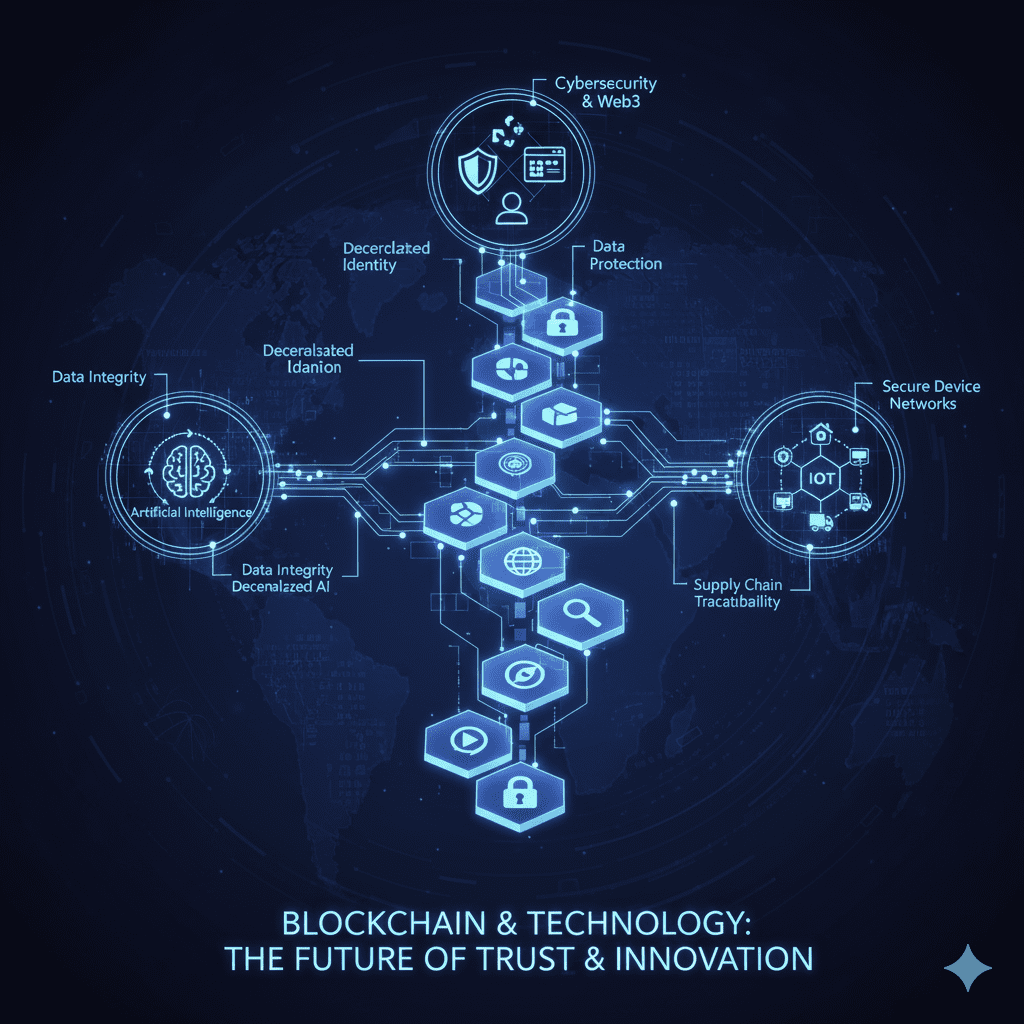
A futuristic infographic titled 'BLOCKCHAIN & TECHNOLOGY,' showing a central blockchain icon connected to other technologies like AI, IoT, Cybersecurity, DeFi, NFTs, and Web3.
Blockchain & Technology

Blockchain’s Role in Building Tomorrow’s Tech

Introduction What do AI, cybersecurity, and the future of the internet (Web3) have in common? They all have critical problems with trust, security, and centralization. Blockchain technology is emerging as the key solution to all three. It’s the invisible architecture that provides the security for our data, the transparency for our transactions, and the ownership of our digital assets. Let’s dive into the technology ecosystem that blockchain is building right now. What is Blockchain? At its simplest, a blockchain is a secure, digital ledger that is shared among many computers in a network. Once a piece of information (a “block”) is added to the ledger, it is linked to the previous block using cryptography, creating a “chain.” This structure makes it immutable, meaning once data is recorded, it is extremely difficult to change or remove. Core Components Decentralization: Instead of one person or company controlling the ledger (like a single bank), the ledger is copied and spread across many computers. This means no single entity has control, and there is no single point of failure. Cryptography: Every transaction is secured and verified using advanced math. This ensures that only the rightful owner can access their assets and that all records are authentic. Blocks: These are the “pages” of the ledger. Each block contains a batch of recent, verified transactions. Consensus Mechanism: This is the “rulebook” that the network follows to agree on which transactions are valid and can be added to the chain (e.g., Proof-of-Work or Proof-of-Stake). The Big Trends: Web3, DeFi, and NFTs Blockchain is the foundational technology for several major trends: Web3: This is the idea of a new, decentralized internet. Web1 was the “read-only” internet (static websites). Web2 is the “read-write” internet we use today (social media, user-generated content), but it’s controlled by large tech companies. Web3 aims to be a “read-write-own” internet, where users control their own data and identity using blockchain. DeFi (Decentralized Finance): This is an entire ecosystem of financial applications built on blockchain. It aims to recreate traditional financial systems (like lending, borrowing, and trading) without the need for intermediaries like banks. Users interact directly with smart contracts. NFTs (Non-Fungible Tokens): An NFT is a unique digital certificate of ownership for an asset (like a piece of digital art, a collectible, or even a real-world item). “Non-fungible” means it’s one-of-a-kind and cannot be replaced by another, unlike a dollar bill, which is fungible. This ownership is recorded and verifiable on the blockchain. Blockchain’s Integration with Other Technologies Blockchain doesn’t exist in a bubble. Its real power is unlocked when combined with other technologies. 1. Artificial Intelligence (AI) Data Integrity: AI models are only as good as the data they’re trained on. Blockchain can provide an immutable, verifiable audit trail for AI training data, ensuring it hasn’t been tampered with and proving its origin. Decentralized AI: It enables “Federated Learning,” where an AI model can be trained across multiple devices without the users’ private data ever leaving their device. The blockchain is used to log and verify the model’s updates, protecting user privacy. 2. Internet of Things (IoT) Security: IoT networks often have thousands of simple devices (like sensors) that are vulnerable to hacking. Blockchain can create a secure, decentralized network for these devices to communicate directly and verifiably, preventing a central server from being hacked. Traceability: For supply chains, an IoT sensor can log a package’s temperature and location to a blockchain at every step. This creates a tamper-proof record that all parties (the producer, the shipper, the customer) can trust. 3. Cybersecurity Decentralized Identity: Instead of relying on Google or Facebook to log in to websites, blockchain allows for Self-Sovereign Identity (SSI). You would control your own digital identity, stored securely, and grant specific, temporary access to services that need to verify it. Mitigating Attacks: By decentralizing data storage, blockchain can help prevent large-scale data breaches. It also makes systems more resilient to Distributed Denial of Service (DDoS) attacks, as there is no single central server to overwhelm Conclusion In conclusion, blockchain has evolved far beyond its origins in cryptocurrency. It is now the essential “trust layer” for the next generation of technology. By providing a decentralized, immutable, and transparent ledger, it solves the critical vulnerabilities in our current systems. It’s the thread that securely connects AI models to verifiable data, enables IoT devices to communicate without a central point of failure, and provides the very foundation for a user-owned internet in Web3, DeFi, and NFTs. As we move forward, it’s clear that blockchain isn’t just another technology in the stack; it’s the fundamental architecture the future is being built on. FAQ Q1: What is blockchain in the simplest terms? Blockchain is a digital ledger, like a shared notebook, that is duplicated and spread across many computers. Once a transaction (a “block”) is added to this notebook, it’s cryptographically linked to the one before it, creating a “chain.” This structure makes the data immutable, meaning it’s nearly impossible to change or tamper with. Q2: Isn’t blockchain just for Bitcoin and cryptocurrency? No. While Bitcoin was the first major application, it’s just one use case. Blockchain is the underlying technology that enables cryptocurrencies, but its core value is in providing a secure and decentralized way to record any kind of data. It’s now being used in supply chains, healthcare, voting systems, cybersecurity, and more. Q3: What’s the difference between Blockchain and Web3? Think of blockchain as the tool and Web3 as the movement. Blockchain is the specific technology (a decentralized ledger). Web3 is the broader vision for a new, decentralized internet built using tools like blockchain, crypto, and decentralized networks. Web3’s goal is to shift control from large tech companies to individual users. Q4: How does blockchain work with Artificial Intelligence (AI)? Blockchain can be seen as the “source of truth” for AI. Data Integrity: It provides a tamper-proof log of the data used to train an AI model, so you can verify its origin and quality. Privacy: It enables federated learning,

Scroll to Top