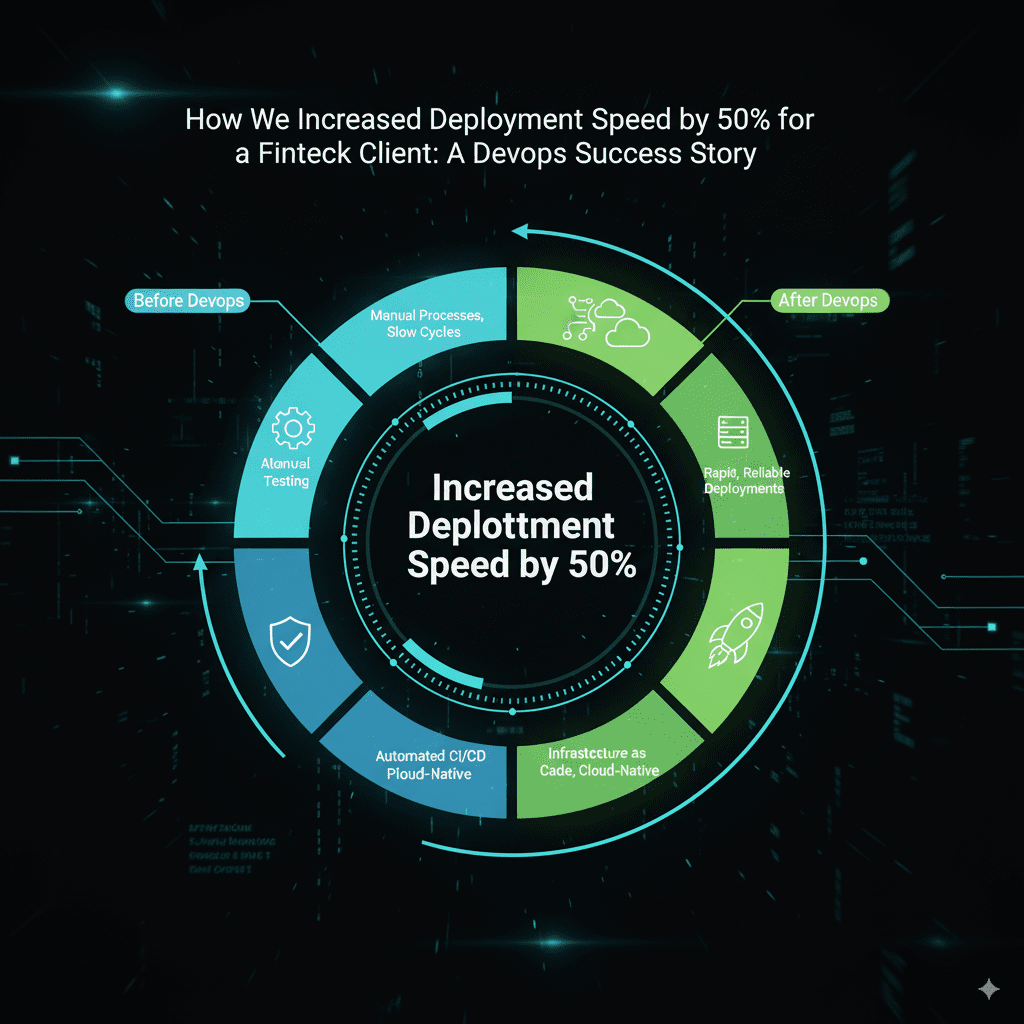
How We Increased Deployment Speed by 50% for a Fintech Client: A DevOps Success Story
Introduction Accelerating deployment velocity while maintaining software quality is the holy grail of modern fintech development. Our recent project achieved a 50% reduction in deployment time for a leading fintech client, enabling faster time-to-market and improved competitive advantage. This transformation streamlined their development pipeline and significantly enhanced their ability to respond to market changes and customer needs. The State of Fintech Development Speed in 2025 Fintech software development has become increasingly complex. According to industry research, projects typically take between one and nine months to complete, averaging about 4.5 months. More concerning is that software development projects often take about 30% more time than initially estimated. In today’s rapidly evolving financial technology landscape, this extended timeline can be the difference between market leadership and obsolescence. The pressure to accelerate deployment is enormous, but the stakes in fintech are equally high. Financial applications demand absolute reliability, security, and compliance, creating a challenging balancing act between speed and quality. Common Deployment Challenges in Fintech Before implementing our solution, our client faced numerous challenges that are common across the fintech industry: Manual Deployment Processes The client’s team spent excessive time manually deploying environments in their application pipeline while still trying to ensure uniform policies, governance, and compliance. This approach was time-consuming but also error-prone and difficult to scale across multiple environments. Tightly Coupled Components The application framework version and the Docker image creation process were tightly coupled, increasing component interdependence and impeding agility. This interdependence created bottlenecks in the deployment process and made it difficult to implement changes quickly. Inefficient Testing Procedures Manual testing consumed over 40% of development time and resources, leading to delayed releases, reduced productivity, and a compromised user experience. Legacy Tools and Vendor Lock-in The existing pipeline presented several problems, including vendor lock-in, lack of transparency, and the inability to support industry-standard integrations. Strategic Approaches That Delivered 50% Faster Deployments Our DevOps Consulting Services are focused on several key areas to dramatically improve deployment speed without compromising quality or security: 1. Implementing Infrastructure as Code (IAC) The most transformative change was the introduction of Infrastructure as Code (Iac) principles. By codifying the deployment of cloud resources, we achieved: One-touch deployment from development to production Consistency across regions, ensuring “First Time Right” changes Reduction in build and deploy times from days to hours This approach eliminated manual errors and provided a repeatable, version-controlled deployment process. 2. Revolutionising the CI/CD Pipeline We completely re-architected the deployment pipeline using DevOps best practices: Replaced proprietary tools with open-source alternatives, saving thousands in licensing costs Implemented streamlined CI/CD pipelines using modern tooling like Drone CI Decoupled Docker image versioning for faster, more flexible deployments 3. Adopting Delta Package Deployments By leveraging Delta package deployments, we reduced deployment time by 60% compared to full deployments. This meant: Only the changed components needed deployment Lower risk of failures More frequent feature releases 4. Automating Quality Assurance Our AI/ML Development team implemented automated testing, which: Replaced manual processes that consumed 40% of development time Enabled consistent, repeatable test scenarios Provided faster feedback to developers Measurable Results Beyond Speed Improvements While the 50% faster deployment was our headline achievement, the benefits extended further: ✅ Enhanced Development Efficiency – Teams now spend more time innovating rather than managing deployments. ✅ Improved Software Quality – Automated testing caught issues earlier, reducing bugs in production. ✅ Cost Reduction – Open-source tools saved thousands in licensing fees. ✅ Better Scalability – Kubernetes orchestration enabled transparent, global scaling. ✅ Increased Business Agility – The client now responds to market changes 50% faster. Implementation Roadmap: Achieving Faster Fintech Deployments For organisations looking to achieve similar results, we recommend our Digital Transformation Services with this roadmap: Assessment & Planning – Identify bottlenecks and automation opportunities. DevOps Foundation – Implement CI/CD pipelines and containerization. Automation Implementation – Use IAC, automated testing, and monitoring. Optimisation & Refinement – Introduce delta deployments and fine-tune resources. Conclusion: Faster Deployment as a Competitive Advantage In the fast-paced fintech industry, deployment speed is a critical differentiator. Our client’s 50% improvement has translated into faster time-to-market, better customer satisfaction, and accelerated innovation. By leveraging Infrastructure as Code, CI/CD optimisation, delta deployments, and QA automation, we’ve set a foundation for sustained success in fintech. For fintech companies struggling with slow deployments, modernising their pipeline isn’t just a technical upgrade—it’s a business imperative. Ready to accelerate your fintech deployments? Explore our DevOps Consulting Services Learn more about our Fintech Solutions How We Increased Deployment Speed by 50% for a Fintech Client: A DevOps Success Story