
healthcare app development

Healthcare & Fitness

How to Custom Healthcare App Development

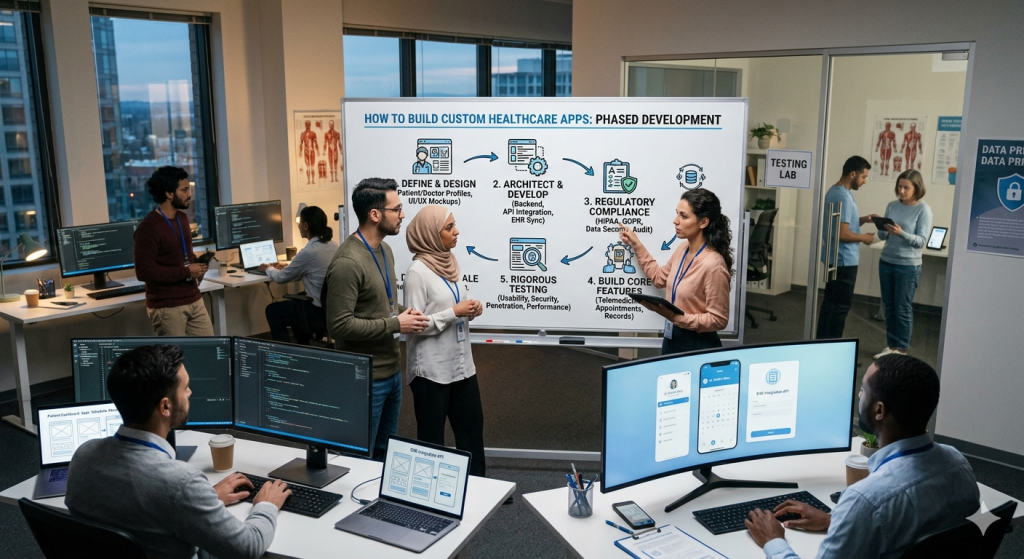
Introduction Custom healthcare app development helps hospitals, clinics, startups, and wellness brands build digital products around real patient and provider needs instead of forcing workflows into generic software. A strong healthcare app can improve appointment booking, remote care, clinical communication, patient monitoring, and record access, but it also has to meet strict privacy, security, and compliance requirements from day one. This guide explains how custom healthcare app development works, what features matter most, how to plan an MVP, and what costs usually shape the project. It is important because healthcare apps handle sensitive data, often integrate with EHR systems, and must balance usability with HIPAA-grade safeguards, audit controls, and role-based access. Custom healthcare app development creates tailored digital solutions for hospitals, clinics, private practices, telehealth startups, and wellness brands, solving real-world problems like appointment chaos, fragmented patient records, inefficient provider communication, and gaps in chronic care management. Unlike generic off-the-shelf software that forces workflows into rigid templates, custom apps adapt to specific needs—whether that’s streamlining triage for emergency departments, enabling remote monitoring for diabetes patients, or building provider collaboration tools that integrate with existing EHR systems. In 2026, healthcare apps must deliver more than convenience; they handle protected health information (PHI), demanding HIPAA-compliant architecture from day one, seamless interoperability with standards like FHIR and HL7, and AI-powered features like predictive analytics, personalized care plans, and real-time clinical decision support. With trends like genomic personalization, blockchain-secured data sharing, AR/VR for medical training and patient education, and 5G-enabled remote monitoring, custom development positions providers and patients for continuous, proactive care beyond clinic walls. The global telemedicine market alone continues explosive growth, making now the ideal time to build apps that scale with rising demand for digital-first healthcare. This comprehensive guide covers planning your app, essential features, compliance requirements, development costs, and proven strategies to launch a HIPAA-secure MVP that drives better outcomes and revenue. Whether you’re a clinic owner modernizing operations or a startup disrupting chronic care, custom healthcare app development delivers measurable ROI through efficiency gains, patient retention, and new service lines. Planning the App The first step in custom healthcare app development is defining the exact problem, audience, and workflow the app will serve, such as patient scheduling, telemedicine, chronic care monitoring, or provider-side care coordination. Successful projects usually start by identifying whether the primary users are patients, doctors, nurses, administrators, or a mix of stakeholders with different needs. A practical planning process includes: Define the core use case and success metric. Build user personas for patients, clinicians, and admins. Prioritize features with an MVP framework such as MoSCoW. Map the core data objects, such as patients, appointments, providers, prescriptions, and reports. Core features Most custom healthcare apps need secure login, profile management, appointments, notifications, and protected data handling as a base layer. Telemedicine products often add doctor discovery, video visits, chat, reminders, and care follow-up tools to make remote consultations work smoothly. Common feature groups include: User authentication and role-based access. Appointment booking and calendar management. Video, voice, or chat consultations. EHR or EMR integration using standards such as HL7 or FHIR. Audit logs, consent handling, and secure document sharing. Compliance and security Compliance is not an add-on in healthcare app development; it shapes architecture, storage, access rules, and incident response from the beginning. If the app handles protected health information for a HIPAA-covered entity and the developer or vendor has persistent access to that data, HIPAA obligations and business associate requirements apply. Security best practices typically include: Encryption in transit and at rest. Strong authentication and session controls. Audit logging and activity tracking. Minimum-necessary access rules. Backup, recovery, and breach response procedures. Cost and timeline Cost depends on the feature set, platform choice, integrations, and compliance complexity. Published 2026-era estimates show that telemedicine-related builds can range from about $40,000 to $100,000 for a basic app and from $100,000 to $300,000 or more for feature-rich platforms, while individual modules such as appointment management or real-time communication add their own cost ranges. A simple budget view is below: Component Typical range Basic telemedicine app $40,000 to $100,000 Advanced healthcare platform $100,000 to $300,000+ Frontend development $20,000 to $70,000 Backend development $30,000 to $100,000+ Conclusion Custom healthcare app development works best when you start with one clear use case, define the right user roles, and build an MVP around secure workflows instead of trying to launch every feature at once. The most reliable products combine patient-friendly UX, provider efficiency, standards-based interoperability, and strict compliance controls before scaling into broader healthcare ecosystems. If you are turning this into a blog title, a cleaner SEO version would be: How to Build a Custom Healthcare App: Complete Development Guide for 2026. FAQ What is custom healthcare app development? It is the process of building a healthcare app tailored to a specific workflow, audience, and compliance need rather than using off-the-shelf software. Which features should come first in an MVP? Secure login, user roles, appointments, messaging or consultations, and protected patient data workflows usually come first. Does every healthcare app need HIPAA compliance? Not every health app does, but apps developed for covered entities that collect or handle protected health information generally must meet HIPAA-related requirements. How much does a custom healthcare app cost? Basic healthcare or telemedicine apps can start around $40,000 to $100,000, while advanced custom platforms can exceed $300,000 depending on integrations and compliance scope. <h2 id=”which-standards-matter-for-interoperability” class=”font-editorial font-bold mb-2 mt-4 [.has-inline-images_&]:clear-end text-base first:mt-0″>Which standards matter for interoperability? HL7 and FHIR are commonly cited standards for healthcare data exchange and interoperability.


Healthcare & Fitness

Telemedicine App Development: Build a Secure & Scalable Telehealth Platform

Introduction As healthcare rapidly digitizes, telemedicine has evolved from a niche offering to an indispensable service connecting patients and providers anywhere, anytime. An effective telemedicine app solves challenges of accessibility, convenience, and real-time care—while navigating complex regulations and security concerns. Building a secure and scalable telehealth platform demands technical innovation, rigorous compliance, and a patient-centered design approach. This blog provides a comprehensive guide for building modern telemedicine apps, packed with insights, feature checklists, technology recommendations, and best practices—plus direct backlinks to TechOTD AI Services, the TechOTD Blog, and other expert resources. 1. Market Research and Defining Your Telemedicine Use Case Successful telemedicine projects start with a clear understanding of real user needs and market gaps. Analyze providers’ workflows and patients’ pain points, leveraging competitor reviews for actionable feedback. Address both acute and chronic care while considering unique regulatory requirements for different specialties and geographies. Plan for compliance early—HIPAA, GDPR, and regional regulations can dramatically affect architecture and timeline. 2. Choose the Right Technology Stack A future-ready telemedicine platform balances security, flexibility, and scale: Layer Examples (2025) Purpose Frontend React Native, Flutter, Swift, Kotlin Cross-platform UI, responsive on all devices Backend Node.js, Python, Java, .NET Fast, scalable API server, handles business logic Database PostgreSQL, MongoDB Secure, reliable storage of health records Cloud AWS, Azure, Google Cloud HIPAA-ready hosting, scalable infrastructure APIs Twilio (video), Stripe/PayPal (payments), Redox/FHIR (EHR) Real-time features, payments, interoperability Security OAuth 2.0, SSL/TLS, JWT Auth, encrypted data, safe transactions AI and predictive analytics integration increase platform value—see TechOTD AI Services and the Predictive Analytics Blog. 3. Design for Security & Compliance Protecting sensitive PHI is paramount. Best practices include: End-to-end encryption for data in transit and at rest Multi-factor authentication Secure role-based access and audit logging Consent management and clear data privacy policies Alignment with HIPAA, GDPR, and local healthcare regulations Blockchain solutions can further secure records and patient consents—explore this in TechOTD Blockchain Integration. 4. Build Core Features for Patients and Providers Modern telehealth platforms deliver an engaging clinical experience: User authentication & onboarding (AI-driven KYC for security) Appointment scheduling & reminders HD video consultations with low-latency streaming Secure chat and document sharing E-prescriptions & digital consents Integrated e-payments & billing, insurance processing EMR/EHR integration for provider continuity AI symptom checkers and post-visit care bots (learn more in AI & LLMs in Healthcare) Accessible UX (voice, large fonts, multi-language) Push notifications and patient engagement tools 5. Ensure Scalability and High Availability App performance should seamlessly support spikes in demand, regional expansion, and new services. Embrace cloud-native, microservices architectures. Implement autoscaling, load balancing, and robust CI/CD pipelines. Plan for future integrations using open APIs and modular software principles. Agile delivery and regular user feedback keep deployment efficient—see how TechOTD’s process optimizes outcomes at How We Work. 6. Testing, Launch, and Post-Launch Strategies Conduct comprehensive unit, integration, UAT, and security tests (HIPAA-aware/penetration testing) Validate cross-platform device and browser compatibility Deploy to app stores/enterprise distribution with rollback and monitoring tools Offer continuous technical support, updates, and user education Monitor app health, collect analytics, and release features iteratively Find guides on process and optimization at the TechOTD Blog. 7. Advanced Innovations: AI, Analytics, and Automation Embed AI to drive smarter care and better outcomes: AI chatbots for triage and 24/7 support (Service Excellence) Predictive risk assessment, personalized content NLP-powered automated documentation and speech-to-text Real-time data dashboards for providers and patients Integration with wearables and IoT for remote monitoring 8. Illustrative Budget and Timeline Telemedicine app costs in 2025 range widely: MVP: $30,000–$75,000 (core video/scheduling/chat) Full scale: $150,000–$250,000+ (AI, cloud, EHR integration, security, automation) Timeline: MVPs in 3–6 months; enterprise solutions 9–18+ months Offshore, onshore, and hybrid teams have different benefits—choose according to compliance needs and project complexity. For more, see: Mobile Apps Services. 9. Key Challenges (and Solutions) Complex multi-jurisdictional compliance—Plan regulatory alignment early User trust and adoption—Transparent privacy, simple UI/UX, clear support Technical integration—Robust APIs and partnerships with labs, pharmacies, and billing platforms Continuous quality—Agile feedback loops, analytics monitoring, rapid update cycles Conclusion Secure, scalable telemedicine platforms are at the heart of digital healthcare’s next decade. With thoughtful planning, a robust technical foundation, airtight security, and user-centric design, organizations can deliver outstanding digital health services at scale. Integrate AI, analytics, and blockchain to future-proof your product, and work with trusted partners for best results. For consulting, custom solutions, and end-to-end app development, partner with TechOTD AI Services, explore real-world results on the TechOTD Blog, and discover streamlined development at How We Work.

Healthcare & Fitness

4 Things You Should Know About Healthcare App Development

Introduction In the last few years, healthcare app development has rapidly gained momentum, revolutionizing how patients, doctors, and healthcare providers interact. From telemedicine platforms to AI-powered diagnostics, healthcare apps today have become an integral part of ensuring efficient care delivery and personalized experiences. The healthcare industry is projected to surpass $660 billion in digital health spending by 2025, with mobile apps leading the wave.   If you’re a healthcare entrepreneur, CTO, or digital transformation leader, understanding the essential factors in healthcare app development is critical. Whether it’s compliance, security, adopting AI, or ensuring seamless user experiences, the right approach can determine your app’s success. 👉 In this blog, we’ll cover the 4 most important things you should know about developing a healthcare app, along with strategies, technologies, and industry best practices. 1. Regulatory Compliance and Data Security in Healthcare Apps Healthcare apps aren’t like normal mobile applications—they deal with highly sensitive patient data. Ensuring compliance with industry regulations is vital to protect user trust and avoid legal issues. Key Compliance Standards: HIPAA (USA) – Protects patient data and privacy. GDPR (Europe) – Ensures secure handling of personal data. ISO 27001 & HL7 Standards – Define best practices for data exchange and information security. Indian PDP Bill (India) – Aligns with data privacy rules. Why Data Security Matters: Over 81% of healthcare organizations have experienced cyberattacks. Breaches cost the healthcare industry $10.93 million per incident (IBM, 2024). Best Practices for Security: Data Encryption – Protect data in transit and at rest. Multi-Factor Authentication (MFA) – Prevent unauthorized access. Cloud Security – Use trusted cloud providers like AWS and Azure (see TechOTD AI services). Compliance-First Development – Integrate compliance rules early in the design (see how we work). 💡 Pro Tip: Always include compliance audits during app development milestones. 2. AI and Emerging Technologies Transforming Healthcare Apps AI is changing the face of healthcare mobile app development. From predictive analytics to computer vision in radiology, AI ensures better outcomes while reducing costs. Examples of AI in Healthcare Apps: Predictive Analytics: For early disease detection (learn more in predictive analytics software guide). Natural Language Processing (NLP): Enables medical chatbots and intelligent diagnosis tools. Generative AI: Assists doctors in generating reports and analyzing patient histories. IoT & Wearables: Collect real-time health data to integrate with hospital systems (IoT in telecom blog). Blockchain: Used in healthcare to secure patient data (see blockchain in Dubai business processes blog). Benefits of AI in Healthcare Apps: ✔️ Faster diagnosis and treatment ✔️ Enhanced patient engagement through personalized care ✔️ Reduced operational costs ✔️ Data-driven insights for doctors and providers 3. User-Centric Design and Seamless Experience No matter how advanced your healthcare app is, if it’s not easy to use, adoption rates will remain low. Both patients and doctors need a frictionless experience. Key Aspects of User Experience (UX) in Healthcare Apps: Intuitive Design: Clear navigation, easy access to reports, and minimal clicks. Accessibility: Voice commands, large fonts, and screen readers for differently-abled users. Telemedicine Integration: Smooth video conferencing with stable connectivity. Data Visualization: Simple dashboards for patients and analytics (powered by tools like Tableau and Grafana—as highlighted in AI services). 📌 Fun Fact: 77% of users uninstall an app within three days if UX is poor. 💡 Pro Tip: Conduct usability testing with real doctors and patients before full-scale deployment. 4. Cost, Scalability, and Long-Term Maintenance Building a healthcare app is not just about the initial launch—it’s a long-term journey. Factors Affecting Healthcare App Development Cost: App Type (patient app, doctor app, telemedicine, pharmacy solutions, etc.) Tech Stack (native apps in Swift vs React Native) AI Features Integration (predictive models, chatbots, computer vision). Security & Compliance Measures. Average Development Cost in 2025: Basic healthcare app: $40K – $60K Mid-level with AI: $80K – $150K Enterprise-grade with full features: $200K+ Scalability Considerations: Support cloud migration with Kubernetes & DevOps integration (TechOTD platforms). Ensure modular architecture for feature upgrades. Invest in ongoing support & maintenance (see service page). Key Points Summary Table Factor Why It’s Important Best Practices / Solutions Regulatory Compliance Legal + patient trust HIPAA, GDPR compliance, audit trails, secure cloud integration AI & Emerging Tech Efficiency + innovation Predictive analytics, NLP chatbots, IoT devices, blockchain for secure records User Experience Adoption & retention Simple UI, telemedicine features, accessibility, dashboard visualization Cost & Scalability Long-term ROI Proper budgeting, modular app design, DevOps + cloud for scalability, maintenance contracts Conclusion Healthcare app development is reshaping global health delivery systems. But success lies in balancing compliance, innovation, patient experience, and scalability. By embracing AI, predictive analytics, robust cloud systems, and secure data handling, businesses can unlock innovative healthcare solutions. If you are planning to develop a healthcare app, partnering with experts like TechOTD can help ensure compliance, efficiency, and future-ready features. 📢 Call-to-Action (CTA): Ready to build a secure, AI-powered healthcare app? Book a free consultation with our experts today to kickstart your journey. Frequently Asked Questions (FAQ) 1. How long does it take to develop a healthcare app? It usually takes 4–8 months depending on app complexity, integrations, and compliance requirements. 2. Which technologies are best for healthcare app development? Popular frameworks include Swift, React Native, Python, TensorFlow, and Kubernetes. AI and IoT integrations are also widely used. 3. How can AI improve healthcare apps? AI improves diagnosis, patient engagement, and predictive healthcare insights while lowering costs. 4. Do healthcare apps need to comply with HIPAA or GDPR? Yes. Compliance is essential to ensure data security, avoid penalties, and maintain patient trust. 5. What is the average cost of developing a healthcare app in 2025? Between $60K and $200K+, depending on complexity, features, and compliance level.

Scroll to Top