
GEO

AI search optimization for websites and modern search visibility
Artificial Intelligence

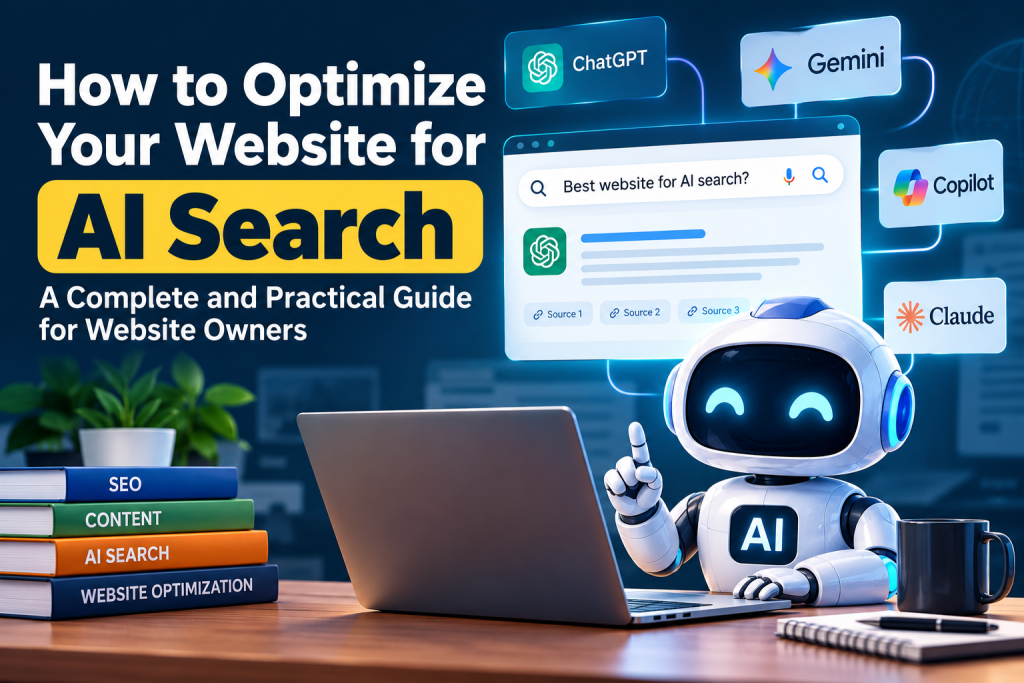
How to Get Your Website Recommended by AI Search in 2026

Artificial intelligence is changing the way people discover information online. Instead of only showing a traditional list of search results, modern search engines can now generate answers, summarize information, and recommend websites as sources. This change is creating a new opportunity for website owners. Ranking on Google is still important, but businesses also need to understand how their content can become visible in AI-powered search experiences such as AI Overviews and AI Mode. AI search optimization focuses on making website content clear, useful, trustworthy, and easy for search systems to understand. Strong content structure, relevant information, technical SEO, and clear answers can all contribute to better visibility across modern search experiences. In this guide, we’ll explain how AI search works, what makes content easier for AI systems to understand, and the practical steps businesses can take to increase their chances of being discovered and cited in AI-powered search. What Is AI Search Optimization? AI search optimization is the process of improving website content so that AI-powered search systems can understand, interpret, and potentially surface it when answering user queries. It combines traditional SEO principles with clear information structure, useful content, strong context, and trustworthy sources. Traditional SEO mainly focuses on helping search engines understand pages and determine where they should appear in search results. AI search adds another layer because systems may need to understand a question, identify relevant information from multiple sources, and generate a direct response for the user. The goal is not to create content specifically for an AI system at the expense of users. Instead, websites should provide accurate, original, well-structured information that clearly answers real questions. This can make content easier for both traditional search engines and AI-powered search experiences to understand. How AI Search Is Different From Traditional Search Traditional search and AI-powered search can use many of the same underlying signals, but the user experience is different. Instead of only returning a list of links, AI search can combine information and provide a conversational answer with supporting sources. Traditional Search In traditional search, a user enters a query and receives a ranked list of web pages. SEO helps search engines understand the content, relevance, and structure of those pages so they can be matched with appropriate queries. AI-Powered Search AI-powered search can interpret more complex questions, identify relevant information, and generate a response using information from multiple sources. Depending on the search experience, users may also see links or citations to websites that support the answer. Why This Matters for Websites A website may therefore need to do more than target individual keywords. Its content should clearly explain topics, answer related questions, provide useful context, and demonstrate credibility. Well-organized information can make it easier for search systems to understand what a page is about and when it may be relevant. How AI Search Chooses Information AI-powered search does not simply look for a page containing an exact keyword. It needs to understand the meaning of a query and identify information that is relevant, useful, and trustworthy. This makes the quality and structure of website content increasingly important.   Relevance to the User’s Question Content should directly address the question a user is asking. A page that clearly explains a topic and answers related questions can provide more useful information than a page that simply repeats a keyword many times. Clear and Structured Information Clear headings, short sections, descriptive titles, lists, tables, and well-organized paragraphs help users understand information quickly. They also provide useful context about the purpose and subject of different sections of a page. Original and Helpful Content Websites should provide information that adds genuine value instead of simply rewriting information already available elsewhere. Original examples, practical explanations, firsthand experience, useful data, and unique insights can make a page more valuable to readers. Trust and Credibility Important claims should be supported by reliable sources where appropriate. Clear authorship, accurate information, transparent references, and a trustworthy website experience can help establish credibility. Fresh and Updated Information Some topics change quickly, especially technology, software, security, and business. Keeping information accurate and updating outdated sections can make content more useful when people search for current information. 7 Practical Ways to Optimize Your Website for AI Search Getting visibility in AI-powered search is not about adding a special meta tag or using one secret SEO technique. It starts with creating content that is genuinely useful, technically accessible, easy to understand, and supported by clear information. 1. Create Direct Answers to Real Questions Research the questions your target audience actually asks and create dedicated sections that answer those questions clearly. Avoid unnecessary introductions before giving the main answer. A direct and complete explanation makes the content more useful for both readers and search systems. 2. Build Topic Depth Instead of Keyword Stuffing Cover the important aspects of a topic rather than repeatedly inserting the same keyword. Related concepts, examples, definitions, comparisons, and practical information help establish the context of a page without making the content unnatural. 3. Use Clear Content Structure Organize articles with descriptive headings, short paragraphs, lists, tables, and clearly separated sections. A logical structure helps visitors find information quickly and makes the relationship between different parts of the topic easier to understand. 4. Add Firsthand Experience and Original Insights Whenever possible, include original examples, experiments, case studies, screenshots, data, or lessons learned from real projects. Unique information gives users a reason to visit your website instead of relying only on content that repeats what other websites have already published. 5. Support Important Claims With Reliable Sources When an article includes statistics, research findings, technical claims, or current information, link to reliable sources that support those claims. This gives readers a way to verify important information and adds useful context to the article. 6. Strengthen Internal Linking Connect related pages across your website using natural and descriptive anchor text. Internal links help visitors discover related information and help search systems understand how different pages within your website are connected. 7. Keep Technical SEO Strong

Artificial Intelligence, Digital Transformation

Future of Search After AI

The Future of Search After AI: Navigating the Era of Generative Discovery For nearly three decades, the foundational mechanics of the internet relied on a simple, predictable contract: a user typed a sequence of keywords into a blank text box, an engine matched those strings against an index of web pages, and the user clicked a blue link to find their answer. This “rank-and-click” paradigm built empires, funded global digital media economies, and formed the bedrock of Search Engine Optimization (SEO). That contract has officially expired. We are living through the most volatile paradigm shift in the history of digital information architecture. The emergence of advanced Large Language Models (LLMs), conversational engines, and multi-modal assistants has transformed search engines from mere finding tools into synthesis tools. Instead of guiding users to a destination where an answer lives, search engines now read the destinations, extract the data, and build the answer themselves. Understanding the future of search after AI requires looking beyond simple keyword lists to understand Generative Engine Optimization (GEO), AI-native user behaviors, and the tactical steps required to keep your brand visible in a synthesized digital world. 1. The Anatomy of Modern AI Search Engines To understand where search is going, we must first look at how the dominant players are evolving their interfaces to merge traditional information retrieval with generative synthesis. [User Dynamic Intent] │ ▼ [Multi-Modal Vector Analysis] ──► [Real-Time Context Tuning] │ ▼ [Retrieval-Augmented Generation (RAG)] ──► [Vector DB & Core Index] │ ▼ [Synthesized Output Layer] ──► [Conversational Interface + Deep Citations] Google AI Overviews (formerly SGE) Google’s approach does not entirely discard the traditional web index; instead, it superimposes a generative summary layer above it. Using a sophisticated pipeline rooted in Retrieval-Augmented Generation (RAG), Google pulls a localized cluster of highly authoritative pages, processes their semantic contents in real-time, and generates an objective answer complete with dynamic link cards and inline citations. OpenAI Search & Conversational Disruptors Alternative models strip away the remnants of legacy SERPs entirely. They favor a natural, fluid conversational interface. Rather than treating each search as an isolated event, these engines retain memory, understand deep pronouns, and allow users to iteratively narrow down a complex task (e.g., “Find a hotel in Tokyo, narrow it down to options with gym access, and build a three-day itinerary around them”). Perplexity AI and the Answer Engine Revolution Perplexity pioneered the concept of the “Answer Engine.” It treats the web as a live vector database, summarizing diverse viewpoints and providing numbered citations for every factual claim. This setup shifts the user’s focus from evaluating website designs to evaluating the factual integrity of the synthesized information block. 2. From Keywords to Entities: The Semantic Shift In the pre-AI era, search engines were largely deterministic systems matching keywords. If your page contained the phrase “best enterprise data security software” a specific number of times alongside strong backlink signals, you ranked. In the post-AI ecosystem, search engines operate via vector embeddings and entity graphs. Vector Spaces: Mathematical representations where words, sentences, and entire concepts are plotted as coordinates based on their semantic proximity. Intent Resolution: AI engines understand the hidden intent behind a phrase, even if the user lacks the technical vocabulary to express it perfectly. Entity Relationships: The engine looks at your brand as a node within a massive knowledge network, assessing how it connects to defined industries, founders, products, and competitor nodes. Attribute / Metric Traditional Search Era Post-AI Search Era Interface Style Static Page Links Dynamic Synthesized Text & Media Optimization Focus Latent Semantic Indexing (LSI) Entity Realism & Information Gain User Interaction Query ➔ Fragmented Clicks Dialogue ➔ Final Resolution Primary Value Metric Raw Organic Traffic / CTR Share of Model (SoM) & Citations 3. The Death of Commodity Content and the Rise of Information Gain For years, the standard playbook for content marketing was to look at what already ranked on page one, combine the points into a longer article, and optimize the metadata. AI search engines have made this strategy completely obsolete. Because LLMs already possess a compressed model of all public information, they don’t need another blog post that restates standard industry definitions. If your content reads like a paraphrase of Wikipedia, the AI will absorb it into its training or retrieval data but will have zero incentive to link out to you. The new currency of digital visibility is Information Gain. Information Gain = Your Unique Insights – Publicly Available Training Data To achieve high information gain scores, content must feature: First-Party Data Matrices: Proprietary benchmarks, survey metrics, or internal operational statistics. Deep Case Studies: Verifiable narratives detailing an exact issue, the step-by-step execution taken, and the quantified results. Counter-Intuitive Frameworks: Expert perspectives that challenge common industry assumptions with logical, well-reasoned evidence. 4. The 6 Strategic Pillars of Generative Engine Optimization (GEO) To adapt to the future of search, digital strategies must pivot from classic SEO to Generative Engine Optimization (GEO). Here are the six pillars required to make your digital properties highly indexable for AI search bots. Pillar 1: The “Atomic Answer” Architecture AI agents search for information blocks that can be easily extracted and integrated into summaries. To optimize for this, build your pages using an atomic layout: The Definition Anchor: Directly under an H2 or H3 heading, write a 40-to-60-word declarative sentence defining the concept clearly. Avoid preamble or filler text. The Structural Breakdown: Immediately follow that definition with a bulleted list, an ordered sequence, or an HTML data table to make the information easy for machines to read. The Explanatory Context: Follow the structured data block with your deep-dive narrative, analysis, and supporting case examples. Pillar 2: Radical E-E-A-T and Digital Identity Mapping Because AI engines risk spreading hallucinations, their retrieval layers use strict quality filtering based on Experience, Expertise, Authoritativeness, and Trustworthiness (E-E-A-T). Author Identity Resolution: Every piece of informational content must be tied to a real person with a verifiable digital footprint. Use explicit schema to connect your author profiles to their

Artificial Intelligence, Digital Transformation, Technology & Innovation

What Is GEO (Generative Engine Optimization)?

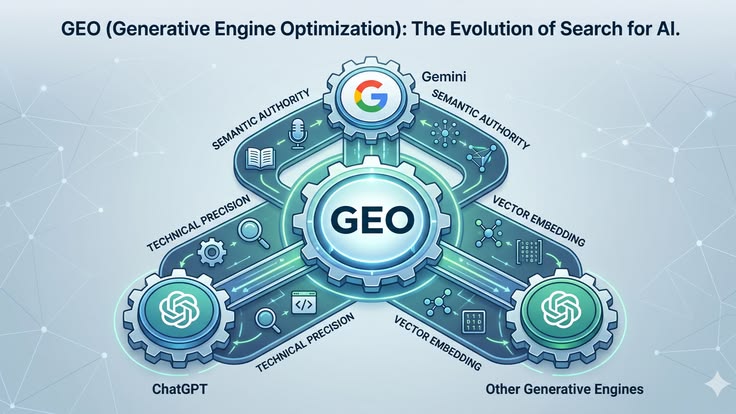
What Is GEO (Generative Engine Optimization)? The Complete Guide to AI-First Search The digital marketing landscape is facing its most disruptive shift since the inception of the commercial internet. For decades, search engine optimization (SEO) has been the undisputed king of organic visibility. Businesses mastered the art of appealing to Google’s PageRank and crawler bots to land a spot on the coveted first page of “10 blue links.” However, user behavior is fundamentally changing. With the massive integration of Artificial Intelligence into our daily search habits—via Google’s AI Overviews, OpenAI’s SearchGPT, and conversational answer engines like Perplexity AI—users no longer want a list of websites to click through. They want direct, synthesized, and immediate answers to complex questions. To survive this transition, brands must pivot from traditional SEO to GEO (Generative Engine Optimization). GEO is the strategic practice of optimizing digital content so that Large Language Models (LLMs) and generative search systems pick your brand, cite your website, and recommend your products when answering a user’s conversational prompt. 1. How Generative Search Works: Under the Hood To optimize for an AI engine, you must understand how it retrieves information. Traditional engines map keywords to a massive database index. Generative engines use an architecture called Retrieval-Augmented Generation (RAG). [ User Complex Prompt ] │ ▼ [ RAG Search Layer ] ──> Scrapes & Aggregates Authoritative Web Sources │ ▼ [ LLM Context Window ] ──> Synthesizes & Formulates Cohesive Response │ ▼ [ Output: Conversational Answer + In-Text Citations ] When a user submits a complex prompt, the AI search engine doesn’t just guess an answer. It uses a RAG system to perform a lightning-fast web search for high-quality, relevant articles. It pulls the text from those top-performing pages and feeds them into the LLM’s context window. The LLM reads that aggregated data, synthesizes it, and formats a humanlike response, complete with in-text citations linking back to the source material. Your entire goal with GEO is to ensure your content is structured so perfectly that the RAG system extracts it, and the LLM trusts it enough to cite it. 2. Core Pillars of Generative Engine Optimization (GEO) According to empirical research on AI search visibility, standard keyword stuffing will actively hurt your performance in generative results. Instead, AI engines favor specific content characteristics: A. Authoritative and Statistical Inclusion LLMs are designed to minimize hallucinations (making things up). Because of this, their retrieval layers actively hunt for concrete facts, verified statistics, and primary research data. The Blueprint: Instead of writing vague statements like “Many companies use remote work software,” write with precision: “According to a 2026 Stanford study, 42% of the US labor force now works from home full-time.” B. Structural Fluency & Information Density AI models read text exponentially faster when it is organized logically. Messy walls of text make it difficult for the retrieval system to pull key facts cleanly. The Blueprint: Use explicit markdown formatting. Break down data into clear comparison tables, use highly descriptive H2 and H3 headings, and present actionable takeaways in bulleted lists. C. Direct Answer Architecture (The TL;DR Block) Generative engines want to answer the user as quickly as possible. If your article hides the main answer at the very bottom of a 2,000-word post, an AI bot will pass it over for a site that delivers immediate value. The Blueprint: Implement a “Direct Answer Block” or a summary box right beneath your main article title. Give the AI the exact definition or solution it needs to scrape instantly, then provide the deep-dive context below. 3. SEO vs. GEO: A Deep Comparison Matrix Feature / Metric Traditional SEO Generative Engine Optimization (GEO) User Search Style Short, fragmented phrases (e.g., “best wireless headphones”) Long, contextual prompts (e.g., “what are the best noise-canceling headphones for a small head on a 6-hour flight?”) Primary Goal Rank #1 in the organic search results list Become the primary cited source or product recommendation inside the AI response Content Focus Target keyword volume, search intent, and comprehensive topic coverage High information density, first-party data, and expert quotes Technical Driver XML sitemaps, clean URLs, and basic meta tags Advanced Schema Markup (Product, FAQ, Organization) and unblocked AI bots Primary Metric Search engine ranking positions (SERP) and raw organic clicks Share of Voice (SoV) in AI answers and referral traffic from AI subdomains 4. How to Optimize Your Website for the Big Three AI Engines Each major player in the AI search race handles data extraction slightly differently. A robust GEO strategy accounts for these unique preferences. 1. Google AI Overviews (Gemini) Google’s AI capabilities are native extensions of its core web index. Leverage EEAT: Experience, Expertise, Authoritativeness, and Trustworthiness are non-negotiable. Ensure your content features clear author biographies, links to verified social profiles, and expert credentials. Keep Core Web Vitals Flawless: If your page takes too long to load or render, Google’s real-time RAG engine will skip past your site to maintain its conversational speed. 2. OpenAI SearchGPT / ChatGPT Search OpenAI heavily weights real-time web discovery alongside its deeply integrated premium publisher partnerships. Digital PR and Third-Party Reviews: SearchGPT often pulls brand recommendations by looking at web sentiment. To show up as a recommended product, ensure your brand has consistent, positive mentions on third-party review platforms (like G2, Trustpilot, or industry forums). Verify Robot Permissions: Check your robots.txt file and make sure you haven’t blocked search crawlers like OAI-SearchBot. 3. Perplexity AI Perplexity operates as an aggressive real-time citation machine, aiming to act as the internet’s definitive bibliography. Be the Original Source: Perplexity prioritizes primary data over secondary aggregators. Focus on publishing original research, proprietary data sets, or case studies. Participate in Community Hubs: Perplexity frequently looks at Reddit and niche forums to gather real-world human consensus. Maintaining an active brand presence on these channels can pull your business directly into Perplexity’s citation loop. 5. Critical Mistakes to Avoid Relying on Generic AI Content Swarms: Mass-producing basic AI-generated text to build a massive blog footprint backfires in GEO. If your

Scroll to Top