
financial innovation

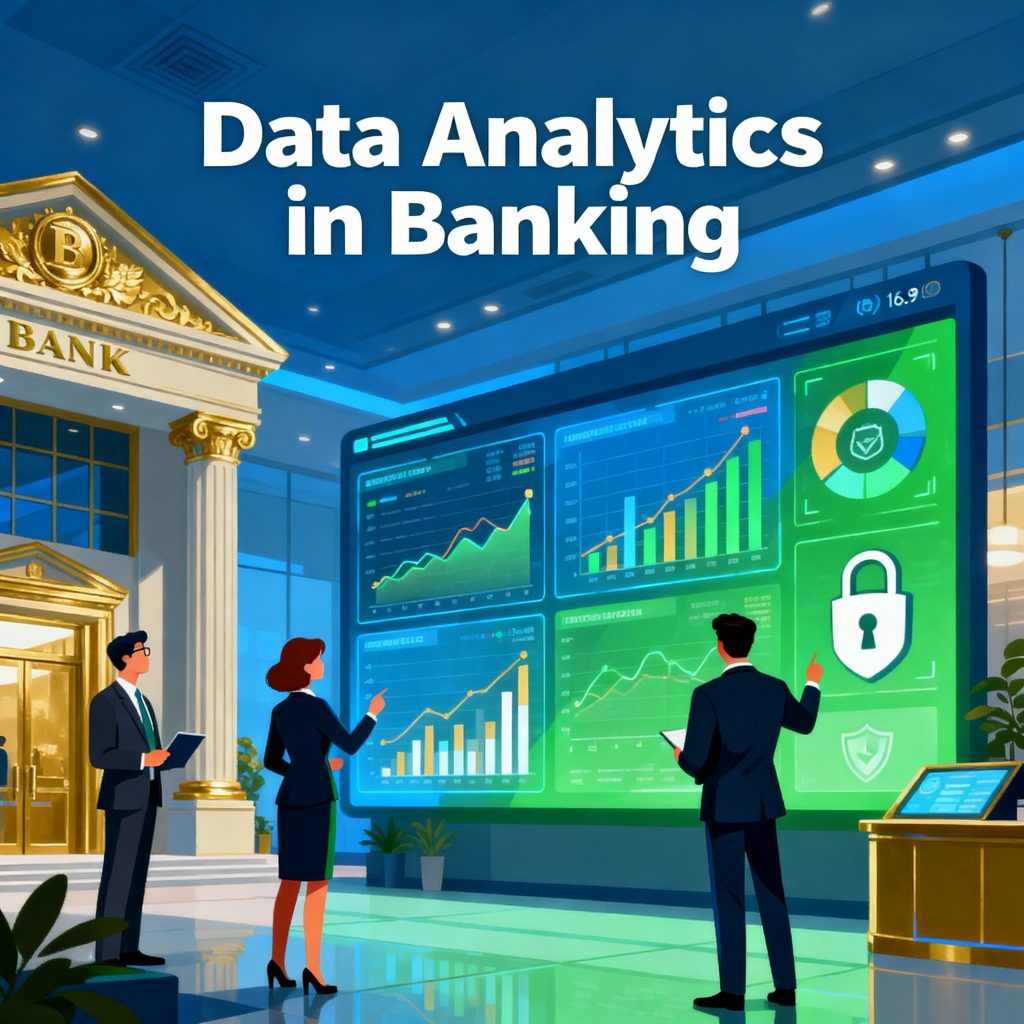
2D illustration of a modern bank with professionals examining colorful digital analytics dashboards, security icons, and vibrant graphs, highlighting data analytics in banking.
data science

Data Analytics in Banking: Transforming Finance in 2025

  Introduction The banking industry is entering a new era—where every transaction, service, and decision is powered by data analytics in banking, banking analytics, and data-driven banking. From retail and commercial banking to investment and treasury, financial institutions are now harnessing the power of analytics tools, financial data analysis, and artificial intelligence to drive smarter strategies, deliver personalized customer experiences, prevent fraud, and manage risk more effectively than ever before. In today’s competitive financial landscape, banks that embrace data analytics not only thrive—they set the pace. For insights on related financial innovation, read our guide to predictive analytics software development. For the latest industry research from a leading consultancy, visit McKinsey Financial Services Insights. How Data Analytics Powers Modern Banking Fraud Detection and AML/KYC Real-time transaction monitoring, anomaly detection, and predictive analytics flag suspicious activity for strong anti-fraud and compliance measures in banking analytics. Machine learning models analyze transaction patterns to detect fraud, building trust and reducing losses for data-driven banking. Customer Segmentation & Personalization Banks group customers by behavior, demographics, and spending patterns for highly relevant product offerings powered by financial data analysis. Personalized recommendations, communications, and experiences increase retention by up to 85% when personalization is prioritized in data analytics in banking. Credit Risk Assessment Advanced credit analytics leverage alternative data and predictive analytics models to accurately assess borrower risk, reducing non-performing assets. Faster and fairer data-driven lending decisions empower responsible lending and expand financial inclusion. Churn Prediction & Retention Analytics identify at-risk customers early, enabling banks to trigger proactive retention campaigns and reduce churn in banking analytics. Early intervention through data-driven banking strategies boosts long-term relationship value. Operational Efficiency & Compliance Streamlined reporting and process automation lower regulatory costs and compliance errors in banking analytics (compliance costs can drop by 20%). Automated pipelines support real-time reporting for Basel, IFRS9, and SEBI requirements with predictive analytics in banking. Predictive Analytics for Strategy Predictive analytics models anticipate cash/ATM demand, optimize pricing, assess investment risk, and forecast market trends for smarter business decisions. Scenario analysis enables banks to adapt to changing economic conditions using data analytics in banking. Real-World Use Cases   Use Case Description Fraud Detection Real-time analytics spot and prevent suspicious transactions using banking analytics. Personalized Banking Banks offer tailored products and services brought by data-driven banking and customer financial data analysis. Loan Default Prediction Machine learning credit scoring supports risk decisions, reducing losses in banking analytics. Compliance Reporting Automation cuts regulatory costs and errors in financial data analysis. Customer Churn Prediction Analytics identify at-risk accounts for targeted retention using predictive analytics. Pricing Optimization Data-driven interest rates and dynamic product pricing improve growth. Strategic ATM Placement Analytics and data-driven banking determine ATM locations for higher usage and savings. Benefits of Data Analytics in Banking Smarter, faster data-driven decisions for revenue growth Stronger fraud prevention and security through predictive analytics Better risk management using banking analytics tools Personalized customer engagement and loyalty Reduced operational costs and improved compliance in financial data analysis Deeper customer insight for strategic data-driven banking innovation Conclusion Data analytics in banking, banking analytics, and predictive analytics are transforming every facet of the industry—empowering institutions to innovate, mitigate risk, and deliver exceptional service. As financial data analysis and data-driven banking become standard in 2025, analytics will drive resilient, future-ready financial strategies. FAQ How does data analytics prevent banking fraud? By using real-time monitoring and machine learning, analytics detect fraudulent patterns and anomalies rapidly, minimizing losses. What is customer segmentation and why does it matter? It’s grouping customers by behavioral and demographic traits, helping banks target relevant offerings for higher engagement and loyalty. How does analytics improve loan approval speed? Credit scoring models use multiple data sources for instant, accurate risk assessment—approving loans faster and reducing bad debt. Can analytics reduce compliance costs? Yes, automation of reporting and data management slashes compliance expenses and error rates. What’s the future of analytics in banking? Expect smarter AI models, blockchain integration for data transparency, real-time insights, and hyper-personalized banking as standard.  

finance, Technology

Digital Currencies vs Traditional Banking: Who Will Win?

Introduction The world of money is at a pivotal crossroads: digital currencies are transforming how people move and store value, while traditional banking remains the cornerstone of global finance. With instantly accessible digital wallets and the rise of central bank digital currencies (CBDCs), the competition between digital and conventional banking is fierce. This blog unpacks what digital currency is, how it compares to traditional banking, and which model could shape the future of finance. What Is a Digital Currency? Digital currency is a form of money that exists only in electronic form There are no coins or notes. Other names include digital money, electronic money, e-currency, and cybercast. These currencies are accessible only via computers, smartphones, and online wallets, and they’re used to execute electronic transactions globally.   Key Take aways Digital currencies are purely electronic; there are no physical coins or notes. They typically allow faster, cheaper transactions by skipping intermediaries. All cryptocurrencies are digital currencies, but not all digital currencies are cryptocurrencies. Pros: Fast transfers, global accessibility, lower costs, enhanced privacy. Cons: Technical barriers, hacking risks, volatile prices, limited acceptance, irreversibility. Types of Digital Currencies Cryptocurrencies: Decentralized, secured using cryptography, e.g., Bitcoin, Ethereum. Virtual Currencies: Issued by private networks, often for gaming or social platforms. Central Bank Digital Currencies (CBDCs): Regulated, issued by governments (e.g., digital yuan), designed to supplement or replace traditional currency. Digital Currency vs Traditional Banking Feature Digital Currency Traditional Banking Form Purely electronic, no physical format Physical + digital (cash, cards, e-banking) Transaction Speed Instant, 24/7 global transfers Slower, especially cross-border, limited by business hours Accessibility Anyone with an internet connection; global reach Branch-based, dependent on banking infrastructure Cost Low transaction fees, no intermediaries Higher fees, multiple middlemen Regulation Varies: crypto unregulated, CBDCs highly regulated Highly regulated and insured Privacy High (in some types), can be anonymous Identity-linked, less private Security & Safety Prone to hacks and irreversibility of errors Strong consumer protection mechanisms Physical Presence Not required Branches for in-person help and complex services Stability & Trust Volatile (especially crypto); growing for CBDCs Stable, decades of public trust Use Cases Remittances, online payments, digital investments Deposits, loans, wealth management, daily banking Where Digital Currencies Shine Seamless online payments and transfers across borders, ideal for gig workers and global businesses. Financial inclusion where traditional banking infrastructure is weak. Programmable money in decentralized finance (Defib), reducing costs and enabling automation (e.g., smart contracts). Increased privacy and control for tech-savvy users. Where Traditional Banks Reign Widespread acceptability—banks are integrated into most economies. Personal service for complex needs like mortgages, investments, and financial advice. Stability during market upheavals due to regulatory protections. Deposit insurance and consumer protections. The Future: Competition or Collaboration? Most experts foresee coexistence: digital currencies will complement, not completely replace, traditional banking in the near term. CBDCs are helping banks modernize, allowing for direct, government-backed digital money. Banks are adopting blockchain and digital tech to offer faster payments and enhanced security. Conclusion No clear winner has emerged—yet. Digital currencies and traditional banking each serve different needs. Digital currencies are pushing boundaries, making transactions faster, cheaper, and potentially more private. Traditional banks still deliver trust, security, and broad financial services. The ultimate “winner” will likely be a hybrid system, combining digital innovation with the reassuring stability of traditional banks. Are you ready for the future of money? Explore how digital wallets, crypto, or CBDCs could enhance your financial life—and don’t ignore the staying power of your local bank branch. The choice is increasingly yours! FAQ Q1: Are all digital currencies cryptocurrencies? No, while all cryptocurrencies are digital currencies, not all digital currencies use blockchain or cryptography—CBDCs and virtual currencies are examples that may not. Q2: Do I need a bank account to use digital currency? Typically, no. Digital currencies can be accessed via digital wallets without a bank, though some platforms may require identity checks. Q3: Are digital currencies safer than traditional banking? Digital currencies offer privacy and fast transfers but carry hacking and volatility risks. Traditional banks provide regulated protection and insurance. Q4: Can digital currencies replace banks? Not entirely—banks offer a range of services, personal support, and stability. Digital currencies may complement, but not fully replace, traditional banking soon. Q5: What is a Central Bank Digital Currency (CBDC)? A CBDC is a state-issued, regulated digital currency designed to supplement (or eventually replace) physical money, with direct access from central authorities.

Scroll to Top