
Enterprise Tech

Artificial Intelligence, Cloud Computing and Technology, Software development

The Shift to Autonomous Ecosystems: Why Static Software is Dying in 2026

The Shift to Autonomous Ecosystems: Why Static Software is Dying in 2026 Remember when we used to log into an application, click five different buttons to generate a report, download a CSV file, and then manually upload it into another software system? For decades, human-computer interaction followed a strict, predictable script. Software was a passive tool. It sat there, waiting for a human to input data, trigger a command, or click a button. If you wanted to automate something, you had to build rigid, brittle API connections or rely on brittle Robotic Process Automation (RPA) scripts that broke the second a user interface changed by a single pixel. Welcome to 2026. The era of the static, passive software application is officially drawing to a close. We are currently living through the most profound shift in computer science since the migration from desktop mainframes to the cloud. We are moving away from traditional software applications and moving toward Autonomous Ecosystems—self-healing, self-optimizing networks of cognitive AI agents, decentralized edge nodes, and fluid data architectures that adapt to human intent in real time. In this deep dive, we will unpack exactly what this paradigm shift looks like, how it’s rewriting the rules of software development, the infrastructure powering it, and what it means for businesses striving to stay relevant. 1. The Anatomy of Static vs. Autonomous Software To understand where we are going, we must first look at where we’ve been. Traditional software is inherently deterministic. You write code that says: If User Executes Action A, Trigger Event B. Autonomous software, by contrast, is probabilistic and goal-oriented. You don’t tell the software how to do a task; you tell it what goal to achieve, establish the boundaries (guardrails), and let the system determine the optimal path to get there. A Side-by-Side Comparison Feature Traditional (Static) Software Autonomous Ecosystems Logic Execution Hardcoded, deterministic rules and conditional branches. Probabilistic reasoning via Cognitive Architectures & LLMs. Integration Rigid, pre-built API integrations or webhook chains. Dynamic, on-the-fly tool discovery and negotiation. User Interface Fixed graphical user interfaces (GUIs) with static dashboards. Generative User Interfaces (GUIs) that adapt to the user’s immediate context. Maintenance Requires manual debugging, patching, and code updates. Self-healing codebases with automated telemetry-driven optimization. Data Interaction Structured relational databases or rigid NoSQL storage. Vector spaces, semantic graphs, and streaming real-time memory. When software transitions from a tool you use to a partner that collaborates with you, the entire friction point of enterprise operations disappears. 2. The Rise of Agentic Workflows: Beyond the Chatbot When Large Language Models (LLMs) exploded onto the scene a few years ago, everyone thought the future of tech was a simple text box. You ask a question, you get an answer. It was impressive, but it was still fundamentally a static interaction model: Prompt $\rightarrow$ Response. Today, we have moved squarely into the era of Agentic Workflows. An AI Agent isn’t just a chatbot; it’s an autonomous software entity equipped with reasoning capabilities, long-term memory, access to external tools, and the ability to execute multi-step plans without human intervention. [User Goal Input] │ ▼ ┌────────────────────────────────────────┐ │ Cognitive Planning Layer │ │ (Breaks goal into sequential tasks) │ └──────────────────┬─────────────────────┘ │ ▼ ┌────────────────────────────────────────┐ │ Execution & Tool Discovery │ │ (APIs, Web Browsing, Databases) │ └──────────────────┬─────────────────────┘ │ ▼ ┌────────────────────────────────────────┐ │ Self-Reflection & Audit │ │ (Evaluates if results match the goal) │ └──────────────────┬─────────────────────┘ │ ▼ [Final Achieved Outcome] The Three Pillars of Modern Agentic Systems Reasoning and Planning (The Brain): Instead of executing code line by line, modern systems leverage advanced cognitive architectures like Tree-of-Thoughts (ToT) or Graph-of-Thoughts (GoT). This allows software to simulate multiple paths to a solution, evaluate the drawbacks of each, and pick the path with the highest probability of success. Dynamic Tool Utilization: If an autonomous system needs information it doesn’t possess, it doesn’t throw an error. It searches for available web APIs, reads the documentation documentation dynamically, authenticates itself, and pulls the required data payload. Reflection and Self-Correction: When a human software engineer writes code, they test it. Autonomous agents do the same. If an action fails or returns a bad payload, the agent reflects on the failure, adjusts its strategy, and tries an alternative route. 3. Deconstructing the Architecture: How it Works Under the Hood Building an autonomous ecosystem requires a fundamentally different tech stack than building a traditional React-Node-PostgreSQL application. Let’s break down the core components driving modern autonomous architectures. The Semantic Memory Layer In traditional apps, memory is state management (like Redux) or a fast cache database (like Redis). In autonomous ecosystems, memory is divided into three tiers: Sensory Memory: Immediate, in-context information processing (the current token window). Short-Term Memory: The trace logs of the current session or task workflow sequence. Long-Term Memory: A vector database combined with a Knowledge Graph. This allows the system to store embeddings of past interactions, organizational policies, and historical context that can be fetched via semantic similarity searches. Dynamic API Generation and Graph Orchestration Instead of hardcoding an integration between your CRM (like Salesforce) and your marketing tool (like Hubspot), autonomous ecosystems treat external software suites as nodes in a dynamic graph. Using protocols like JSON-RPC or semantic OpenAPI schemas, an orchestrator evaluates the capabilities of different platforms on the fly. If you migrate from one vendor to another, you no longer need to spend months rewriting your integration pipeline. The autonomous system auto-discovers the new endpoints, maps the data schemas, and continues operation seamless. 4. Real-World Applications: Where the Paradigm Shift is Happening Now This isn’t theoretical science fiction. Businesses across sectors are actively dismantling their legacy, static software suites to make room for fluid ecosystems. Supply Chain and Logistics Autonomy In traditional supply chain software, an alert flags a delay in shipping. A human manager logs in, views the delay, calls alternative suppliers, creates a new purchase order, updates the inventory tracker, and emails the logistics coordinator. In an autonomous supply chain ecosystem: The system monitors global weather patterns, port telemetry, and shipping data streams. The
Artificial Intelligence, Technology & Innovation

Architects of Autonomy: The Complete Guide to Deploying Agentic AI in Enterprise Infrastructure

Introduction:- The landscape of artificial intelligence has shifted dramatically. For the past few years, organizations focused heavily on Generative AI—using Large Language Models (LLMs) primarily as sophisticated chatbots, creative writing assistants, or static data summarizers. While these applications delivered clear productivity gains, they remained fundamentally reactive. A human had to prompt the system, evaluate the output, copy-paste the result into another tool, and decide on the next course of action. The AI was a tool, not a teammate. Today, we are witnessing the dawn of the Agentic AI era. This paradigm shift moves us away from passive text generation and toward autonomous execution. Agentic AI refers to systems powered by advanced foundation models that can perceive their environment, reason through complex objectives, formulate multi-step plans, utilize external tools, collaborate with other digital entities, and execute actions to achieve specific business goals with minimal human intervention. For enterprise leaders and technology architects, this transition represents both an unprecedented opportunity and a massive infrastructure challenge. Transitioning from a single prompt-and-response model to a continuously running ecosystem of autonomous agents requires a fundamental rethinking of data pipelines, compute allocation, security frameworks, and software architecture. This guide provides a definitive roadmap for understanding, designing, and deploying enterprise-grade Agentic AI within modern technical ecosystems. Understanding the Anatomy of an AI Agent To build an effective agentic architecture, we must first break down what an AI agent actually is. Unlike a standard software program that follows rigid if/then logic, or a baseline LLM that predicts the next token in a vacuum, an autonomous agent functions as a dynamic loop of perception, reasoning, and action. An enterprise-grade agent consists of four core pillars. The Reasoning Core (The Brain) At the center of every agent is a foundation model, typically an LLM or a multimodal model. The core model acts as the central processing unit. It accepts a high-level goal from a user—such as “Audit our quarterly cloud expenditure and automatically resolve any misallocated billing codes”—and breaks it down into a logical sequence of sub-tasks. The reasoning engine utilizes sophisticated cognitive frameworks like Chain-of-Thought (CoT) or ReAct (Reason and Act) to evaluate its own progress, spot mistakes in its thinking, and pivot its approach when encountering obstacles. Memory Systems (The Context Engine) An agent cannot function effectively if it forgets what it did two minutes ago or lacks historical context about the enterprise. Agent architectures employ two primary types of memory: Short-Term Memory: This captures the immediate, in-flight context of the current task. It tracks what sub-tasks have been completed, what data has been gathered, and what the immediate next step is within a single session. Long-Term Memory: Powered by vector databases and semantic indexing, long-term memory allows an agent to retain knowledge across weeks, months, or thousands of distinct interactions. It stores user preferences, historical corporate data, past mistakes, and successful resolution patterns, allowing the agent to get smarter over time. Tool Integration (The Extremities) An LLM trapped in a sandbox can only talk. To turn talk into action, agents must be equipped with tools. Tools are APIs, database connectors, software development kits (SDKs), web scrapers, or even legacy terminal interfaces that allow the agent to interact with the external digital world. Through a process called function calling, the reasoning core determines when it needs external data or actions, selects the appropriate tool, formats the payload correctly, executes the call, and consumes the resulting data back into its reasoning loop. The Execution and Planning Layer (The Controller) This layer acts as the orchestrator that manages the state machine of the agent. It enforces constraints, manages token budgets, sets timeouts, and dictates how the agent should handle errors. If an API call fails, the planning layer prompts the reasoning core to find an alternative route rather than letting the system crash or enter an infinite loop. Infrastructure Requirements for Enterprise Agentic AI Deploying an application that hits an OpenAI or Anthropic API occasionally is relatively straightforward. Deploying thousands of autonomous agents that run continuously, polling systems, analyzing data streams, and modifying databases requires a robust, scalable, and highly resilient underlying infrastructure. Organizations looking to adopt agentic workflows must invest heavily in three distinct areas of their tech stack. Compute Optimization and Inference Scalability Agentic workflows are compute-intensive. A single user request to an agent might trigger twenty sequential calls to an LLM as the agent reasons, checks a database, refines its query, calls an API, validates the output, and finalizes the result. This creates a massive compounding effect on inference costs and latency. To mitigate this, enterprises are moving away from relying solely on commercial, one-size-fits-all API endpoints. Instead, they are adopting hybrid architectures. High-level planning and critical decision-making are routed to frontier models. Meanwhile, specialized, smaller open-source models (such as Llama-3 or Mistral variants fine-tuned for specific tasks like SQL generation or API interaction) are hosted locally on private cloud infrastructure. Utilizing advanced inference frameworks like vLLM or TensorRT-LLM, combined with dynamic batching, allows enterprises to maintain low latencies and manage predictable compute expenditures. High-Velocity and Graph-Based Data Pipelines Traditional Retrieval-Augmented Generation (RAG) relies on chunking documents and turning them into flat vector embeddings. While this works well for basic question-answering, it falls short for agentic workflows that require understanding complex corporate hierarchies, relational dependencies, and fast-changing operational data. Next-generation agent infrastructure requires a shift toward Knowledge Graphs integrated with vector spaces (GraphRAG). By representing corporate data as nodes (e.g., projects, employees, servers, clients) and edges (e.g., owns, reports to, depends on), agents can perform vastly superior semantic reasoning. If an agent is tasked with diagnosing a system outage, a knowledge graph allows it to instantly trace how a failure in a specific microservice impacts a downstream billing database, giving it the holistic perspective needed to take accurate corrective action. LLM Orchestration and Agent Frameworks Building an agent from scratch using raw API calls is akin to writing a web application in assembly language. Development teams require structured frameworks to manage agent lifecycles, states, and communications.

Artificial Intelligence, Software development, Technology & Innovation

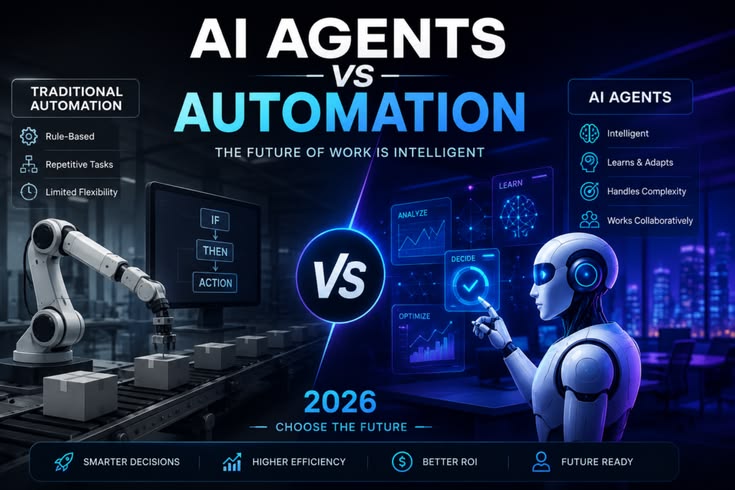
AI Agents vs. Traditional Automation: What’s Changing in 2026?

Introduction: The Evolution from Rules to Reasoning For decades, digital transformation was defined by a single, unwavering engineering paradigm: determinism. If you wanted a machine to execute a task, you had to explicitly map out every single variable, branch, and conditional statement beforehand. If an input deviated by even a single character from the expected schema, the automation would crash. This rigid framework birthed the massive market for Robotic Process Automation (RPA) and standard backend API integrations. By 2026, this deterministic wall has completely crumbled. We are currently witnessing a massive architectural migration from standard rule-based workflows to autonomous AI Agents. Unlike traditional software that simply accelerates data transmission across static structures, AI agents possess a cognitive layer. They don’t just execute instructions; they reason, interpret intent, adapt to unpredictable runtime changes, and dynamically formulate their own execution paths. This guide explores the deep technical divides between these two methodologies, maps out the core mechanics of agentic systems, and provides an enterprise blueprint for managing this massive shift. Section 1: Defining the Technical Boundary To understand this architectural evolution, we must establish clear technical boundaries between traditional automation and an actual AI agent. Traditional Automation: Rule-Based Systems Traditional automation operates entirely on if-this-then-that (IFTTT) execution graphs. A software engineer constructs a explicit pipeline using tools like Selenium, UiPath, or custom cron jobs. The software intercepts an input, references a hardcoded template or static database schema, maps fields explicitly, and routes the data to a destination API. The software has zero contextual understanding of the data it manipulates. If a vendor changes a button’s CSS selector on a billing portal, or if an invoice shifts a line item by five pixels, the script breaks. It cannot problem-solve because its world consists exclusively of binary conditions and explicitly coded paths. AI Agents: Goal-Oriented Systems An AI Agent is a software entity that leverages a Large Language Model (LLM) or Large Multimodal Model (LMM) as its central processing unit, running inside a continuous, stateful loop. Instead of receiving a step-by-step instruction set, an agent is given an objective, a set of constraints, and access to an array of external tools. The agent evaluates the current state of its environment, breaks down the main objective into an ordered series of sub-tasks, selects the appropriate tool for the immediate sub-task, analyzes the output of that tool, and continuously modifies its strategy based on real-time feedback. It handles unstructured data natively because it interprets semantic meaning rather than just looking for exact string matches. Section 2: Architectural Comparison: Static Pipelines vs. Cognitive Loops The foundational code paths of these two systems look fundamentally different under the hood. The Linear Pipeline Structure Traditional automation relies on linear or predictable branching logic. The execution flow looks like this: [Inbound Webhook] —> [Parse Exact JSON Schema] —> [Conditional Branching] —> [Write to Destination API] If any link in this chain encounters an anomaly, the execution thread fails, records an error log, and requires human intervention to patch the underlying code. The Agentic Cognitive Loop An autonomous AI agent runs within a non-linear, dynamic cognitive loop, often structured around the OODA Loop (Observe, Orient, Decide, Act) framework: +—————————————+ | Goal Formulation | +—————————————+ | v +———————————————+ —–> | Perception & Observation (Ingest Context) | | +———————————————+ | | | v | +———————————————+ | | Reasoning & Planning (LLM Evaluation) | | +———————————————+ | | | v | +———————————————+ | | Tool Selection & Execution (Take Action) | | +———————————————+ | | +—————————–+ The Core Pillars of Agent Architecture 1. The Planning Core The planning engine decomposes the primary target into manageable milestones. Modern agents utilize advanced prompt-engineering frameworks like Chain-of-Thought (CoT) or Tree-of-Thoughts (ToT) to explore multiple reasoning paths simultaneously, evaluating the probability of success for each direction before executing code. 2. Contextual Memory Systems Agents rely on two distinct memory tiers to maintain consistency over long-running operations: Short-Term Memory: Managed directly via the model’s active context window, keeping track of immediate conversational turns, tool outputs, and local state variables. Long-Term Memory: Powered by an external vector database or graph database. The agent saves past executions, successful problem-solving strategies, and corporate guidelines, retrieving them via semantic search whenever a similar task boundary arises. 3. Tool Utilization (Function Calling) Tools are the hands of the agent. A tool can be a database connection, an internal API, a web scraper, or a command-line terminal. The agent reads the documentation of these tools (written in clear, natural language schemas), determines which tool matches the current sub-task, formats the payload dynamically, executes the call, and parses the returned data to determine the next course of action. Section 3: In-Depth Comparison Matrix Technical Capability Traditional Automation (RPA/APIs) Autonomous AI Agents (2026 Paradigm) Input Type Access Strictly Structured (JSON, XML, CSV) Fully Unstructured (Audio, Video, PDFs, Free Text) Execution Paths Static, Pre-compiled, Deterministic Dynamic, Emergent, Goal-Oriented Error Handling Hardcoded try/catch blocks; immediate crash Autonomous Self-Healing and Error Correction Maintenance Profile High overhead; breaks on UI/API changes Self-adapting; updates strategies based on UI shifts Data Processing Exact string matching and regex parsers Semantic interpretation and conceptual mapping Compute Overhead Negligible; ultra-lightweight execution Substantial; high dependency on token throughput and inference speeds Section 4: Deep Dive into Multi-Agent Orchestration Systems As enterprise environments scale up, relying on a single, massive monolithic agent becomes inefficient. The complexity of managing massive context windows and disparate tool sets introduces latency and hallucinations. The industry has shifted heavily toward Multi-Agent Systems (MAS). In a multi-agent framework, complex corporate operations are divided among specialized, narrow AI agents that communicate with each other over structured protocol buses. +———————————–+ | Enterprise Controller | | (Manager/Router Agent) | +———————————–+ | +———————–+———————–+ | | v v +———————–+ +———————–+ | Security Audit Agent | | Data Extraction Agent | | – Validates Code | <== (Internal Bus) => | – Parses Documents | | – Monitors Regs | | – Cleans Inbound APIs| +———————–+ +———————–+ The Hierarchical Topology In this architecture, a Manager Agent intercepts user intents

Scroll to Top