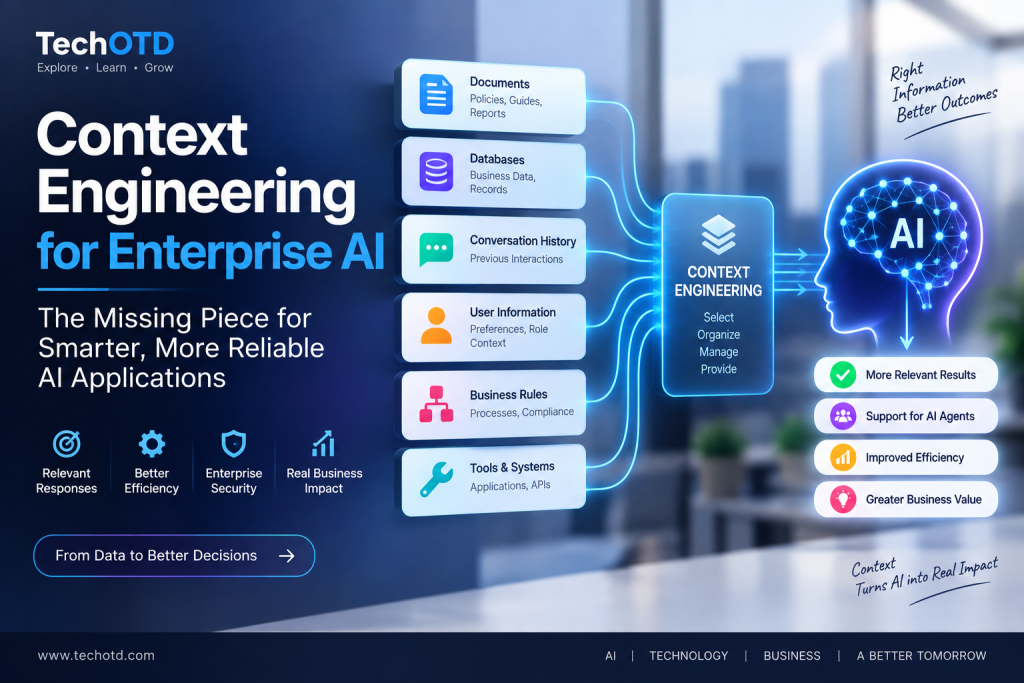
Enterprise AI

Context engineering for enterprise AI using business data and relevant information
Artificial Intelligence

Context Engineering: Why It Is Becoming Essential for Enterprise AI

Introduction As artificial intelligence becomes more deeply integrated into business applications, the quality of AI responses depends on more than the prompt alone. AI systems often need access to relevant information, instructions, user history, business data, and task-specific context to produce useful and reliable results. Prompt engineering focuses on designing effective instructions for AI models, but enterprise AI applications often require a broader approach. Businesses need to determine what information should be provided to an AI system, how that information should be structured, and when it should be included in the AI workflow. Context engineering is the process of designing and managing the information available to an AI system so it can better understand a task and generate more relevant responses. As organizations build AI agents and complex AI applications, effective context management is becoming increasingly important for performance, reliability, and scalability. What Is Context Engineering? Context engineering is the process of selecting, organizing, and providing the right information to an AI system so it can better understand a task and generate relevant, accurate, and useful responses. This information can include instructions, user preferences, conversation history, business data, documents, retrieved knowledge, and details about the current task. More Than Writing Better Prompts Prompt engineering focuses primarily on how instructions are written, while context engineering takes a broader approach. It considers everything the AI system needs to know before generating a response, including relevant background information, data, rules, and the current situation. Providing the Right Information at the Right Time An AI system does not always need access to every available piece of information. Context engineering helps determine which information is relevant to a specific task and when that information should be provided to the model. Managing Different Types of Context Enterprise AI applications may use multiple types of context, including system instructions, conversation history, customer information, company documents, database records, retrieved knowledge, and outputs from other AI tools or workflows. Why Context Quality Matters The quality and relevance of the information provided to an AI model can directly influence the usefulness of its output. Too little context may lead to incomplete responses, while irrelevant or excessive information can make it harder for the AI system to focus on the task. By carefully managing what information an AI system receives, businesses can build applications that produce more relevant and consistent results while using AI resources more efficiently. Context Engineering vs Prompt Engineering Context engineering and prompt engineering are closely related, but they focus on different parts of an AI interaction. Prompt engineering focuses on designing effective instructions, while context engineering focuses on managing the broader set of information that an AI system receives before generating a response. The Role of Prompt Engineering Prompt engineering focuses on how instructions are written and structured to guide an AI model toward a desired response. A well-designed prompt can clarify the task, define the expected output, and provide instructions about tone, format, or constraints. The Role of Context Engineering Context engineering considers the wider information environment around the prompt. This can include conversation history, user preferences, business rules, retrieved documents, database information, previous actions, and other task-specific data. Why Enterprise AI Needs Both Enterprise AI applications often require both effective prompts and well-managed context. Clear instructions help the AI understand what it should do, while relevant context helps the model understand the information and situation required to complete the task effectively. A Simple Example A customer support AI may receive an instruction to answer a customer’s question, but it may also need access to the customer’s recent interactions, product information, account details, company policies, and relevant support documents. Context engineering helps determine which of this information should be available for that specific request. Prompt engineering helps define the task, while context engineering helps provide the information needed to complete that task. Together, they can support more useful and reliable AI applications. Why Context Engineering Is Important for Enterprise AI Enterprise AI applications often operate in complex environments where a simple prompt is not enough to produce reliable results. AI systems may need access to business knowledge, user information, current data, previous interactions, and specific organizational rules to understand and complete a task effectively. Enterprise Information Is Often Distributed Business information may be stored across documents, databases, internal applications, knowledge bases, and communication systems. Context engineering helps determine how relevant information can be selected and provided to AI applications when it is needed. Better Context Can Improve AI Output Quality AI models can generate more useful responses when they receive relevant and accurate information about the task. Providing appropriate context can help reduce incomplete responses and improve the relevance of AI-generated outputs. Supporting AI Agents and Complex Workflows AI agents often perform tasks across multiple steps and may interact with different tools, systems, and sources of information. Context engineering can help ensure that an AI agent has access to the relevant information required at each stage of a workflow. Reducing Unnecessary Information Providing every available document or data source to an AI model can create unnecessary complexity and increase resource usage. Context engineering helps focus the AI system on information that is relevant to the current task. Supporting More Consistent AI Applications Enterprise AI applications may be used by many employees, customers, or automated systems. Well-managed context can help create more consistent behavior by ensuring that AI systems receive relevant instructions and information across different interactions. As enterprise AI systems become more connected to business data and workflows, context engineering can play an important role in improving AI performance, reliability, efficiency, and scalability. Key Components of Context Engineering Effective context engineering involves managing different types of information that can influence how an AI system understands and completes a task. Businesses need to decide what information should be included, how it should be organized, and when it should be provided to the AI model. System Instructions System instructions define the overall role, rules, priorities, and behavior expected from an AI system. They can provide consistent guidance
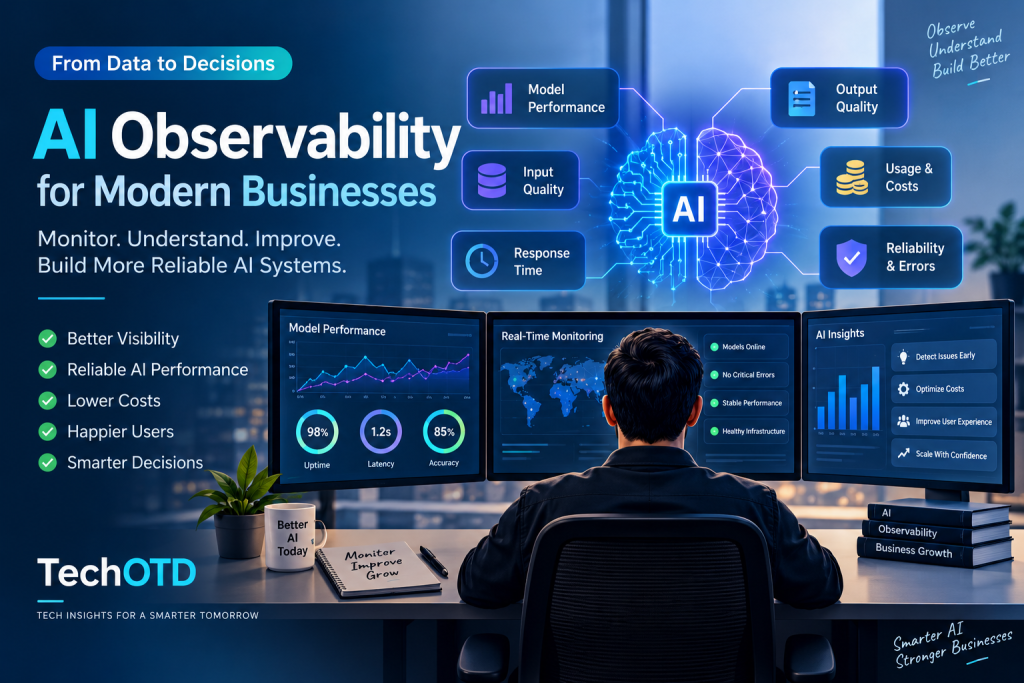
AI observability dashboard monitoring AI performance and system reliability
Artificial Intelligence

AI Observability: Why Businesses Need to Monitor AI Systems

Introduction Businesses are increasingly using artificial intelligence in customer support, software development, data analysis, automation, and decision-making. As AI systems become more important to daily business operations, organizations need better visibility into how these systems perform in real-world environments. Traditional monitoring tools can track infrastructure, applications, and system availability, but AI systems introduce additional challenges. AI outputs can vary, model performance can change over time, and factors such as data quality, response time, cost, and reliability can directly affect business outcomes. AI observability helps organizations understand what is happening inside their AI systems by monitoring model behavior, performance, inputs, outputs, and operational metrics. This visibility can help businesses identify problems, improve reliability, and manage AI systems more effectively as they scale. What Is AI Observability? AI observability is the ability to understand, monitor, and analyze how an AI system behaves in real-world operation. It provides visibility into factors such as model inputs, outputs, performance, response times, reliability, and resource usage. Beyond Traditional System Monitoring Traditional monitoring focuses primarily on infrastructure health, application availability, and technical metrics. AI observability goes further by helping organizations understand how AI models behave, whether their outputs remain useful and reliable, and how changes in data or usage affect overall performance. Understanding AI System Behavior AI systems can produce different outputs depending on the input, context, model configuration, and data available at the time of a request. AI observability helps businesses analyze these behaviors and identify unexpected patterns or performance issues. Monitoring Inputs and Outputs Monitoring AI inputs and outputs can help organizations understand how users and applications interact with AI systems. This visibility can support the detection of poor-quality inputs, unexpected responses, and patterns that may affect business performance. Supporting Reliable AI Operations As AI systems become part of important business workflows, reliability becomes increasingly important. AI observability can help teams identify potential issues earlier and maintain better visibility into how AI applications perform over time. By combining operational monitoring with visibility into model behavior, inputs, outputs, and performance, AI observability helps organizations manage increasingly complex AI systems more effectively. Why AI Observability Is Important for Businesses As businesses move AI systems from experimentation into real-world applications, understanding how those systems perform becomes increasingly important. Without clear visibility, organizations may struggle to identify why AI outputs change, performance declines, costs increase, or user experiences become inconsistent. AI Systems Can Change Over Time AI performance can change as user behavior, data patterns, workloads, and business requirements evolve. AI observability helps organizations identify these changes and understand whether they are affecting the quality or reliability of AI applications. AI Problems Are Not Always Infrastructure Problems An AI application can appear technically available while still producing poor or unreliable results. Infrastructure monitoring may show that servers and APIs are working correctly, but AI observability can provide additional visibility into model outputs and application behavior. Better Visibility for Business and Technical Teams AI systems often involve technical teams, business teams, and end users. AI observability can provide useful information that helps different stakeholders understand system performance and identify areas that may require improvement. Supporting AI at Scale As AI applications handle more users, requests, models, and workflows, identifying problems manually becomes increasingly difficult. AI observability can help organizations maintain visibility as their AI environments become larger and more complex. By providing a clearer view of how AI systems behave in production, AI observability can help businesses make more informed decisions about reliability, performance, cost, and future AI improvements. What Businesses Should Monitor in AI Systems AI observability involves monitoring more than whether an application is online or offline. Businesses need visibility into different aspects of AI system behavior to understand whether their models and AI-powered applications are delivering reliable and useful results. Model Performance Businesses should monitor whether AI models continue to perform effectively for their intended tasks. Changes in model behavior or output quality can affect the reliability and usefulness of AI applications. Input Quality and Data Patterns The quality and characteristics of inputs can significantly influence AI outputs. Monitoring data patterns can help organizations identify unusual inputs, changing user behavior, or data issues that may affect model performance. Output Quality AI-generated outputs should be monitored to determine whether they remain accurate, relevant, consistent, and useful for the intended business use case. Unexpected output patterns may indicate a need for further investigation or improvement. Response Time and Latency Response speed can directly affect the user experience of AI applications. Monitoring latency helps businesses identify whether delays are caused by models, APIs, infrastructure, or other parts of the AI workflow. AI Usage and Costs Businesses should monitor how AI resources are being used and how costs change as workloads grow. Tracking model usage, requests, and resource consumption can support better AI cost management and help identify unexpected spending. Errors and Reliability Monitoring errors, failures, and system reliability can help organizations identify technical issues that affect AI applications. Reliable AI operations require visibility into both traditional system health and AI-specific performance. By monitoring these areas together, businesses can develop a more complete understanding of how their AI systems perform and identify opportunities to improve reliability, efficiency, and business outcomes. AI Observability vs Traditional Monitoring Traditional monitoring and AI observability both help organizations understand how technology systems perform, but they focus on different types of information. Traditional monitoring primarily tracks infrastructure and application health, while AI observability provides additional visibility into model behavior, inputs, outputs, and AI-specific performance. Traditional Monitoring Traditional monitoring focuses on technical metrics such as server availability, CPU usage, memory consumption, application uptime, network performance, and error rates. These metrics help technical teams determine whether the underlying infrastructure and applications are operating correctly. AI Observability AI observability expands monitoring by examining how AI systems behave. It can provide visibility into model inputs, generated outputs, response quality, latency, usage patterns, and other factors that affect the performance of AI-powered applications. Why Businesses May Need Both An AI application depends on both reliable technical infrastructure and reliable AI behavior.

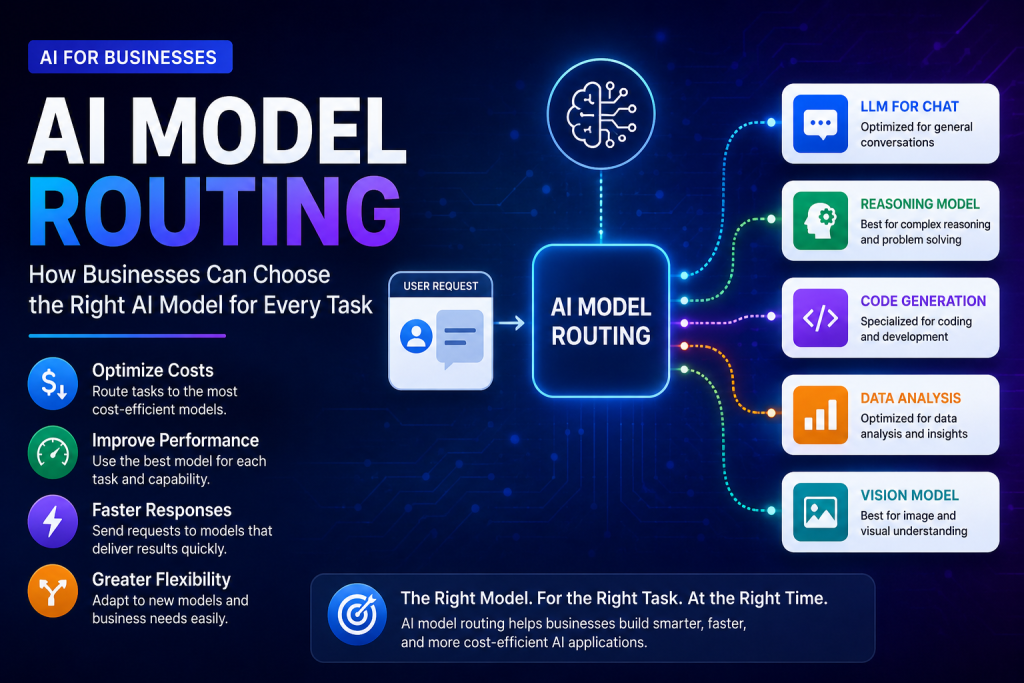
AI model routing for businesses choosing the right AI model for every task
Artificial Intelligence

AI Model Routing: How Businesses Can Choose the Right AI Model for Every Task

Introduction Businesses are increasingly using artificial intelligence for customer support, content creation, data analysis, software development, and decision-making. However, not every AI task requires the same type of model. Different AI models can vary in capability, speed, cost, and specialization. Using a single AI model for every task can increase costs and may not always provide the best balance between performance and efficiency. As organizations adopt multiple AI models, they need a smarter way to decide which model should handle each request. AI model routing helps businesses direct AI tasks to the most suitable model based on factors such as complexity, cost, speed, capability, and business requirements. This approach can help organizations improve performance while using AI resources more efficiently. What Is AI Model Routing? AI model routing is the process of directing an AI request to the most suitable model based on the requirements of a specific task. Instead of sending every request to the same model, an AI system can evaluate factors such as task complexity, required accuracy, response speed, cost, and model capabilities. Why One AI Model Is Not Always Enough AI models are designed with different strengths. Some models may be better for complex reasoning, while others may provide faster responses, lower costs, coding capabilities, or multimodal features. Using one model for every situation can therefore be inefficient. How AI Model Routing Works An AI model routing system analyzes the requirements of an incoming request and selects an appropriate model. Simple tasks may be directed to efficient models, while more complex tasks can be routed to advanced models with stronger reasoning or specialized capabilities. Key Factors Used in Model Selection AI model routing can consider factors such as task type, complexity, expected output quality, response time, cost, available models, and specific business requirements. These factors help determine which model is the most suitable for a particular request. By matching AI workloads with appropriate models, businesses can create more flexible AI systems that balance performance, speed, and cost. Why AI Model Routing Is Becoming Important for Businesses As businesses adopt more AI tools and models, managing which model is used for each task is becoming increasingly important. Organizations may use different models for language processing, reasoning, coding, data analysis, and multimodal applications, creating a need for more efficient AI model management. Growing Number of Available AI Models Businesses now have access to a growing range of AI models with different capabilities, performance levels, and pricing structures. Choosing the same model for every workload can limit flexibility and increase unnecessary costs. Balancing Performance and Cost More advanced AI models can provide stronger capabilities for complex tasks, but they may also require more computing resources or have higher usage costs. AI model routing can help businesses balance performance requirements with the cost of AI operations. Improving Response Speed Some AI applications require fast responses, such as customer support systems and real-time business tools. Routing suitable requests to faster models can help improve responsiveness while reserving more powerful models for tasks that require advanced capabilities. Supporting Multiple AI Use Cases A single organization may use AI for many different purposes, including content processing, software development, analytics, customer service, and internal automation. AI model routing can help manage these diverse workloads more effectively. How AI Model Routing Works in Practice In practice, AI model routing works by evaluating an incoming request and determining which available model is most suitable for handling it. The routing decision can be based on predefined rules, performance requirements, cost limits, or automated evaluation systems. Step 1: Understanding the Request The AI system first analyzes the incoming request to understand its type and requirements. For example, a request may involve summarization, reasoning, coding, data analysis, image understanding, or another specialized task. Step 2: Evaluating Task Requirements The routing system can evaluate factors such as task complexity, required response speed, expected accuracy, available budget, and security or privacy requirements. These factors help determine the level of AI capability needed. Step 3: Selecting the Appropriate Model Based on the evaluation, the system selects a suitable AI model. Simple or repetitive tasks may be handled by smaller and more efficient models, while complex reasoning or specialized tasks may be directed to more advanced models. Step 4: Processing the Request The selected AI model processes the request and generates a response. The result can then be returned directly to the user or passed to another application, workflow, or business system. Step 5: Monitoring Results and Performance Businesses can monitor response quality, processing time, model usage, and cost after requests are completed. This information can help organizations improve routing decisions and optimize their AI systems over time. By continuously evaluating AI workloads and model performance, businesses can make AI model routing more accurate, efficient, and aligned with changing business requirements. Key Benefits of AI Model Routing for Businesses AI model routing can help businesses build more flexible and efficient AI systems. By selecting models based on the requirements of each task, organizations can improve how they use AI resources while maintaining the level of performance required for different business applications. 1. Better Cost Optimization Not every request requires the most advanced or expensive AI model. AI model routing can direct simpler tasks to efficient models and reserve more powerful models for complex workloads, helping businesses reduce unnecessary AI spending. 2. Improved Performance Different AI models have different strengths. Routing tasks to models that are better suited for specific capabilities, such as reasoning, coding, language processing, or multimodal analysis, can help improve overall application performance. 3. Faster Response Times Businesses can route time-sensitive requests to models that provide faster responses. This can improve the user experience for applications such as customer support, internal tools, and real-time AI services. 4. Greater Flexibility A multi-model approach allows organizations to adapt as AI technologies change. Businesses can add, replace, or evaluate models without redesigning their entire AI strategy around a single provider or model. 5. Better AI Resource Management AI model routing provides greater control

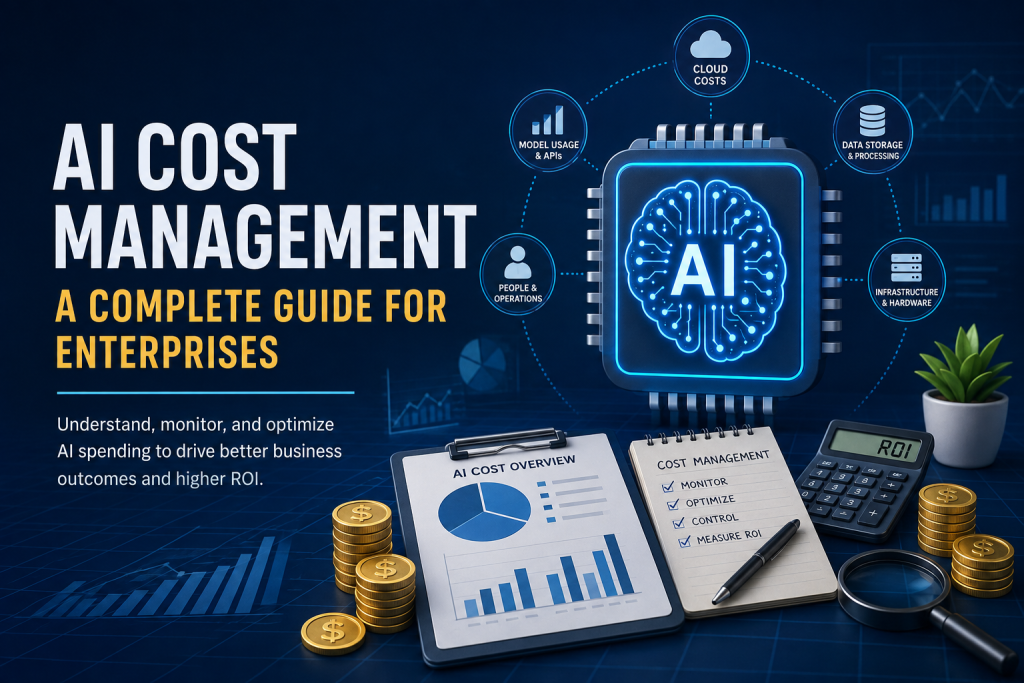
AI cost management for enterprises to monitor and optimize AI spending
Artificial Intelligence

The Hidden Cost of AI: How Businesses Can Control AI Spending in 2026

Introduction Artificial intelligence is becoming an increasingly important part of modern business operations. Companies are using AI for automation, data analysis, customer support, software development, content creation, and decision-making. However, as AI adoption grows, so does the cost of running and scaling AI systems. The cost of AI is not always limited to purchasing a software subscription. Businesses may also need to consider AI model usage, token consumption, API requests, inference infrastructure, data processing, specialized hardware, and the cost of managing AI systems at scale. AI cost management helps organizations understand where their AI spending is coming from and how efficiently their resources are being used. By monitoring costs, optimizing AI workloads, and connecting spending with business outcomes, companies can work toward improving the return on their AI investments. What Is AI Cost Management? AI cost management is the process of tracking, understanding, and controlling the expenses associated with developing, deploying, and using artificial intelligence systems. It helps businesses identify where AI spending occurs and make informed decisions about how AI resources are used. Understanding AI Spending AI spending can come from several sources, including AI software subscriptions, API usage, model inference, data storage, cloud infrastructure, specialized hardware, and the people required to manage AI systems. As usage increases, these costs can become more difficult to monitor. Why Traditional Cost Management Is Not Enough Traditional IT and cloud cost management focuses mainly on infrastructure and software resources. AI systems can introduce additional cost factors because usage may depend on model complexity, the amount of data processed, the number of requests, and how frequently AI services are used. The Role of AI FinOps AI FinOps applies financial management principles to AI operations. It encourages teams to monitor AI spending, improve visibility, optimize resource usage, and connect technology costs with measurable business value. By understanding how and where AI resources are consumed, businesses can build a more effective AI cost management strategy and reduce unnecessary spending as their AI adoption grows. The Hidden Costs of Enterprise AI The cost of enterprise AI can increase in ways that are not always visible at the beginning of an AI project. A company may start with a small number of users or limited workloads, but expenses can grow as more employees, applications, data, and AI models are added. 1. AI Model and API Costs Many businesses access AI capabilities through APIs or hosted AI platforms. Costs can depend on the number of requests, the amount of information processed, and the type of AI model being used. High-volume workloads can therefore create significant expenses over time. 2. AI Inference Costs Every time an AI model processes a request and generates an output, computing resources are required. As AI applications scale, inference can become a major operational expense, particularly for systems that require frequent or real-time responses. 3. Data Processing and Storage AI systems often require large amounts of data for training, testing, retrieval, and ongoing operations. Collecting, processing, storing, and transferring data can add additional costs that may not be obvious when an AI project first begins. 4. Infrastructure and Hardware Organizations that run AI workloads on dedicated infrastructure may need specialized computing resources. Cloud computing charges, GPUs, AI accelerators, networking, and supporting infrastructure can all contribute to the total cost of AI operations. 5. Integration and Maintenance AI systems also require integration with existing business applications, regular monitoring, updates, testing, security controls, and ongoing maintenance. These operational requirements can create costs beyond the initial implementation of an AI solution. Why AI Spending Can Grow So Quickly AI spending can grow rapidly because the cost of an AI system often increases with usage. A small pilot project may appear affordable, but expenses can rise as more users, applications, requests, and workloads are added across the organization. Increasing AI Usage As employees begin using AI tools more frequently, the number of requests and the amount of data processed can increase significantly. Without clear visibility into usage patterns, businesses may not immediately notice how quickly these costs are growing. Using More Expensive Models Than Necessary Not every AI task requires the most advanced or expensive model. Using high-cost models for simple tasks can increase AI spending without providing a proportional improvement in business results. Uncontrolled AI Experiments Different teams may independently test AI tools, models, and platforms. While experimentation can encourage innovation, uncoordinated usage can create duplicate subscriptions, overlapping tools, and unnecessary spending. Rapid Growth in AI Applications Organizations may gradually add AI capabilities to customer support, internal operations, software development, analytics, marketing, and other business functions. Each new application can introduce additional infrastructure, integration, and operational costs. Lack of Cost Visibility AI costs can be spread across cloud services, APIs, software platforms, infrastructure, and different business teams. Without centralized visibility, it can be difficult to understand the total cost of AI and identify opportunities for optimization. How Businesses Can Control AI Spending Controlling AI spending does not necessarily mean reducing AI adoption. The goal of AI cost management is to help businesses use artificial intelligence efficiently while ensuring that technology investments continue to support meaningful business outcomes. 1. Monitor AI Usage and Costs Businesses should track how AI tools, models, APIs, and infrastructure are being used. Monitoring usage patterns can help organizations identify unexpected increases in spending and understand which workloads are generating the highest costs. 2. Choose the Right AI Model for Each Task Different AI models have different capabilities and costs. Organizations can evaluate whether a task requires an advanced model or whether a smaller and more efficient model can provide an acceptable result at a lower cost. 3. Set Budgets and Usage Limits Setting budgets, spending alerts, and usage limits can help prevent unexpected AI expenses. Teams can define appropriate limits for specific projects and review spending regularly as AI workloads grow. 4. Reduce Unnecessary AI Requests Optimizing how applications interact with AI systems can reduce unnecessary requests and repeated processing. Techniques such as improving workflows, reusing appropriate results, and avoiding duplicate requests

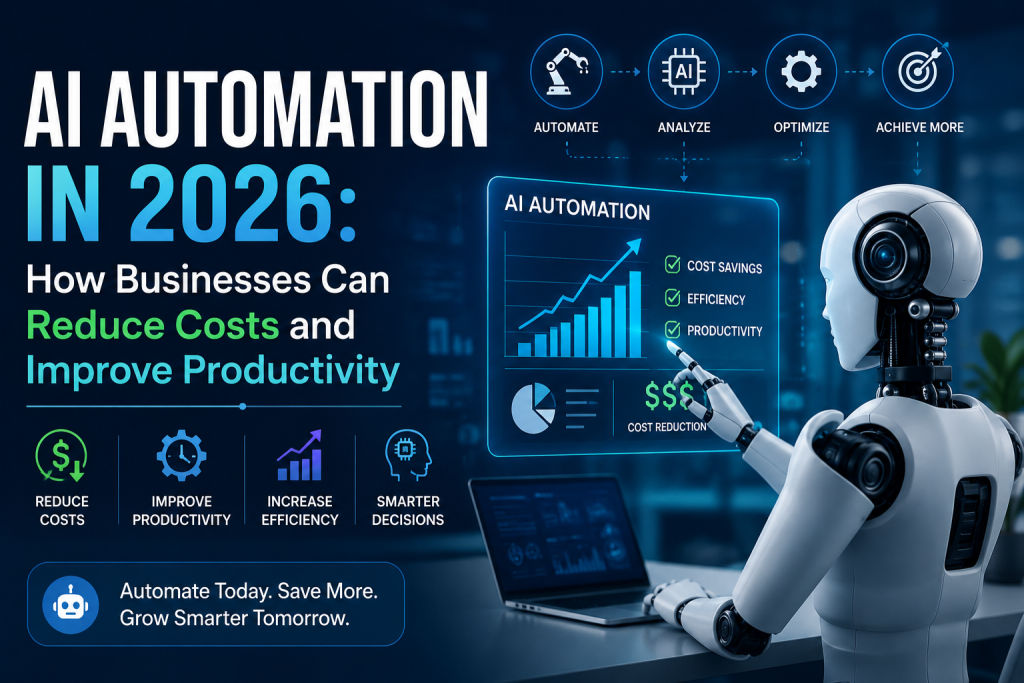
AI automation in 2026 helping businesses reduce costs and improve productivity
AI + Digital Transformation

AI Automation in 2026: How Businesses Can Reduce Costs and Improve Productivity

Artificial Intelligence is rapidly changing the way businesses operate. In 2026, AI automation is moving beyond simple chatbots and repetitive task automation. Businesses are increasingly using AI-powered systems to analyze information, automate workflows, assist employees, improve customer experiences, and make faster decisions. For organizations dealing with increasing operational costs, large amounts of data, and repetitive processes, AI automation can provide a practical way to improve efficiency without continuously increasing manual workloads. From customer support and sales to finance, human resources, software development, and business analytics, AI automation is becoming an important part of modern digital transformation. What Is AI Automation? AI automation combines artificial intelligence with automated workflows to perform tasks that traditionally require human intervention. Traditional automation usually follows predefined rules: Input → Rule → Action → Result AI automation can work with more flexible processes: Data → AI Analysis → Decision → Automated Action → Evaluation This allows automated systems to handle information, identify patterns, make recommendations, and trigger appropriate actions based on changing situations. For example, a traditional workflow might automatically send the same email to every new customer. An AI-powered workflow could analyze customer information, identify their interests, personalize the message, update the CRM, and schedule a follow-up automatically. This makes AI automation more adaptable to modern business processes. Why AI Automation Matters in 2026 Businesses are under constant pressure to improve productivity while controlling operational costs. Employees often spend significant amounts of time performing repetitive activities such as: Entering data Responding to routine emails Updating CRM systems Preparing reports Scheduling meetings Processing documents Answering common customer questions Monitoring business metrics Managing repetitive administrative workflows AI automation can reduce the amount of manual work involved in these processes. The goal is not simply to automate everything. Instead, businesses can use AI to automate suitable tasks while allowing employees to focus on activities that require creativity, strategic thinking, communication, and human judgment. Some major benefits include: Reduced repetitive work Improved employee productivity Faster business processes Lower operational overhead Faster customer responses Better data utilization Improved decision-making Scalable workflows 24/7 automated operations How AI Automation Helps Businesses Reduce Costs Reducing costs does not always mean reducing employees. In many cases, businesses can reduce operational costs by improving how existing resources are used. AI automation can help organizations achieve this in several ways. 1. Reduce Repetitive Manual Work Employees can spend hours performing repetitive tasks that follow predictable patterns. AI automation can handle many of these processes automatically. For example: Manual Process: Employee receives request → Reads information → Updates system → Sends response → Creates follow-up task Automated Process: Request received → AI analyzes request → System updated → Personalized response sent → Follow-up created This allows employees to spend more time on higher-value work. 2. Improve Operational Efficiency Manual processes often involve multiple systems and departments. For example, processing a new customer may require information to be entered into: CRM Email platform Accounting system Project management software Customer support platform Analytics system AI automation can coordinate these systems and reduce unnecessary manual data entry. 3. Reduce Errors Manual data entry and repetitive processing can result in mistakes. AI-powered workflows can validate information, identify inconsistencies, and trigger alerts when something requires human attention. This can help reduce the operational cost associated with avoidable errors and rework. 4. Improve Resource Utilization Businesses can use automation to handle routine processes while employees focus on more complex responsibilities. Instead of hiring additional resources for every increase in workload, organizations can automate suitable processes and scale operations more efficiently. 5. Provide 24/7 Support AI-powered systems can operate outside normal business hours. Customer questions, internal requests, monitoring activities, and other automated processes can continue even when employees are unavailable. This can improve service availability without requiring a larger support team to work around the clock. How AI Automation Improves Productivity Cost reduction is only one side of AI automation. The larger opportunity is improving productivity. Faster Task Completion AI systems can process large amounts of information quickly and automate workflows that previously required multiple manual steps. Less Administrative Work Employees can spend less time on repetitive activities such as documentation, scheduling, reporting, and data entry. Better Access to Information AI-powered systems can help employees search internal information and retrieve relevant data using natural language. Faster Decision Support AI automation can analyze business information and highlight trends, anomalies, and important changes. This gives teams faster access to information needed for decision-making. Improved Collaboration Automated workflows can notify the right team members, create tasks, update systems, and share information automatically. This reduces delays caused by manual communication between departments. AI Automation in Customer Support Customer support is one of the most practical areas for AI automation. Businesses can use AI-powered systems to handle routine customer interactions and automate support workflows. Common applications include: Answering frequently asked questions Tracking orders Checking account information Creating support tickets Categorizing customer requests Routing issues to the appropriate department Scheduling appointments Providing personalized responses Escalating complex issues to human agents For example, when a customer submits a support request, an AI system can understand the request, retrieve relevant information, categorize the issue, and either provide an answer or route the request to a human support professional. This can reduce response times while allowing support teams to focus on more complex customer problems. AI Automation in Sales and Marketing Sales and marketing teams manage large amounts of customer and prospect information. AI automation can help reduce administrative workloads across the sales process. A sales automation workflow can: Identify potential leads. Collect relevant customer information. Qualify prospects. Update CRM records. Generate personalized outreach. Schedule follow-ups. Notify sales representatives. Track engagement. Generate performance reports. Marketing teams can also use AI automation for: Content planning Audience segmentation Campaign analysis Lead scoring Customer research Trend identification Personalized communication Performance reporting The objective is not to remove human involvement from sales and marketing. Instead, automation can handle administrative tasks so professionals can focus on relationships, creativity, and strategy. AI Automation in Finance and Accounting Finance

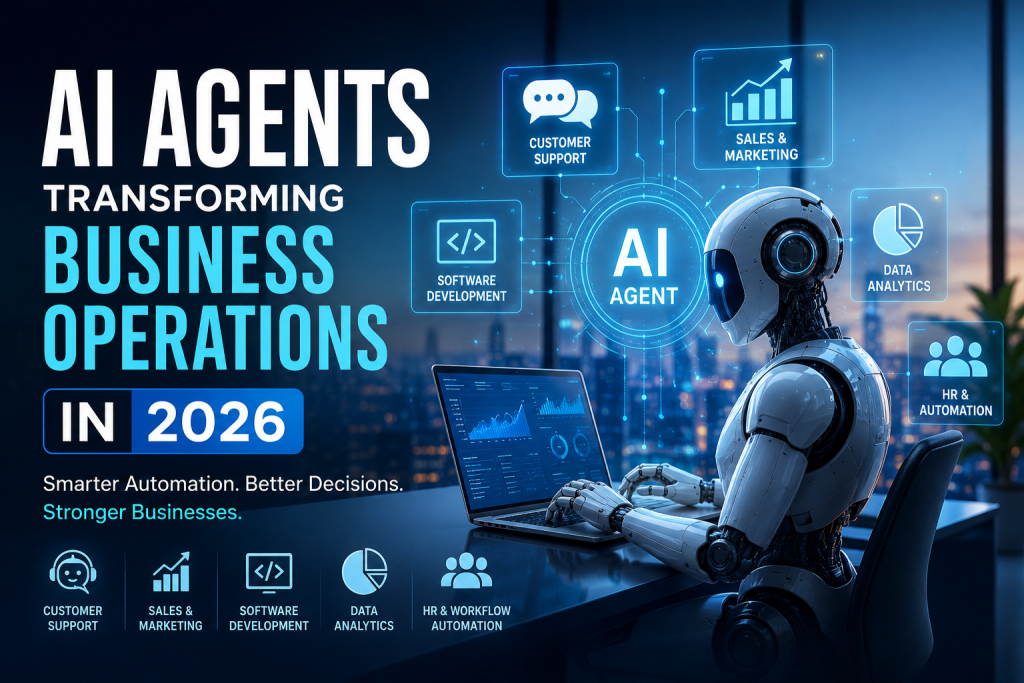
AI Agents Transforming Business Operations in 2026
Artificial Intelligence

How AI Agents Are Transforming Business Operations in 2026

Artificial Intelligence has moved far beyond chatbots and simple automation. In 2026, businesses are increasingly adopting AI agents that can understand goals, make decisions, use digital tools, and complete multi-step tasks with minimal human intervention. Unlike traditional software automation, which generally follows predefined rules, AI agents can analyze information, determine the next action, interact with different systems, and adapt their approach based on the situation. From customer service and sales to software development, finance, human resources, and data analysis, AI agents are changing how organizations operate and make decisions. For businesses looking to improve productivity, reduce operational costs, and deliver better customer experiences, AI agents are becoming an important part of the modern digital transformation strategy. What Are AI Agents? AI agents are intelligent software systems designed to achieve specific goals by combining artificial intelligence with reasoning, decision-making, and tool usage. Traditional automation generally follows a fixed sequence: Input → Rule → Action → Result AI agents can operate more dynamically: Goal → Analyze → Plan → Use Tools → Take Action → Evaluate → Adapt For example, instead of simply responding to a customer’s question, an AI-powered customer service agent could: Understand the customer’s request. Retrieve relevant customer information. Check an order or account status. Determine the appropriate solution. Update the required system. Respond to the customer. Escalate the issue to a human when necessary. This ability to perform multiple connected tasks makes AI agents particularly valuable for modern businesses. Why AI Agents Matter for Businesses in 2026 Businesses generate enormous amounts of data and perform thousands of repetitive processes every day. Employees often spend valuable time searching for information, updating systems, preparing reports, responding to routine queries, and managing repetitive workflows. AI agents can help automate many of these processes while allowing employees to focus on more strategic and creative work. Some of the biggest advantages include: Higher productivity Faster business processes Reduced repetitive work 24/7 operational support Improved customer experiences Faster decision-making Better utilization of business data Scalable automation The biggest shift is that businesses are moving from simply using AI as an assistant to using AI as an active participant in business workflows. AI Agents in Customer Support Customer support is one of the most practical applications of AI agents. Traditional chatbots usually provide answers based on predefined flows or a limited knowledge base. Modern AI agents can understand context and interact with business systems to resolve more complex requests. An AI customer service agent can: Answer product-related questions Track orders Check account information Handle appointment scheduling Create support tickets Recommend relevant solutions Escalate complex issues to human agents This allows businesses to provide faster support without requiring employees to manually handle every routine request. AI Agents for Sales and Marketing Sales teams spend significant amounts of time researching prospects, updating CRM records, writing emails, and following up with leads. AI agents can automate many of these activities. A sales AI agent can help: Identify potential leads Analyze customer information Qualify prospects Generate personalized outreach Schedule meetings Update CRM systems Track follow-ups Analyze sales performance Marketing teams can also use AI agents to analyze campaigns, generate content ideas, segment audiences, and identify trends. Instead of replacing sales and marketing professionals, AI agents can act as intelligent assistants that reduce administrative work and allow teams to focus on relationships and strategy. AI Agents in Software Development Software development is another area experiencing rapid AI adoption. AI coding assistants are already helping developers generate code, explain existing code, identify bugs, write tests, and improve documentation. AI agents take this concept further by supporting multi-step development workflows. For example, an AI development agent could: Analyze a development requirement. Create an implementation plan. Generate or modify code. Run tests. Identify errors. Suggest fixes. Update documentation. This does not eliminate the need for developers. Instead, it allows development teams to spend more time on architecture, product decisions, security, and complex engineering problems. AI Agents for Data Analysis and Business Intelligence Modern businesses collect data from websites, applications, CRM platforms, financial systems, marketing platforms, and other sources. The challenge is turning this data into actionable insights. AI agents can help business teams interact with their data using natural language. For example, a business manager could ask: “Why did our sales decrease this month?” An AI-powered system could analyze sales data, compare it with previous periods, identify unusual patterns, and present possible reasons. AI agents can support: Automated reporting Data exploration Trend detection Forecasting KPI monitoring Anomaly detection Business recommendations This can make data-driven decision-making more accessible to non-technical teams. AI Agents in Human Resources HR departments handle many repetitive processes, including employee queries, onboarding, documentation, scheduling, and internal requests. AI agents can provide employees with instant access to company information and automate administrative workflows. Common applications include: Employee onboarding Leave and policy queries Internal knowledge management Interview scheduling Candidate screening assistance HR document management Employee support With appropriate security and human oversight, AI agents can help HR teams reduce administrative workloads while improving employee experiences. AI Agents for Business Process Automation One of the most important applications of AI agents is connecting different business systems. A business may use separate platforms for CRM, accounting, email, customer support, project management, inventory, and analytics. AI agents can potentially coordinate workflows across these systems. For example, when a new customer signs up, an automated workflow could: Create CRM record → Send welcome email → Create onboarding task → Notify sales team → Update analytics This type of intelligent workflow automation can reduce manual data entry and improve operational efficiency. AI Agents vs Traditional Automation Traditional automation remains extremely useful, especially when processes are predictable and rules are clearly defined. However, AI agents provide additional flexibility when workflows involve changing information or require reasoning. Traditional Automation AI Agents Rule-based Goal-oriented Fixed workflows Dynamic workflows Predictable inputs Can handle variable inputs Limited decision-making AI-assisted reasoning Usually predefined actions Can select tools and actions Best for repetitive rules Best for complex workflows The two approaches are not

AI Is Eating Software: Why "Writing Code" Is Being Replaced by "Expressing Intent"
Artificial Intelligence

AI Is Eating Software: Why “Writing Code” Is Being Replaced by “Expressing Intent”

AI Is Eating Software: Why “Writing Code” Is Being Replaced by “Expressing Intent” For decades, the mark of a elite software engineer was syntax fluency. We valued the developer who memorized standard library calls, mastered complex language idioms, and typed out hundreds of lines of clean boilerplate before lunch. Code was the ultimate currency of software creation, and the developer’s primary tool was the keyboard. That era is quietly coming to an end. Marc Andreessen famously declared over a decade ago that “software is eating the world.” Today, artificial intelligence is eating software itself. But AI is not merely automating mechanical keystrokes or making code auto-complete faster; it is fundamentally altering the abstraction layer of technology. The primary unit of software engineering is shifting from writing code to expressing intent. When developers spend less time typing out function bodies and more time orchestrating autonomous multi-agent systems, the entire discipline undergoes a tectonic shift. We are witnessing the birth of Intent-Driven Development (IDD)—where human genius focuses on architecture, context, and validation, while machine intelligence handles the mechanical translation into working software. Part 1: The Death of the Syntax Artisan To understand where software engineering is heading, we must examine where it has been. Computer science is a relentless history of ascending abstraction layers. We evolved from toggling physical switches on punch cards to assembly language, from assembly to procedural C, and from C to garbage-collected, expressive languages like Python, Rust, and TypeScript. Every leap in abstraction was initially met with fierce skepticism. Compiler pioneers were told that high-level languages would make programmers lazy or yield inefficient machine code. Yet, higher abstractions allowed engineers to build distributed cloud platforms, global real-time networks, and complex operating systems that would have been mathematically impossible if everyone still manually managed memory pointers. ┌─────────────────────────────────────────────────────────────────────────┐ │ The Evolution of Code Abstraction │ ├─────────────────────────────────────────────────────────────────────────┤ │ Era 1: Hardware Ops ──> Physical Switches & Punch Cards │ │ Era 2: Low-Level ──> Assembly & Direct Memory Management │ │ Era 3: High-Level ──> C, Java, Python (Manual Syntax Mechanics) │ │ Era 4: Intent-Driven ──> Natural Language Specs & AI Agent Execution │ └─────────────────────────────────────────────────────────────────────────┘ Generating code syntax is no longer an engineering bottleneck. Modern Large Language Models (LLMs) and autonomous agent networks do not just assist with line completion; they synthesize entire microservices, draft comprehensive unit tests, and refactor monolithic codebases in seconds. When the marginal cost of writing syntax approaches zero, syntax loses its status as a competitive moat. The artisan who takes pride solely in typing out boilerplate REST endpoints or standard UI components faces an existential realization: typing syntax was always just a low-fidelity medium for communicating human thought to machines. Part 2: The Three Pillars of Intent-Driven Development If syntax generation is delegated to autonomous AI agents, what constitutes the core workflow of the modern software team? Intent-Driven Development replaces manual implementation with three foundational pillars: Capability Dimension Traditional Development Intent-Driven Development Primary Skill Memorizing syntax & API methods Context engineering & system architecture Execution Medium Manual code writing in an IDE Declarative specifications & prompt design Quality Control Manual code reviews & PR checks Automated verification loops & guardrails Output Metric Lines of Code (LOC) committed Speed & accuracy of verified feature delivery 1. Context Engineering AI models are only as effective as the context fed into them. Instead of writing raw logic, engineers focus on building rich, structured context architectures. This includes maintaining clear repository maps, dependency graphs, domain schemas, and historical design records so that AI agents possess deep, accurate domain knowledge before executing a single task. 2. High-Precision Specification (Declarative Architecture) Expressing intent is not about throwing vague, lazy English prompts at a chatbot. It demands declarative precision. Engineers define exact API contracts, state machine transitions, edge-case boundaries, and performance budgets using formal specs, system prompts, and structured schemas. 3. Automated Guardrails and Verification Because probabilistic AI models can hallucinate or introduce subtle edge-case bugs, Intent-Driven Development relies on non-negotiable verification loops. Human engineers construct automated environments—combining static analysis, property-based testing, fuzzing, and sandbox security constraints—that continuously test machine-generated code before it touches production. Part 3: The New Role of the Developer: System Orchestrator In an intent-driven ecosystem, the developer’s day-to-day identity shifts from a code builder to a system orchestrator. ┌────────────────────────────────────────────────────────┐ │ Intent-Driven Orchestration Flow │ ├────────────────────────────────────────────────────────┤ │ 1. Human Architect defines Intent & Context Specs │ │ │ │ │ ▼ │ │ 2. Specialized AI Agents assemble code & test suites │ │ │ │ │ ▼ │ │ 3. Automated Guardrails run security & stress tests │ │ │ │ │ ▼ │ │ 4. Human Specialist audits diff & authorizes release │ └────────────────────────────────────────────────────────┘ Instead of grinding through sprint tickets line by line, the modern engineer manages a team of specialized AI agents: The Architectural Agent: Scaffolds modular file structures based on system specifications. The Implementation Agent: Writes concrete, production-ready code aligned with existing codebase patterns. The Red-Teaming Agent: Intentionally attempts to break the newly generated code with security exploits and edge-case inputs. The Documentation Agent: Keeps API documentation and system diagrams continuously synchronized in real-time. The human engineer remains elevated at the top of this chain, making high-leverage decisions: evaluating trade-offs between latency and infrastructure cost, enforcing compliance and security boundaries, and aligning software capabilities with real business goals. Part 4: The Engineering Manager’s Playbook: Re-tooling Teams for the AI Era For technology leaders, the transition to Intent-Driven Development presents an organizational challenge. Traditional engineering management metrics—like Lines of Code (LOC) written, PR volume, or commit frequency—become useless when a developer can generate thousands of lines of functional code in minutes. To successfully lead engineering teams through this transformation, managers must execute three strategic pivots: 1. Measure “Velocity of Intent” Shift performance evaluations away from raw output toward Velocity of Intent—how effectively an engineer converts a complex business requirement into an airtight specification, orchestrates its machine generation, and verifies its safe deployment. 2. Treat Context as a First-Class Code Asset System prompts, architectural decision records

Artificial Intelligence

AI Agents vs Traditional Automation: What’s Changing in 2026?

Introduction:- Automation has been a cornerstone of digital transformation for decades. Businesses have long relied on software to eliminate repetitive tasks, reduce operational costs, and improve efficiency. From manufacturing lines to customer relationship management systems, traditional automation has helped organizations streamline workflows and maintain consistency. However, the technological landscape in 2026 is undergoing a significant shift. Organizations are no longer satisfied with systems that simply follow predefined rules. They increasingly require software that can understand context, adapt to changing situations, make informed decisions, and collaborate with humans. This demand has accelerated the adoption of AI agents, one of the most influential developments in modern artificial intelligence. Unlike traditional automation, AI agents are designed to reason, plan, and act toward specific goals. They can analyze large amounts of information, interact with multiple applications, learn from feedback, and even coordinate with other AI systems. Rather than replacing simple automation, AI agents expand what automation can achieve by handling more dynamic and complex tasks. This article explores how AI agents differ from traditional automation, why organizations are investing in intelligent systems, and how businesses can prepare for the next generation of digital operations. Understanding Traditional Automation Traditional automation refers to software that performs predefined actions based on fixed rules. These systems execute workflows exactly as they were programmed, making them highly reliable for repetitive processes. Examples include: Automated invoice generation Payroll processing Scheduled email campaigns Data backups Manufacturing assembly lines Basic customer support chatbots Rule-based approval workflows The primary advantage of traditional automation is consistency. Once configured correctly, it performs the same task repeatedly with minimal errors. It is ideal for environments where processes rarely change. However, these systems have clear limitations. They cannot interpret ambiguous information, adapt to unexpected scenarios, or make decisions beyond their programmed rules. If the business process changes, developers often need to redesign or update the automation. What Are AI Agents? AI agents are intelligent software systems capable of perceiving information, reasoning about it, making decisions, and taking actions to achieve defined objectives. Unlike conventional automation tools, AI agents do not rely solely on fixed rules. They use technologies such as large language models, machine learning, natural language processing, retrieval systems, and external tools to solve problems dynamically. For example, an AI customer support agent can: Read a customer’s email. Identify the issue and urgency. Search internal documentation. Check order status. Draft a personalized response. Escalate complex cases when necessary. Learn from user feedback over time. Instead of executing a single scripted workflow, the agent evaluates the situation and chooses the most appropriate action. Traditional Automation vs AI Agents Feature Traditional Automation AI Agents Decision-making Rule-based Context-aware Learning No Yes, through AI models and feedback Flexibility Low High Handles unstructured data Limited Excellent Human-like communication Minimal Advanced Adaptability Requires reprogramming Can adjust to changing inputs Best suited for Repetitive tasks Complex, evolving workflows Why 2026 Marks a Turning Point Several technological trends have converged to make AI agents practical at scale. Large language models have become significantly more capable, enabling agents to understand natural language and generate useful responses. Cloud infrastructure now provides the computing power needed to run advanced AI workloads efficiently. Businesses have also accumulated vast amounts of digital data, creating opportunities for AI systems to deliver meaningful insights and automation. At the same time, organizations are under pressure to improve productivity, reduce costs, and respond faster to customer expectations. AI agents address these needs by automating tasks that previously required human judgment. Real-World Business Applications Customer Service Modern AI agents can resolve support tickets, summarize conversations, translate languages, and personalize responses while maintaining a consistent customer experience. Software Development Development teams use AI agents to generate code, review pull requests, identify bugs, write documentation, and automate testing. These capabilities accelerate delivery while allowing engineers to focus on architecture and innovation. Cybersecurity Security operations centers increasingly deploy AI agents to monitor logs, detect anomalies, investigate suspicious behavior, and recommend remediation steps. This helps analysts respond more quickly to emerging threats. Cloud Operations Cloud management platforms benefit from AI agents that optimize infrastructure, monitor resource utilization, predict outages, and recommend cost-saving opportunities. They can assist administrators in maintaining reliable and scalable environments. Healthcare Hospitals and healthcare providers use intelligent agents to organize patient records, assist with appointment scheduling, summarize clinical notes, and support administrative workflows, enabling staff to spend more time on patient care. Benefits of AI Agents Organizations adopting AI agents are seeing improvements in several areas: Increased productivity through intelligent task automation. Faster decision-making based on real-time data. Improved customer experiences with personalized interactions. Reduced operational costs by minimizing manual work. Better scalability across departments. Continuous learning and optimization through AI-driven feedback loops. These advantages make AI agents an important part of digital transformation strategies across industries. AI Governance in 2026: Balancing Innovation and Regulation  

Artificial Intelligence, Business Intelligence, Digital Transformation, Technology

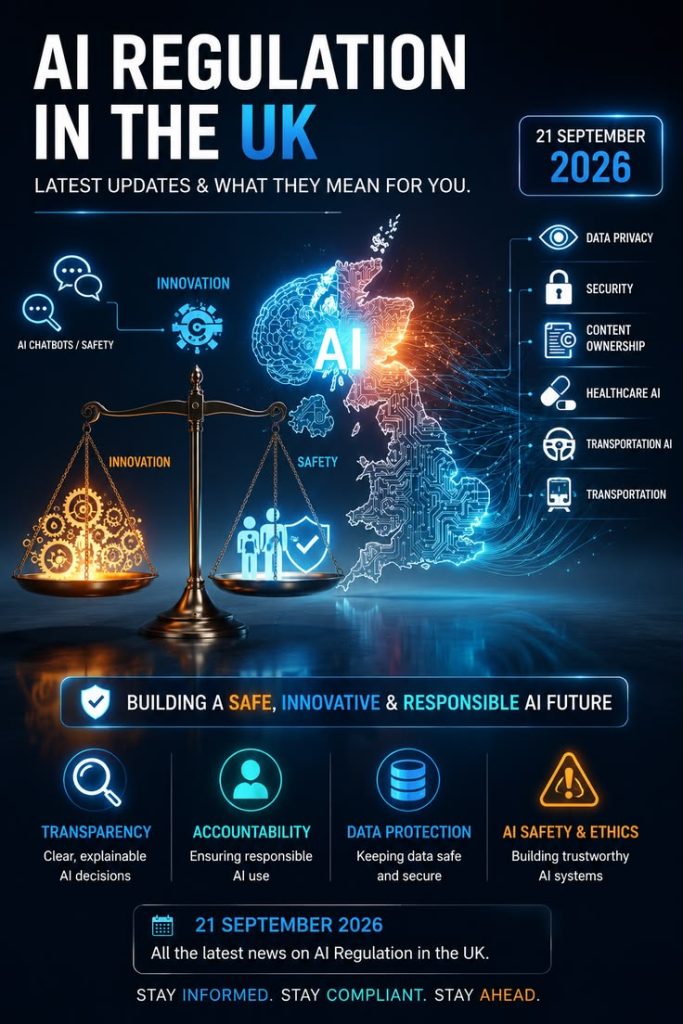
AI Governance in 2026: Balancing Innovation and Regulation

AI Governance in 2026: Balancing Innovation and Regulation Artificial intelligence has rapidly evolved from an emerging technology into a critical business and societal tool. From automating business operations and improving healthcare outcomes to powering advanced research and enhancing customer experiences, AI is transforming nearly every industry. However, as AI systems become more powerful and influential, concerns surrounding transparency, accountability, privacy, bias, and security continue to grow. In 2026, AI governance has become one of the most important topics in the technology landscape. Governments, regulators, technology companies, and enterprises are working together to create frameworks that encourage innovation while ensuring AI is developed and deployed responsibly. The challenge is clear: how can society unlock the enormous benefits of AI without exposing individuals, businesses, and governments to unnecessary risks? The answer lies in effective AI governance. What Is AI Governance? AI governance refers to the policies, standards, regulations, and organizational practices used to guide the development, deployment, and management of artificial intelligence systems. Its primary objectives include: Ensuring AI systems operate ethically Promoting transparency and accountability Protecting user privacy Reducing bias and discrimination Strengthening cybersecurity Maintaining regulatory compliance Building public trust Unlike traditional software governance, AI governance must address unique challenges associated with machine learning, generative AI, autonomous decision-making, and continuously evolving algorithms. As organizations increasingly rely on AI-powered systems for critical decisions, governance frameworks are becoming essential components of modern business operations. Why AI Governance Matters More Than Ever The rapid adoption of generative AI and autonomous systems has dramatically increased the importance of governance. Organizations are now using AI for: Financial decision-making Hiring and recruitment Healthcare diagnostics Customer service automation Cybersecurity monitoring Supply chain optimization Legal research Business intelligence While these applications offer significant benefits, they also introduce potential risks. An AI system that generates inaccurate information can damage a company’s reputation. A biased algorithm can lead to discrimination claims. Weak AI security controls can expose sensitive data to cybercriminals. Without proper governance, AI can become a liability instead of a competitive advantage. Businesses are realizing that governance is not merely about compliance—it is about creating sustainable and trustworthy AI ecosystems. The Global Push for AI Regulation One of the biggest developments in 2026 is the increasing focus on AI regulation worldwide. Governments recognize that artificial intelligence is reshaping economies, national security, labor markets, and public services. As a result, regulators are introducing policies designed to manage AI risks while encouraging innovation. Several key areas are receiving attention: Risk-Based AI Classification Many governments are adopting risk-based approaches to AI oversight. Under this model, AI applications are categorized according to their potential impact. Examples include: Low-Risk Systems Chatbots Recommendation engines Productivity assistants Medium-Risk Systems Customer service automation Business analytics platforms Educational AI tools High-Risk Systems Medical diagnosis systems Financial approval algorithms Law enforcement technologies Critical infrastructure management systems The higher the risk level, the stricter the governance requirements become. This approach helps regulators avoid unnecessary restrictions on innovation while focusing oversight where it is needed most. Transparency Requirements AI transparency has become a major regulatory priority. Users increasingly want to know: How AI systems make decisions What data is being used Whether content was AI-generated How organizations monitor AI outputs Transparency requirements are encouraging businesses to provide clearer explanations of AI-driven decisions and maintain detailed documentation of their AI models. Data Protection and Privacy AI systems require large amounts of data to function effectively. This has raised concerns about: User consent Data ownership Personal information protection Cross-border data transfers Governments are introducing stricter data governance rules to ensure AI systems respect privacy rights while still enabling innovation. Organizations that fail to comply may face significant financial penalties and reputational damage. Enterprise AI Governance Becomes a Strategic Priority In 2026, AI governance is no longer just the responsibility of compliance departments. It has become a boardroom issue. Executives recognize that poorly managed AI initiatives can create legal, financial, and operational risks. As a result, organizations are establishing dedicated AI governance programs that include: AI ethics committees Risk management teams Compliance officers Data governance specialists Cybersecurity professionals Legal advisors These teams work together to ensure AI projects align with business objectives, regulatory requirements, and ethical standards. Companies that implement robust governance frameworks are often able to deploy AI more confidently and at greater scale. Ethical AI Takes Center Stage Ethical AI has become one of the defining themes of AI governance. Businesses understand that compliance alone is not enough. Users expect AI systems to operate fairly, responsibly, and transparently. Ethical AI initiatives focus on several key principles. Fairness AI systems should treat all individuals fairly and avoid discriminatory outcomes. Organizations are investing in bias detection tools and model auditing processes to identify and mitigate unfair decision-making. Accountability There must be clear responsibility for AI-generated outcomes. Businesses are establishing governance structures that define who is accountable when AI systems make errors or produce harmful results. Human Oversight Despite significant advances in automation, human involvement remains critical. Many organizations require human review for high-impact decisions involving: Employment Healthcare Financial services Legal matters This ensures AI supports decision-making rather than replacing human judgment entirely. Transparency Users should understand when they are interacting with AI systems and how important decisions are made. Transparent AI helps build trust and reduces concerns about hidden algorithms influencing outcomes. The Rise of AI Audits Just as financial audits help ensure accountability in business operations, AI audits are becoming increasingly common. AI audits evaluate: Model performance Bias levels Security controls Regulatory compliance Data quality Decision-making processes Organizations are conducting regular assessments to verify that AI systems continue operating as intended. Independent third-party audits are also gaining popularity because they provide additional credibility and transparency. In many industries, AI auditing is becoming a standard governance practice. Managing Generative AI Risks Generative AI remains one of the most transformative technologies of the decade. Businesses are using AI tools to create: Marketing content Software code Product designs Business reports Customer communications Educational materials However, generative AI introduces unique governance challenges. Hallucinations AI models can

Artificial Intelligence, Business Analytics, enterprice

The Impact of Agentic AI on Enterprise Productivity

The Impact of Agentic AI on Enterprise Productivity Artificial Intelligence has evolved rapidly over the past few years. What started as chatbots, recommendation engines, and predictive analytics has now entered a new phase known as Agentic AI. Unlike traditional AI systems that primarily respond to commands or analyze data, Agentic AI can independently plan, execute, monitor, and optimize tasks to achieve specific goals. As organizations continue their digital transformation journeys, Agentic AI is emerging as one of the most influential technologies reshaping enterprise productivity. Businesses are no longer looking at AI merely as a tool that assists employees; instead, they are deploying AI agents capable of acting as digital workers that can handle complex workflows with minimal human intervention. From customer service and IT operations to finance, marketing, and supply chain management, Agentic AI is helping enterprises operate more efficiently, reduce costs, improve decision-making, and unlock new levels of productivity. As we move through 2026, companies across industries are recognizing that the future of work will involve close collaboration between humans and autonomous AI agents. Understanding Agentic AI Agentic AI refers to artificial intelligence systems that possess the ability to act autonomously toward achieving predefined objectives. Unlike conventional AI applications that require constant prompts or supervision, Agentic AI can make decisions, initiate actions, adapt to changing environments, and complete multi-step tasks independently. For example, a traditional AI chatbot may answer customer questions based on available information. An Agentic AI system, however, can handle an entire customer support process—from receiving the request and identifying the issue to processing refunds, updating records, and following up with customers. The key capabilities that distinguish Agentic AI include: Goal-oriented decision-making Autonomous workflow execution Continuous learning and adaptation Multi-step task management Context awareness Integration with enterprise systems Proactive problem-solving These characteristics enable Agentic AI to function more like a virtual employee rather than a simple software application. Why Enterprises Are Adopting Agentic AI Organizations are under increasing pressure to improve efficiency, reduce operational expenses, and maintain competitiveness in rapidly changing markets. Traditional automation solutions can handle repetitive tasks, but they often struggle with complex processes that require decision-making and adaptability. Agentic AI fills this gap by bringing intelligence and autonomy to business operations. Several factors are driving enterprise adoption: Growing Operational Complexity Modern businesses manage enormous volumes of data, processes, and interactions. Human teams often struggle to keep up with increasing complexity. Agentic AI can process information at scale and coordinate multiple tasks simultaneously. Demand for Faster Decision-Making Markets move quickly, and delays can be costly. AI agents analyze data in real time and provide immediate actions or recommendations, helping organizations respond more rapidly to opportunities and challenges. Workforce Productivity Challenges Many industries continue to face talent shortages and increasing workloads. Agentic AI helps organizations maximize productivity without significantly expanding headcount. Cost Optimization Businesses are continuously seeking ways to reduce expenses. AI agents can automate labor-intensive processes, reducing operational costs while maintaining service quality. Digital Transformation Initiatives Organizations investing in cloud computing, analytics, and automation increasingly view Agentic AI as a natural extension of their digital transformation strategies. Workflow Automation Beyond Traditional RPA Robotic Process Automation (RPA) has been used for years to automate repetitive tasks. However, RPA systems generally follow predefined rules and struggle when unexpected situations arise. Agentic AI enhances automation by introducing intelligence into workflows. For example, instead of simply processing invoices according to fixed rules, an AI agent can: Identify anomalies Communicate with vendors Request missing information Resolve exceptions Complete approvals automatically This significantly reduces manual intervention and accelerates business processes. Enhanced Employee Productivity One of the most important benefits of Agentic AI is its ability to augment human workers. Employees often spend significant time on administrative tasks such as: Data entry Scheduling Reporting Documentation Research Information retrieval AI agents can handle these responsibilities, allowing employees to focus on strategic, creative, and high-value work. Rather than replacing workers, Agentic AI often acts as a productivity multiplier, enabling teams to accomplish more with the same resources. Faster Decision-Making Data-driven decision-making has become essential for modern enterprises. However, analyzing large datasets can be time-consuming. Agentic AI systems continuously monitor: Market trends Customer behavior Operational performance Financial metrics Supply chain activities They can identify patterns, generate insights, and recommend actions in real time. Executives and managers benefit from faster access to actionable intelligence, improving organizational agility and responsiveness. Improved Customer Service Operations Customer experience has become a major competitive differentiator. Agentic AI is transforming customer support by enabling intelligent automation. AI agents can: Resolve support tickets Handle account updates Process refunds Schedule appointments Escalate complex issues Follow up with customers Because these systems operate around the clock, businesses can provide faster and more consistent service while reducing support costs. Knowledge Management and Information Access Large enterprises often struggle with fragmented information spread across multiple systems. Employees may spend considerable time searching for documents, policies, procedures, and data. Agentic AI can act as an intelligent knowledge assistant that: Retrieves relevant information Summarizes documents Generates reports Provides recommendations Answers internal queries This improves productivity by reducing time spent searching for information. Supply Chain Optimization Supply chain management involves numerous interconnected activities, making it an ideal environment for Agentic AI deployment. AI agents can: Monitor inventory levels Predict demand fluctuations Optimize procurement Coordinate logistics Identify supply chain risks Recommend corrective actions These capabilities help organizations improve efficiency while minimizing disruptions. Financial Operations Efficiency Finance departments often deal with repetitive and time-consuming processes. Agentic AI can streamline activities such as: Invoice processing Expense management Budget forecasting Financial reporting Compliance monitoring Fraud detection As a result, finance teams can focus more on strategic planning and business growth initiatives. IT Operations and Infrastructure Management Enterprise IT environments continue to grow in complexity. Agentic AI is increasingly being used to manage infrastructure and support operations. AI agents can: Detect system anomalies Monitor performance Resolve incidents Apply security updates Allocate resources Predict failures This proactive approach improves system reliability while reducing operational workloads. Marketing and Sales Productivity Marketing and sales teams are

Scroll to Top