
EdTech trends

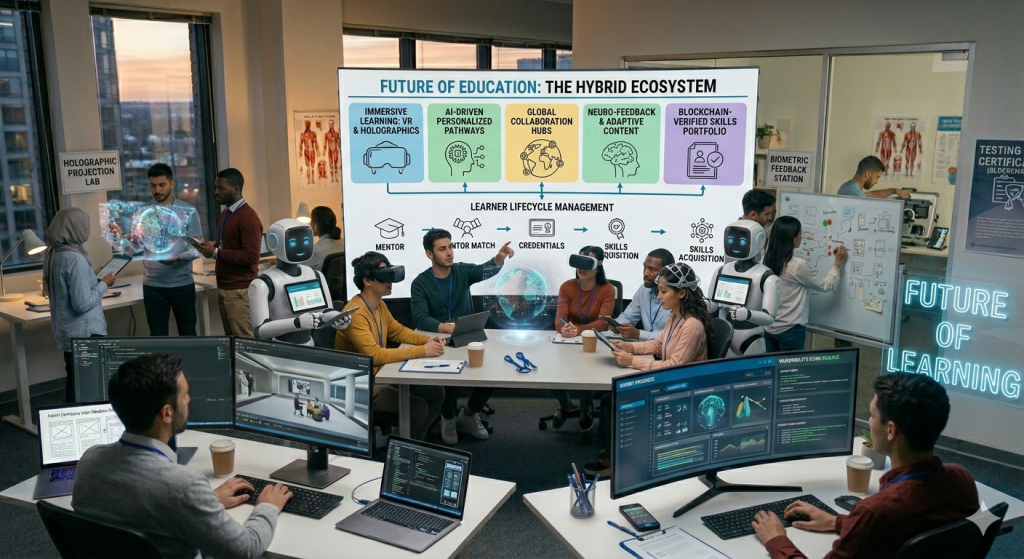
Diverse students in futuristic classroom using VR headsets, AR tablets, and AI holograms for immersive digital learning, with engagement metrics overlay
Education & Learning

Future of Education in Digital Age

Introduction The future of education in the digital age promises personalized, immersive, and globally connected learning that adapts to individual needs while leveraging AI, VR/AR, and mobile platforms. Traditional classrooms are evolving into hybrid ecosystems where students access interactive content anytime, anywhere, breaking geographical and socioeconomic barriers. This transformation is crucial as digital natives demand engaging experiences—studies show EdTech market growth exceeding $400 billion by 2025, driven by AI personalization and remote tools that boost retention by up to 75% over lectures. AI-Powered Personalization AI analyzes student data to create custom learning paths, adjusting pace, content, and style for better outcomes. Tools like adaptive platforms identify weaknesses and deliver targeted lessons, supporting diverse learners including those with special needs. Key benefits include: Real-time feedback and progress tracking. Automated grading freeing teachers for mentorship. Multilingual support for global access. Immersive Technologies (VR/AR) VR/AR turns abstract concepts into hands-on experiences—students explore ancient Rome or molecular structures without leaving class. These tools enhance engagement, with VR yielding 75% retention rates versus 10% for reading. Practical applications: Virtual labs for safe science experiments. AR overlays on textbooks for 3D models. Global field trips via shared virtual spaces. Hybrid Learning Models Blending online and in-person education offers flexibility, accelerated by the pandemic. Platforms like Google Classroom enable live sessions, collaboration, and cloud-based resources accessible on mobiles. Advantages: 5G-enabled seamless remote classes. Blockchain for secure certifications. IoT smart classrooms linked to apps. The future of education in the digital age promises personalized, immersive, and globally connected learning that adapts to individual needs while leveraging AI, VR/AR, and mobile platforms. Traditional classrooms are evolving into hybrid ecosystems where students access interactive content anytime, anywhere, breaking geographical and socioeconomic barriers. This transformation is crucial as digital natives demand engaging experiences—studies show EdTech market growth exceeding $400 billion by 2025, driven by AI personalization and remote tools that boost retention by up to 75% over lectures. AI-Powered Personalization AI analyzes student data to create custom learning paths, adjusting pace, content, and style for better outcomes. Tools like adaptive platforms identify weaknesses and deliver targeted lessons, supporting diverse learners including those with special needs. Key benefits include: Real-time feedback and progress tracking. Automated grading freeing teachers for mentorship. Multilingual support for global access. Immersive Technologies (VR/AR) VR/AR turns abstract concepts into hands-on experiences—students explore ancient Rome or molecular structures without leaving class. These tools enhance engagement, with VR yielding 75% retention rates versus 10% for reading. Practical applications: Virtual labs for safe science experiments. AR overlays on textbooks for 3D models. Global field trips via shared virtual spaces. Blending online and in-person education offers flexibility, accelerated by the pandemic. Platforms like Google Classroom enable live sessions, collaboration, and cloud-based resources accessible on mobiles Challenges and Equity Digital divides persist, with risks of isolation, privacy issues, and unequal access. Policymakers must prioritize teacher training, affordable devices, and inclusive design to ensure technology enhances rather than replaces human connection. Solutions include: Subsidized devices for low-income areas. Ethical AI guidelines. Blended models preserving teacher roles. Conclusion The future of education in the digital age lies in balanced integration of AI, VR/AR, and hybrid models that make learning immersive, equitable, and lifelong. Start exploring EdTech tools today to prepare students for tomorrow’s workforce—your first step could transform a classroom. FAQ (5 Questions) What role does AI play in the future of education in the digital age? AI personalizes learning, automates assessments, and provides virtual tutors for adaptive experiences. How will VR/AR change classrooms? They create immersive simulations for safe, engaging practice in subjects like science and history. What are hybrid learning benefits? Flexibility, global collaboration, and anytime access without losing in-person interaction. Will digital education widen inequality? Potentially, but equitable policies and affordable tech can bridge gaps. What’s next for EdTech? 5G, voice assistants, and AI mentors for hyper-personalized global learning.
Educational Technology

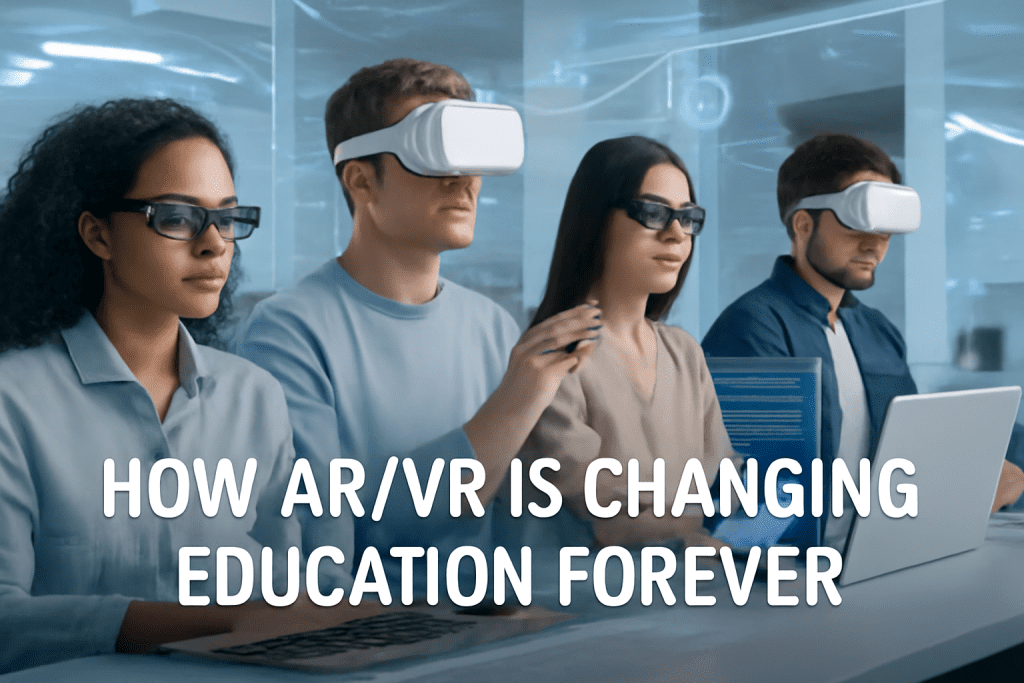
How AR/VR is Changing Education Forever

Introduction Augmented Reality (AR) and Virtual Reality (VR) are revolutionizing education, creating immersive, interactive environments that go far beyond traditional textbooks and lectures. From elementary schools introducing fun, 3D models in classrooms to universities using advanced VR simulations for medical training, AR/VR is making learning more engaging, effective, and accessible for all―forever transforming how students experience knowledge. What is AR and VR in Education?          .   Augmented Reality(AR): Integrates digital elements—like images, text, or 3D models—into the real world, viewed               through devices such as tablets, smartphones, or smart glasses. Virtual Reality (VR): Fully immerses users in a digital environment, typically via headsets, enabling “learning by doing,” simulation, and exploration far beyond the classroom’s physical walls. How AR/VR is Transforming Learning 1. Enhanced Engagement & Motivation Interactive AR/VR lessons make complex and abstract topics fun and tangible—students retain more information and develop a love for learning. Gamified elements and hands-on experiences break the monotony of rote learning. 2. Improved Understanding of Complex Concepts 3D models let students visualize everything from atoms to the solar system, and even human anatomy, enhancing their grasp of difficult subjects. Virtual field trips allow students to “visit” historical sites, disaster zones, or far-off planets—without leaving their school. 3. Safe, Experiential Learning VR simulations provide a risk-free way to practice real-world skills, such as surgery, engineering, or scientific experiments, improving practical skills with zero danger. 4. Personalized & Differentiated Learning Tailored AR/VR scenarios adapt to individual learning speeds and preferences, catering to diverse learning needs and styles. 5. Increased Collaboration and Social Skills Multi-user VR classrooms and AR projects encourage teamwork, communication, and collaborative problem-solving—even when students are remote. Real-World Examples Elementary Schools: AR sandboxes for geography; interactive 3D flashcards for biology; chemistry visualizations through AR cubes. Colleges/Universities: VR simulations for medical training; AR to study brain functions and psychological phenomena. Vocational Training: Virtual reality labs for mechanics, engineers, and healthcare professionals to practice skills before entering real workplaces. Distance/Online Learning: Students from around the world attend the same immersive VR classrooms, making quality education globally accessible. Benefits at a Glance Benefit AR Example VR Example Higher Student Engagement 3D interactive models in class Immersive field trips Improved Knowledge Retention AR flashcards, games Simulated hands-on lab work Accessibility Translation & instant guides Attend remote classrooms Collaboration & Social Learning Group AR projects Multi-user VR lessons Safe Practice for Risky Scenarios Step-by-step AR guides VR medical & engineering sims Personalized Learning Adaptive AR quizzes Branching VR scenarios How to Use AR/VR in Your Education Setting Start with available AR apps and tools—many offer free trials for classrooms (like Google Expeditions and ClassVR). Identify complex topics or skills in your curriculum where AR/VR can add value. Train teachers and students on using devices and software for maximum impact. Foster collaboration by creating group VR projects or AR-based treasure hunts/assignments. Regularly assess learning outcomes and adapt experiences for continued progress. Conclusion AR/VR is much more than a tech trend—it’s a paradigm shift in education. By merging virtual and real worlds, educators make learning vivid, memorable, and personalized for every student. As AR and VR tools become more accessible, their role in classrooms will only grow, ensuring that education everywhere is more engaging, relevant, and future-ready. FAQ Q1: What is the difference between AR and VR in education? A1: AR overlays digital information on the real world, enhancing what you see; VR immerses users in a completely virtual environment, allowing “hands-on” practice and exploration. Q2: Is AR/VR expensive for schools to implement? A2: Costs are dropping as technology evolves. Many AR apps work on smartphones/tablets. VR headsets are becoming more affordable, and many companies offer education discounts and ready-to-use lesson packages. Q3: How does AR/VR affect student learning outcomes? A3: Research shows AR/VR increases engagement, improves memory retention by nearly 9%, and supports diverse learners, especially those with special needs or remote access challenges. Q4: Can AR/VR be used for online or distance education? A4: Yes! VR classrooms enable students worldwide to learn together, while AR tools support remote, interactive, and collaborative activities. Q5: Will AR/VR replace teachers? A5: No. AR/VR is a tool to enhance teaching, not replace it. Human guidance, support, and expertise remain crucial for effective learning outcomes.

Lifestyle & Future Trends

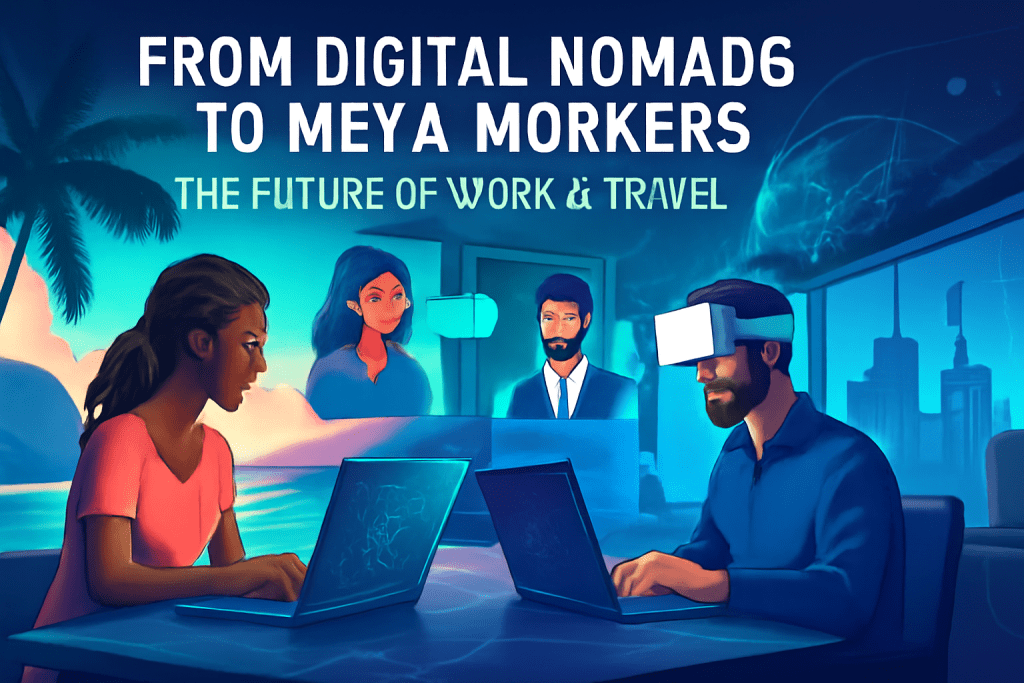
From Digital Nomads to Meta-Workers: The Future of Work & Travel

Introduction The way we work and travel in 2025 is unlike anything seen before. Thanks to accelerated digital transformation and the rise of immersive technologies, the lines between career and lifestyle are rapidly blurring. Digital nomads, once a niche community of remote workers exploring the globe, now lead a revolution—ushering in the age of the “meta-worker.” Whether collaborating from tropical beaches or inside virtual office spaces, today’s professionals expect flexibility, inclusivity, and experience-driven work-life balance. This blog explores the evolution from digital nomadism to meta-working, key trends shaping the future of work and travel, and why this movement is reshaping how we live, connect, and achieve success. The Evolution: From Digital Nomads to Meta-Workers Digital Nomads in 2025: The digital nomad lifestyle has become “mainstream,” with over 40 million people worldwide identifying as nomads. Typical nomads are tech-literate, mid-career professionals, predominantly from the US, but with a rising share from the Global South and Gen Z. Many travel with partners or families, not just solo. Most digital nomads value flexibility, cultural immersion, and freedom, often changing locations every few weeks. Meta-Workers: The Next Frontier: Meta-workers use immersive technologies like VR and AR to engage in work from anywhere—physical or virtual. In the “metaverse,” workers design customizable avatars, participate in virtual offices, and join global teams in 3D environments. This move toward meta-working challenges traditional expectations around workplace identity, collaboration, and inclusion, offering new forms of expression and belonging. Key Points: High job satisfaction: Over 80% of digital nomads report satisfaction, noting improved quality of life and work independence. Major job types: Software development, digital marketing, UX/UI, product management, writing, and AI-powered freelancing are common. Annual income varies, but top earners (like developers and product managers) can make €58,000–€128,000/year. The Future of Work & Travel: Trends, Destinations, and Impacts Work Trends You Can’t Ignore Hybrid Work and “Bleisure” Travel: Hybrid models combining business and leisure travel are thriving. Professionals seek destinations with robust digital infrastructure, coworking spaces, and recreational opportunities. Meta-Workspaces: Firms are investing in VR/AR, with 60% of workers wanting VR headsets in the office and 70% expecting to work globally via immersive platforms. Flexibility & Inclusion: 67% of organizations say they’ll lose talent without flexible/remote options. Face-to-face meetings are shifting to virtual or augmented reality spaces, creating a new paradigm of global collaboration. Slow & Sustainable Travel: The “slow travel” and “regenerative travel” waves encourage longer stays and community impact, driven by remote professionals aiming for deeper cultural engagement and reduced environmental footprints. Popular Destinations & Legal Evolution Countries like Mexico, Georgia, Thailand, and Portugal remain top hotspots for digital nomads due to affordable cost of living, reliable internet, and supportive visa programs. The Global South is rising fast, with locations like Colombia, Kenya, and the Philippines gaining attention for flexibility and value-for-money. Governments are increasing compliance and creating digital nomad visas, making legal remote work more accessible worldwide. Technology, Wellbeing, and Lifestyle AI and automation tools make freelancing and entrepreneurship more efficient than ever. Community-led nomad villages and eco-friendly coworking hubs are flourishing worldwide. A strong emphasis on wellness, with professionals choosing destinations prioritizing health, nature, and work-life balance. Conclusion The convergence of digital nomadism and meta-working signals a radical shift in how we perceive, perform, and enjoy work and travel. As immersive tech, flexible policies, and global opportunities take center stage, more individuals are forging careers without borders—balancing freedom, innovation, and mindful living. Whether you’re a freelancer seeking new horizons or an exec rethinking virtual offices, now is the time to embrace the future of work and travel. Ready to become a meta-worker or take your digital nomad journey to the next level? The world—and the metaverse—are open. Start shaping your future, anywhere. FAQ 1. What is a meta-worker? A meta-worker is someone who works using immersive digital technologies (like AR and VR) in virtual spaces, often represented by avatars and collaborating transcending physical boundaries. 2. Are digital nomads still relevant in 2025? Absolutely! Digital nomad numbers are at an all-time high, with new types like “slowmads,” families, and hybrid-nomads gaining momentum. 3. Can I work legally while traveling abroad? Yes. Many countries now offer digital nomad visas, making it easier to live and work remotely around the world. 4. How do metaverse offices change collaboration? Virtual offices enable inclusivity, creative teamwork, and reduce the isolation of remote work by simulating real-world interaction in digital environments. 5. What jobs are best for digital nomads and meta-workers? Software development, digital marketing, design, virtual assistance, content creation, and AI-driven roles are especially well-suited for remote, globe-trotting professionals.

Scroll to Top