
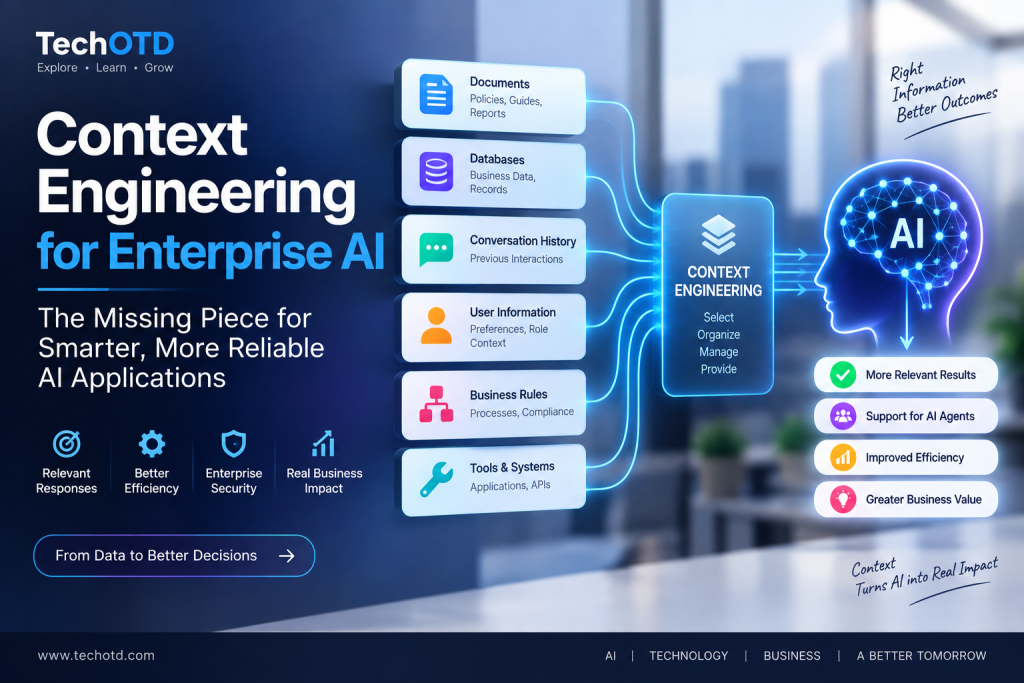
Context Engineering

Context engineering for enterprise AI using business data and relevant information
Artificial Intelligence

Context Engineering: Why It Is Becoming Essential for Enterprise AI

Introduction As artificial intelligence becomes more deeply integrated into business applications, the quality of AI responses depends on more than the prompt alone. AI systems often need access to relevant information, instructions, user history, business data, and task-specific context to produce useful and reliable results. Prompt engineering focuses on designing effective instructions for AI models, but enterprise AI applications often require a broader approach. Businesses need to determine what information should be provided to an AI system, how that information should be structured, and when it should be included in the AI workflow. Context engineering is the process of designing and managing the information available to an AI system so it can better understand a task and generate more relevant responses. As organizations build AI agents and complex AI applications, effective context management is becoming increasingly important for performance, reliability, and scalability. What Is Context Engineering? Context engineering is the process of selecting, organizing, and providing the right information to an AI system so it can better understand a task and generate relevant, accurate, and useful responses. This information can include instructions, user preferences, conversation history, business data, documents, retrieved knowledge, and details about the current task. More Than Writing Better Prompts Prompt engineering focuses primarily on how instructions are written, while context engineering takes a broader approach. It considers everything the AI system needs to know before generating a response, including relevant background information, data, rules, and the current situation. Providing the Right Information at the Right Time An AI system does not always need access to every available piece of information. Context engineering helps determine which information is relevant to a specific task and when that information should be provided to the model. Managing Different Types of Context Enterprise AI applications may use multiple types of context, including system instructions, conversation history, customer information, company documents, database records, retrieved knowledge, and outputs from other AI tools or workflows. Why Context Quality Matters The quality and relevance of the information provided to an AI model can directly influence the usefulness of its output. Too little context may lead to incomplete responses, while irrelevant or excessive information can make it harder for the AI system to focus on the task. By carefully managing what information an AI system receives, businesses can build applications that produce more relevant and consistent results while using AI resources more efficiently. Context Engineering vs Prompt Engineering Context engineering and prompt engineering are closely related, but they focus on different parts of an AI interaction. Prompt engineering focuses on designing effective instructions, while context engineering focuses on managing the broader set of information that an AI system receives before generating a response. The Role of Prompt Engineering Prompt engineering focuses on how instructions are written and structured to guide an AI model toward a desired response. A well-designed prompt can clarify the task, define the expected output, and provide instructions about tone, format, or constraints. The Role of Context Engineering Context engineering considers the wider information environment around the prompt. This can include conversation history, user preferences, business rules, retrieved documents, database information, previous actions, and other task-specific data. Why Enterprise AI Needs Both Enterprise AI applications often require both effective prompts and well-managed context. Clear instructions help the AI understand what it should do, while relevant context helps the model understand the information and situation required to complete the task effectively. A Simple Example A customer support AI may receive an instruction to answer a customer’s question, but it may also need access to the customer’s recent interactions, product information, account details, company policies, and relevant support documents. Context engineering helps determine which of this information should be available for that specific request. Prompt engineering helps define the task, while context engineering helps provide the information needed to complete that task. Together, they can support more useful and reliable AI applications. Why Context Engineering Is Important for Enterprise AI Enterprise AI applications often operate in complex environments where a simple prompt is not enough to produce reliable results. AI systems may need access to business knowledge, user information, current data, previous interactions, and specific organizational rules to understand and complete a task effectively. Enterprise Information Is Often Distributed Business information may be stored across documents, databases, internal applications, knowledge bases, and communication systems. Context engineering helps determine how relevant information can be selected and provided to AI applications when it is needed. Better Context Can Improve AI Output Quality AI models can generate more useful responses when they receive relevant and accurate information about the task. Providing appropriate context can help reduce incomplete responses and improve the relevance of AI-generated outputs. Supporting AI Agents and Complex Workflows AI agents often perform tasks across multiple steps and may interact with different tools, systems, and sources of information. Context engineering can help ensure that an AI agent has access to the relevant information required at each stage of a workflow. Reducing Unnecessary Information Providing every available document or data source to an AI model can create unnecessary complexity and increase resource usage. Context engineering helps focus the AI system on information that is relevant to the current task. Supporting More Consistent AI Applications Enterprise AI applications may be used by many employees, customers, or automated systems. Well-managed context can help create more consistent behavior by ensuring that AI systems receive relevant instructions and information across different interactions. As enterprise AI systems become more connected to business data and workflows, context engineering can play an important role in improving AI performance, reliability, efficiency, and scalability. Key Components of Context Engineering Effective context engineering involves managing different types of information that can influence how an AI system understands and completes a task. Businesses need to decide what information should be included, how it should be organized, and when it should be provided to the AI model. System Instructions System instructions define the overall role, rules, priorities, and behavior expected from an AI system. They can provide consistent guidance

AI Is Eating Software: Why "Writing Code" Is Being Replaced by "Expressing Intent"
Artificial Intelligence

AI Is Eating Software: Why “Writing Code” Is Being Replaced by “Expressing Intent”

AI Is Eating Software: Why “Writing Code” Is Being Replaced by “Expressing Intent” For decades, the mark of a elite software engineer was syntax fluency. We valued the developer who memorized standard library calls, mastered complex language idioms, and typed out hundreds of lines of clean boilerplate before lunch. Code was the ultimate currency of software creation, and the developer’s primary tool was the keyboard. That era is quietly coming to an end. Marc Andreessen famously declared over a decade ago that “software is eating the world.” Today, artificial intelligence is eating software itself. But AI is not merely automating mechanical keystrokes or making code auto-complete faster; it is fundamentally altering the abstraction layer of technology. The primary unit of software engineering is shifting from writing code to expressing intent. When developers spend less time typing out function bodies and more time orchestrating autonomous multi-agent systems, the entire discipline undergoes a tectonic shift. We are witnessing the birth of Intent-Driven Development (IDD)—where human genius focuses on architecture, context, and validation, while machine intelligence handles the mechanical translation into working software. Part 1: The Death of the Syntax Artisan To understand where software engineering is heading, we must examine where it has been. Computer science is a relentless history of ascending abstraction layers. We evolved from toggling physical switches on punch cards to assembly language, from assembly to procedural C, and from C to garbage-collected, expressive languages like Python, Rust, and TypeScript. Every leap in abstraction was initially met with fierce skepticism. Compiler pioneers were told that high-level languages would make programmers lazy or yield inefficient machine code. Yet, higher abstractions allowed engineers to build distributed cloud platforms, global real-time networks, and complex operating systems that would have been mathematically impossible if everyone still manually managed memory pointers. ┌─────────────────────────────────────────────────────────────────────────┐ │ The Evolution of Code Abstraction │ ├─────────────────────────────────────────────────────────────────────────┤ │ Era 1: Hardware Ops ──> Physical Switches & Punch Cards │ │ Era 2: Low-Level ──> Assembly & Direct Memory Management │ │ Era 3: High-Level ──> C, Java, Python (Manual Syntax Mechanics) │ │ Era 4: Intent-Driven ──> Natural Language Specs & AI Agent Execution │ └─────────────────────────────────────────────────────────────────────────┘ Generating code syntax is no longer an engineering bottleneck. Modern Large Language Models (LLMs) and autonomous agent networks do not just assist with line completion; they synthesize entire microservices, draft comprehensive unit tests, and refactor monolithic codebases in seconds. When the marginal cost of writing syntax approaches zero, syntax loses its status as a competitive moat. The artisan who takes pride solely in typing out boilerplate REST endpoints or standard UI components faces an existential realization: typing syntax was always just a low-fidelity medium for communicating human thought to machines. Part 2: The Three Pillars of Intent-Driven Development If syntax generation is delegated to autonomous AI agents, what constitutes the core workflow of the modern software team? Intent-Driven Development replaces manual implementation with three foundational pillars: Capability Dimension Traditional Development Intent-Driven Development Primary Skill Memorizing syntax & API methods Context engineering & system architecture Execution Medium Manual code writing in an IDE Declarative specifications & prompt design Quality Control Manual code reviews & PR checks Automated verification loops & guardrails Output Metric Lines of Code (LOC) committed Speed & accuracy of verified feature delivery 1. Context Engineering AI models are only as effective as the context fed into them. Instead of writing raw logic, engineers focus on building rich, structured context architectures. This includes maintaining clear repository maps, dependency graphs, domain schemas, and historical design records so that AI agents possess deep, accurate domain knowledge before executing a single task. 2. High-Precision Specification (Declarative Architecture) Expressing intent is not about throwing vague, lazy English prompts at a chatbot. It demands declarative precision. Engineers define exact API contracts, state machine transitions, edge-case boundaries, and performance budgets using formal specs, system prompts, and structured schemas. 3. Automated Guardrails and Verification Because probabilistic AI models can hallucinate or introduce subtle edge-case bugs, Intent-Driven Development relies on non-negotiable verification loops. Human engineers construct automated environments—combining static analysis, property-based testing, fuzzing, and sandbox security constraints—that continuously test machine-generated code before it touches production. Part 3: The New Role of the Developer: System Orchestrator In an intent-driven ecosystem, the developer’s day-to-day identity shifts from a code builder to a system orchestrator. ┌────────────────────────────────────────────────────────┐ │ Intent-Driven Orchestration Flow │ ├────────────────────────────────────────────────────────┤ │ 1. Human Architect defines Intent & Context Specs │ │ │ │ │ ▼ │ │ 2. Specialized AI Agents assemble code & test suites │ │ │ │ │ ▼ │ │ 3. Automated Guardrails run security & stress tests │ │ │ │ │ ▼ │ │ 4. Human Specialist audits diff & authorizes release │ └────────────────────────────────────────────────────────┘ Instead of grinding through sprint tickets line by line, the modern engineer manages a team of specialized AI agents: The Architectural Agent: Scaffolds modular file structures based on system specifications. The Implementation Agent: Writes concrete, production-ready code aligned with existing codebase patterns. The Red-Teaming Agent: Intentionally attempts to break the newly generated code with security exploits and edge-case inputs. The Documentation Agent: Keeps API documentation and system diagrams continuously synchronized in real-time. The human engineer remains elevated at the top of this chain, making high-leverage decisions: evaluating trade-offs between latency and infrastructure cost, enforcing compliance and security boundaries, and aligning software capabilities with real business goals. Part 4: The Engineering Manager’s Playbook: Re-tooling Teams for the AI Era For technology leaders, the transition to Intent-Driven Development presents an organizational challenge. Traditional engineering management metrics—like Lines of Code (LOC) written, PR volume, or commit frequency—become useless when a developer can generate thousands of lines of functional code in minutes. To successfully lead engineering teams through this transformation, managers must execute three strategic pivots: 1. Measure “Velocity of Intent” Shift performance evaluations away from raw output toward Velocity of Intent—how effectively an engineer converts a complex business requirement into an airtight specification, orchestrates its machine generation, and verifies its safe deployment. 2. Treat Context as a First-Class Code Asset System prompts, architectural decision records

Scroll to Top