
AI Observability: Why Businesses Need to Monitor AI Systems
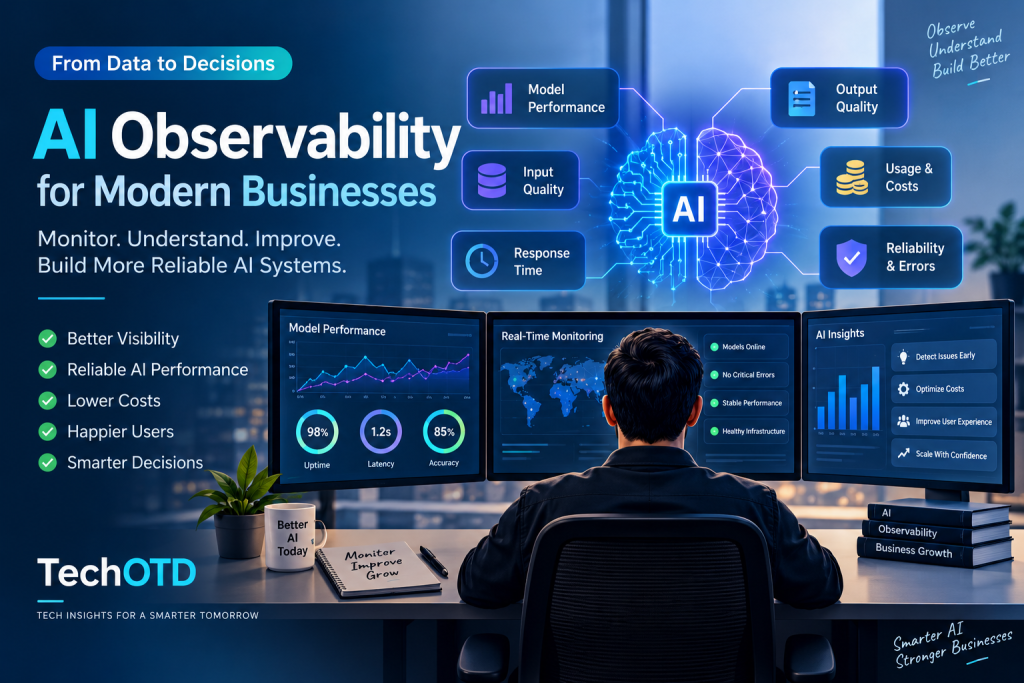
Introduction Businesses are increasingly using artificial intelligence in customer support, software development, data analysis, automation, and decision-making. As AI systems become more important to daily business operations, organizations need better visibility into how these systems perform in real-world environments. Traditional monitoring tools can track infrastructure, applications, and system availability, but AI systems introduce additional challenges. AI outputs can vary, model performance can change over time, and factors such as data quality, response time, cost, and reliability can directly affect business outcomes. AI observability helps organizations understand what is happening inside their AI systems by monitoring model behavior, performance, inputs, outputs, and operational metrics. This visibility can help businesses identify problems, improve reliability, and manage AI systems more effectively as they scale. What Is AI Observability? AI observability is the ability to understand, monitor, and analyze how an AI system behaves in real-world operation. It provides visibility into factors such as model inputs, outputs, performance, response times, reliability, and resource usage. Beyond Traditional System Monitoring Traditional monitoring focuses primarily on infrastructure health, application availability, and technical metrics. AI observability goes further by helping organizations understand how AI models behave, whether their outputs remain useful and reliable, and how changes in data or usage affect overall performance. Understanding AI System Behavior AI systems can produce different outputs depending on the input, context, model configuration, and data available at the time of a request. AI observability helps businesses analyze these behaviors and identify unexpected patterns or performance issues. Monitoring Inputs and Outputs Monitoring AI inputs and outputs can help organizations understand how users and applications interact with AI systems. This visibility can support the detection of poor-quality inputs, unexpected responses, and patterns that may affect business performance. Supporting Reliable AI Operations As AI systems become part of important business workflows, reliability becomes increasingly important. AI observability can help teams identify potential issues earlier and maintain better visibility into how AI applications perform over time. By combining operational monitoring with visibility into model behavior, inputs, outputs, and performance, AI observability helps organizations manage increasingly complex AI systems more effectively. Why AI Observability Is Important for Businesses As businesses move AI systems from experimentation into real-world applications, understanding how those systems perform becomes increasingly important. Without clear visibility, organizations may struggle to identify why AI outputs change, performance declines, costs increase, or user experiences become inconsistent. AI Systems Can Change Over Time AI performance can change as user behavior, data patterns, workloads, and business requirements evolve. AI observability helps organizations identify these changes and understand whether they are affecting the quality or reliability of AI applications. AI Problems Are Not Always Infrastructure Problems An AI application can appear technically available while still producing poor or unreliable results. Infrastructure monitoring may show that servers and APIs are working correctly, but AI observability can provide additional visibility into model outputs and application behavior. Better Visibility for Business and Technical Teams AI systems often involve technical teams, business teams, and end users. AI observability can provide useful information that helps different stakeholders understand system performance and identify areas that may require improvement. Supporting AI at Scale As AI applications handle more users, requests, models, and workflows, identifying problems manually becomes increasingly difficult. AI observability can help organizations maintain visibility as their AI environments become larger and more complex. By providing a clearer view of how AI systems behave in production, AI observability can help businesses make more informed decisions about reliability, performance, cost, and future AI improvements. What Businesses Should Monitor in AI Systems AI observability involves monitoring more than whether an application is online or offline. Businesses need visibility into different aspects of AI system behavior to understand whether their models and AI-powered applications are delivering reliable and useful results. Model Performance Businesses should monitor whether AI models continue to perform effectively for their intended tasks. Changes in model behavior or output quality can affect the reliability and usefulness of AI applications. Input Quality and Data Patterns The quality and characteristics of inputs can significantly influence AI outputs. Monitoring data patterns can help organizations identify unusual inputs, changing user behavior, or data issues that may affect model performance. Output Quality AI-generated outputs should be monitored to determine whether they remain accurate, relevant, consistent, and useful for the intended business use case. Unexpected output patterns may indicate a need for further investigation or improvement. Response Time and Latency Response speed can directly affect the user experience of AI applications. Monitoring latency helps businesses identify whether delays are caused by models, APIs, infrastructure, or other parts of the AI workflow. AI Usage and Costs Businesses should monitor how AI resources are being used and how costs change as workloads grow. Tracking model usage, requests, and resource consumption can support better AI cost management and help identify unexpected spending. Errors and Reliability Monitoring errors, failures, and system reliability can help organizations identify technical issues that affect AI applications. Reliable AI operations require visibility into both traditional system health and AI-specific performance. By monitoring these areas together, businesses can develop a more complete understanding of how their AI systems perform and identify opportunities to improve reliability, efficiency, and business outcomes. AI Observability vs Traditional Monitoring Traditional monitoring and AI observability both help organizations understand how technology systems perform, but they focus on different types of information. Traditional monitoring primarily tracks infrastructure and application health, while AI observability provides additional visibility into model behavior, inputs, outputs, and AI-specific performance. Traditional Monitoring Traditional monitoring focuses on technical metrics such as server availability, CPU usage, memory consumption, application uptime, network performance, and error rates. These metrics help technical teams determine whether the underlying infrastructure and applications are operating correctly. AI Observability AI observability expands monitoring by examining how AI systems behave. It can provide visibility into model inputs, generated outputs, response quality, latency, usage patterns, and other factors that affect the performance of AI-powered applications. Why Businesses May Need Both An AI application depends on both reliable technical infrastructure and reliable AI behavior.